Undercuts and side actions in injection molding
An undercut is any feature — a side hole, snap, thread, clip, groove or overhang — that stops a part from sliding straight off the core when the mold opens. To make one, the tool needs a piece of steel that moves out of the way before the part ejects: a slide (side-action) driven sideways by a cam pin, a lifter that angles inward to clear an internal undercut, or a collapsible or unscrewing core for threads. Each added motion makes the tool more complex — which is why the cheapest undercut is often the one you design out.
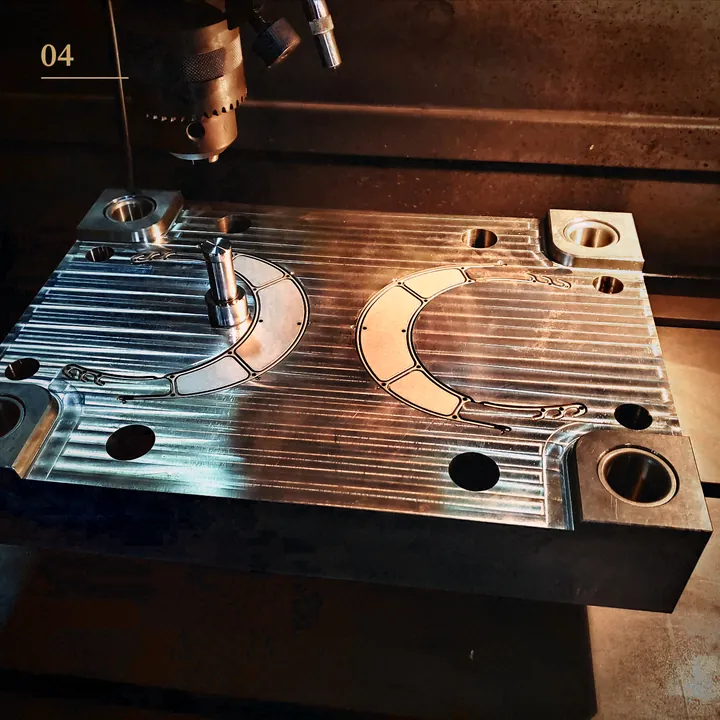
What an undercut actually is
Picture the simplest possible mold: two halves that pull straight apart along one axis, with the part sitting on a core. When the halves separate, the part has to slide cleanly off that core in the same direction the mold opens. An undercut is any feature that gets in the way of that clean slide. If there is part material — or tool steel — sitting "behind" a feature relative to the pull direction, nothing can move past it, and the part is trapped. A side hole through a wall, a snap hook, an external or internal thread, a retaining clip, a groove for an O-ring, a barbed fitting, a logo recessed into a side face, a lip that overhangs and wraps back: all of these are undercuts. The test is simple and worth applying to every feature on your part — can this detail be formed by steel that pulls straight in the open/close direction? If the answer is no, you have an undercut, and the tool needs a plan for it.
The reason this matters so much is that the undercut does not just change the part; it changes the machine that makes the part. A feature that takes five seconds to draw can convert a straightforward two-plate tool into one with extra moving mechanisms. So undercuts are less a modeling question than a tooling question, and the earlier you treat them that way, the more options stay open.
Why undercuts raise cost and risk
A plain core-and-cavity tool is reliable because it does one thing: open and close along a single line. An undercut forces a second, different motion — a block of steel that has to travel in another direction, in time with the mold, every single cycle, for the life of the tool. That extra motion is where the cost and the risk live. Every moving mechanism adds precision-machined components, hand-fitting to get the shutoffs tight, guides and wear plates, and a way to drive and return the motion. More parts mean a longer build and a higher up-front tool price. More moving steel means more surfaces that wear, more clearances that can pick up flash, and more ways for two pieces of steel to arrive in the same place at the wrong moment and damage each other. A slide that fails to retract fully before the mold closes, or a lifter that binds, is not a cosmetic problem — it can crush tooling.
This is why a single undercut can be the most expensive line on a mold quote even when the part looks simple. It is also why relocating or removing an undercut is usually the highest-leverage change in a design review: you are not shaving a few percent off a feature, you are deleting a whole mechanism, its build time and its lifetime maintenance. If you want to see how added mechanisms move a tooling estimate, our mold cost estimator lets you feel the direction those choices push.
The mechanisms that make an undercut moldable
When an undercut has to stay, the toolmaker picks a mechanism to form it and then clear it. The main ones:
- Slides (side-actions / cams). A slide is a block of steel that forms an external undercut — a side hole, a side snap, a window — and then moves sideways out of the way as the mold opens. The classic driver is an angle pin (cam pin): a round pin set at an angle so that, as the mold opens along its axis, the pin pushes the slide sideways by a geometry-controlled amount. Other slides are driven by cam units, hydraulic cylinders or cam-and-wedge arrangements when the travel or force is larger. The slide is locked solid by a heel block while the part is being filled, then released as the tool opens.
- Lifters. A lifter forms an internal undercut — a snap or clip or ledge on an inside wall. It is an angled blade or post mounted on the ejector plate; as the ejectors push the part off the core, the lifter rides its angle so it travels both up (with ejection) and inward (away from the undercut) at the same time, pulling its detail out of the recess as the part releases. Lifters are compact and ride on the motion you already have, which is why they are the common answer for internal catches.
- Collapsible cores and unscrewing cores. Internal threads are their own undercut: you cannot pull a core straight out of a formed thread. A collapsible core contracts radially so the thread clears; an unscrewing core rotates, backing the thread out the way you would unscrew a cap. Both are specialized, both add drive mechanisms, and both are chosen based on thread size, pitch and volume.
- Hand-loaded inserts. For low volume, instead of building an automatic mechanism you can form the undercut with a loose steel insert that is placed into the tool, molded around, then ejected with the part and separated by an operator before the insert is reloaded for the next shot. It trades cycle time and labor for a much simpler, cheaper tool — a sensible path when quantities do not justify a slide. Volume is the usual deciding factor here, the same trade that drives single- versus multi-cavity tooling decisions.
Designing the undercut out — the cheapest fix
Before you pay for any mechanism, it is worth asking whether the undercut needs to exist at all. Several moves remove it:
- Shutoff / pass-through features. Often a side hole can be formed not by a slide coming in from the side, but by letting the core steel touch the cavity steel through the wall — a "shutoff." Where the two halves of the tool kiss, no plastic forms, so you get an opening made by steel-to-steel contact in the open/close direction instead of by a side-action. This is one of the most common ways to delete a slide; it usually needs extra draft on the shutoff faces (often around 3° or more, per Protolabs) and a slightly different-looking hole rather than a whole mechanism.
- Redesign a snap to be a straight pull. A snap hook that points sideways is an undercut; a snap designed so its hook faces the open direction, with a clearance window molded behind it by a pass-through, can often be ejected straight. Thinking about pull direction while you lay out the snap, rather than after, is the difference. (More on this in our snap-fit design primer.)
- Relocate the feature to the parting line. A detail that sits on a side wall is an undercut; the same detail moved onto the parting line — the surface where the two mold halves meet — can be formed by the split itself with no extra motion. Shifting the parting line, or the feature, so they coincide is often a low-cost way to kill an undercut.
None of these is always available, and each has its own cosmetic or geometric cost, but collectively they resolve a large share of undercuts for the price of a design conversation instead of a mechanism.
Shallow undercuts that simply strip off
There is a middle path between "needs a mechanism" and "redesign it away": letting the part flex over a small undercut as it ejects. This is called a strip-off or bump-off. If the undercut is shallow, the wall around it can flex, the resin is ductile enough to stretch over it without yielding, and there is room for the part to distort during ejection, the ejector system can simply push the part off and let it snap over the undercut — no slide, no lifter, no moving steel. It is how most container lids, bottle-cap liner grooves and many snap lips are made. The catch is that it only works within limits: a stiff, glass-filled grade has far less elongation than an unfilled ductile resin, a deep undercut will not strip, and a thin or heavily constrained wall may not flex enough to clear without whitening or cracking. As with so much of this, the geometry that strips cleanly depends on the exact grade and temperature, so treat any rule of thumb as a starting point and confirm it against the resin supplier's data and a sample shot. A rounded lead-in on the undercut and a generous radius at its root both help the part ride off instead of catching.
What undercuts cost you in cycle, maintenance and cosmetics
Even when a mechanism works well, it carries ongoing costs worth knowing before you commit. Slides and lifters add cycle time: the mold has to open far enough to clear the slide travel, and sequenced motions cannot all happen at once, so each added mechanism tends to lengthen the cycle a little. They add maintenance: moving steel wears, needs lubrication, and will eventually need refitting; a worn slide starts to flash at its shutoffs. They add witness lines: wherever a slide or insert meets fixed steel there is a parting line on the part, so an undercut mechanism usually leaves a visible line or slight step that matters on a cosmetic surface. And they concentrate risk at the one place in the tool that is not simply opening and closing. None of this makes undercuts wrong — plenty of excellent parts need them — but it does mean each one should earn its keep, because the costs recur on every cycle and every service interval, not just on the up-front quote. Where a feature only needs to clear for ejection, a lifter riding the existing ejector motion is often gentler on the cycle than a large slide; the right choice depends on the specific geometry.
What to flag to your toolmaker early
The expensive mistakes with undercuts come from discovering them late — after the pull direction and parting line are fixed, or after steel is cut. Avoid that by walking the whole part at the first CAD review and flagging every feature that is not a straight pull off the core: side holes, side snaps, external and internal threads, clips and barbs, grooves, side-wall logos, and any lip or wall that wraps back on itself. For each flagged feature, decide together whether it becomes a slide, a lifter, a collapsible or unscrewing core, a hand-loaded insert, a strip-off, or a redesign that removes it. Settle the pull direction and the parting-line location first, because those two choices decide how many features are undercuts at all — rotate the part or move the split, and an undercut can vanish. Undercuts that sit near each other, or that would need two slides to cross paths, deserve special attention, since their interaction drives real tooling complexity. Draft, parting line and undercuts are one connected conversation; our notes on draft angle and on how a family mold groups parts both touch the same layout decisions.
Common questions
What is an undercut? Any feature — side hole, snap, thread, clip, groove, overhang — that blocks the part from sliding straight off the core when the mold opens, because there is material or steel "behind" it relative to the pull direction.
How does a mold make one? With a moving mechanism: a slide (side-action) driven sideways by an angle/cam pin for external undercuts, a lifter that angles inward for internal ones, a collapsible or unscrewing core for threads, or a hand-loaded insert for low volume.
Why do undercuts cost more? They force a second motion in a direction other than the mold opening, which adds precision parts, build time, wear items and crash risk — sometimes the most expensive single thing on a tool.
Can you avoid a side-action? Frequently — with a pass-through/shutoff that forms a hole by steel-to-steel contact, a snap redesigned for straight pull, or a feature relocated to the parting line. Shallow undercuts in ductile resins can also strip off with no mechanism at all.
What do I tell my toolmaker? Flag every non-straight-pull feature at the first review and agree pull direction and parting line before the tool layout is fixed.
Engineering estimate, not a quote. General information, not engineering advice — the right mechanism for any undercut depends on your exact geometry, resin and volume.
JCH Design & Manufacturing can review your part for undercuts before the tool is laid out — and tell you where a slide or lifter is genuinely needed versus where a shutoff, a parting-line change, or a strip-off would delete the mechanism and the cost that comes with it. Send your model; NDA first.
Book a 30-minute call