Hot runner vs cold runner molds — what's the difference, and which should my part use?
A cold runner cuts the feed channel into cold steel, so the plastic in it freezes on every shot and is ejected with the parts as scrap or regrind — a cheaper, simpler tool. A hot runner keeps the melt molten inside a heated manifold right up to the gate, so there is no runner scrap and the cycle is usually faster, at the cost of a pricier, higher-maintenance tool. Which one your part wants comes down mostly to volume, part size, and resin.
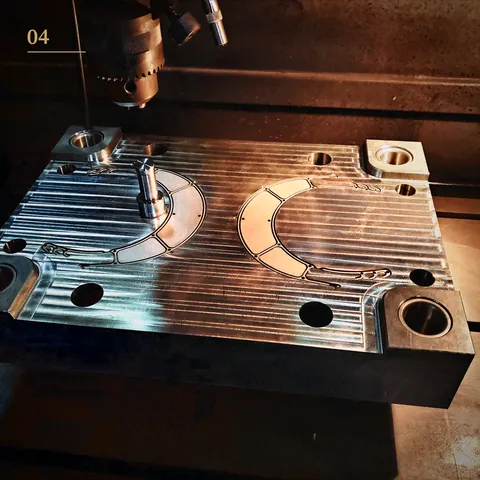
First, what a "runner" actually is
When plastic leaves the machine it enters the tool through the sprue — the tapered entry under the nozzle — and then has to be distributed to the gate of each cavity. The channels that carry it from the sprue out to those gates are the runners. On a single-cavity tool the runner may be almost nothing; on a thirty-two-cavity tool it is a branching tree that has to deliver the same pressure and the same fill timing to every cavity so they all pack out identically. The runner system is not glamorous, but it quietly decides how much material you throw away per shot, how fast you can cycle, how balanced your cavities fill, and a surprising share of the tool's cost. Every injection mold handles the runner in one of two fundamentally different ways, and the choice between them is one of the first real tooling decisions on a program.
The cold runner: the feed freezes every shot
A cold runner is exactly what it sounds like — channels machined into the cold steel of the mold. On each shot, molten resin flows through those channels, fills the cavities, and then everything inside the tool cools together: the parts and the plastic sitting in the runner. When the mold opens, the runner is ejected right along with the parts, usually still joined to them at the gate (on a simple tool you snap or trim it off; on others it self-shears). That solid runner is the catch. It is material you melted, pushed, cooled, and then did not ship. With most thermoplastics you can granulate it and feed it back in as regrind at some blend ratio, so it is not purely lost — but regrind has to be collected, kept clean and dry, and capped, because every trip through the barrel degrades the polymer a little and too much regrind shows up as weaker, off-color, or inconsistent parts.
Cold runners have real virtues that keep them the default for a huge share of tooling. The tool is simpler to design, cheaper to build, and far more forgiving to run. There is nothing to overheat, nothing to leak, no controller to fail. Color changes are quick because there is no large hot volume to purge — you flush the barrel, maybe a few shots of runner, and you are into the new color. For low and medium volumes, frequent color or material swaps, and heat-sensitive resins, a cold runner is usually the right and cheaper answer. Its two costs are the runner material you sacrifice each shot and a slightly longer cycle, because the thick runner often takes longer to cool enough to eject than the parts themselves do. On a big multi-cavity tool that runner can weigh as much as the parts, and that is the pressure that eventually pushes high-volume programs toward the hot side.
The hot runner: the melt never freezes until the gate
A hot runner replaces those cold channels with an actively heated system built into the tool: a heated steel manifold that splits the flow, and individually heated nozzle drops that carry it to each gate, all held at melt temperature by cartridge heaters, thermocouples, and dedicated temperature controllers. The plastic inside this system stays molten from shot to shot and never solidifies — the only plastic that freezes is what is inside the cavity. When the mold opens, only finished parts come out. There is no runner to eject, trim, regrind, or handle, the gate marks are small and clean, and the parts drop free in a way that suits lights-out automation and robots.
That buys you several things at once: no runner scrap (so your material yield per shot is just the parts), a generally faster cycle (no thick runner to cool before ejection), better, more balanced control over how each cavity fills because each drop can be tuned, and clean automatic degating that is friendly to high-cavity, high-volume work and to large parts where a cold runner would be enormous. Valve-gated hot runners go a step further, using a mechanical pin to open and close each gate for precise, mark-free gating and sequential filling of big parts.
The price is complexity and money. A hot-runner system adds real hardware and engineering, so the tool costs meaningfully more up front than an equivalent cold-runner mold, and it introduces failure modes a cold runner simply does not have: melt can leak past the manifold into the plates and ruin a shift, heaters and thermocouples fail, a poorly balanced or dead-spot manifold lets material stagnate and degrade (bad for sensitive or filled resins), and color changes are slower and wasteful because the entire hot volume has to be purged through. It asks for more skilled setup and more maintenance over the tool's life. None of that makes it worse — it makes it a system you adopt when the volume is there to pay for it.
Two-plate, three-plate, and the hot half
How the runner is arranged physically shows up in how the mold is built, and you will hear three shorthand terms:
| Arrangement | What it is | Trade |
|---|---|---|
| Two-plate | The simplest cold runner: runner sits on the single parting line; part and runner eject together, usually still attached at the gate. | Cheapest, most robust; you degate by hand or with a self-shearing gate, and gating is limited to the parting line. |
| Three-plate | A cold runner on its own separate parting plane, so the runner breaks away from the parts automatically (typically through pin gates) and gating can land anywhere on the part face. | Automatic clean degating and center/face gating, but a bigger, pricier tool and more cold runner scrap. |
| Hot half | The cold runner side is replaced by a heated manifold assembly (often bought as a unit) that feeds each cavity through heated nozzles. | No runner scrap, fast cycle, clean automation; highest tool cost and the maintenance of a heated system. |
A useful way to see it: the two-plate cold runner and the hot half are the two ends, and the three-plate mold is the cold-runner way to get the gating freedom (gate anywhere, auto-degate) that people often reach a hot runner for — at the cost of even more runner to grind up. Which end you land on is set by volume, part geometry, and how clean the gate has to be. The runner choice and the gate type are decided together, because each strongly constrains the other.
The economics: where the hot runner pays back
Strip away the jargon and the decision is an investment question. A hot runner costs more to build. In return it saves you runner material on every single shot and usually shaves cycle time, which means more parts per hour from the same press. Multiply those two savings by your annual volume and compare the total against the extra tooling and maintenance the hot system costs. At high volume, with many cavities or large/heavy parts, those per-shot savings are large and the hot runner pays itself back comfortably — which is why high-volume tooling commonly uses hot runners. At low or medium volume, the runner scrap and the few saved seconds are small in total, and the cheaper, simpler cold-runner tool wins outright. There is also a near-automatic tie-breaker: if your program needs frequent color changes, the cold runner's fast, low-waste purge can swing the decision on its own, because slow hot-runner color changes burn material and time every switch.
Two more factors move the break-even. Big, heavy parts have correspondingly big, heavy runners in a cold tool, so the material saved by going hot is larger and the payback comes sooner. And part cavitation matters: the more cavities, the longer and heavier the cold runner tree, so multi-cavity high-volume tools tip hot earlier than a single-cavity tool of the same part would. If you are weighing cavity count and tooling spend together, our single- vs multi-cavity tooling explainer and the mold cost estimator are the companion reads, and the bigger picture of what moves a tool's price is in what drives injection mold cost.
Material considerations
The resin can override the economics. Heat-sensitive resins — some PVC, POM, and certain flame-retardant or bio-based grades — do not like sitting at melt temperature with nowhere to go, which is exactly what can happen in a hot manifold's slower-moving zones; stagnation there means thermal degradation, discoloration, or outgassing, so these materials often favor a cold runner or, if hot, a carefully balanced, low-residence manifold designed for them. Glass-filled and other abrasive filled resins are tough on a hot runner's nozzles and gates and demand hardened, wear-resistant hot-runner hardware; a cold runner in tool steel tolerates them more easily. Highly viscous or shear-sensitive materials need runner and gate sizing matched to their flow behavior either way. The point is that "hot runner, because volume is high" is only half the decision — the resin's heat and wear behavior has to agree, and it is confirmed against the material supplier's processing data before the manifold is specified, not discovered after the first degraded shots.
So which should your part use?
Reason in this order. Start with volume: low or medium annual quantity leans cold; high volume leans hot. Layer on part size and cavitation: large, heavy, or many-cavity parts make the cold runner's scrap expensive and move you toward hot sooner. Check color and material changes: frequent swaps favor cold. Check the resin: heat-sensitive or aggressively filled materials can veto a hot runner regardless of volume. Finally weigh budget and risk tolerance: a cold runner is cheaper, simpler, and more forgiving to run with less that can fail. For many new products and most low-to-medium runs, a cold runner is the honest right answer; hot runners earn their keep when the volume, part size, and automation genuinely demand them. It is a cost-and-fit trade, not a quality one — the parts can be excellent either way.
Common questions
What's the core difference? Cold runner = feed channels in cold steel that freeze and eject as scrap/regrind each shot (cheap, simple). Hot runner = a heated manifold that keeps the melt molten to the gate, so there's no runner scrap (usually faster, cleaner, pricier).
Does a cold runner waste plastic? Yes, every shot — often reground and blended back, but regrind must be kept clean and capped because each melt history degrades the polymer.
Why is a hot runner harder to run? It's an active heated system (manifold, nozzles, heaters, controllers) that can leak, fail a heater, stagnate material, and makes color changes slow and wasteful.
Two-plate vs three-plate vs hot half? Two-plate = simplest cold runner on the parting line; three-plate = cold runner on its own plane with auto-degating and face gating (more scrap); hot half = heated manifold, no cold runner at all.
Which should my part use? Mostly volume and resin. Low/medium volume, frequent color changes, heat-sensitive or abrasive filled resins → often cold (or a hot runner with hardened, wear-resistant hardware). High volume, many cavities, large parts, no-scrap automation → hot. Engineering estimate, not a quote.
JCH Design & Manufacturing can look at your part, your annual volume, and your resin and tell you whether a cold runner, a three-plate, or a hot-runner tool is the right call — so you neither over-buy a hot manifold you don't need yet nor outgrow a cold tool you'll have to recut. Send your part and target volume; NDA first.
Book a 30-minute call