Injection mold gate types, and how to choose one
A gate is the small opening where molten plastic enters the cavity. The common types — edge/tab, sub/tunnel, hot-tip/valve, pin, fan, and diaphragm — each trade off tool cost, cosmetics, runner scrap, and how cleanly the part degates. You pick one by working from the part geometry, then the volume, then the cosmetics; and you place it so the cavity packs out and the scar lands somewhere acceptable.
What a gate is, and why it earns so much attention
The gate is the last few millimeters the melt passes through before it fills the cavity, and for such a small feature it controls a surprising amount of the result. It sets the direction and speed of the flow front, so it decides where the material knits together into weld lines and where air has to be pushed out to the vents. It governs the packing phase — the brief window after the cavity is full when the press holds pressure to feed in a little more material and compensate for cooling shrinkage — because the gate is the straw through which that packing happens, and when the gate freezes, packing stops whether the part is done shrinking or not. And it leaves a permanent mark: the vestige, the little nub or scar where the gate was, which has to land somewhere you can live with. Get the gate right and the part fills evenly, packs out without sink, and shows a clean witness mark; get it wrong and you chase cosmetic defects and dimensional problems that no amount of press tuning fully cures.
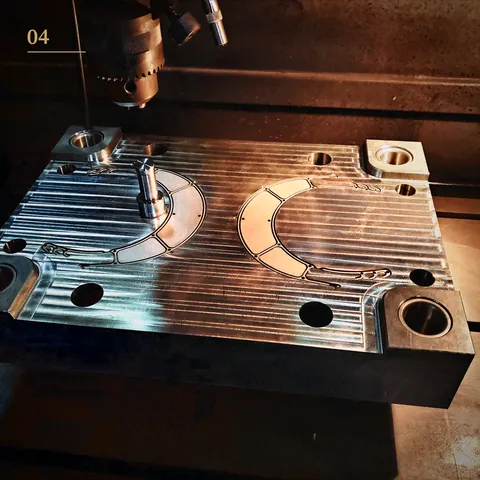
The common gate types and their trade-offs
There is no universally best gate; each one buys you something and costs you something else. These are the ones you will actually see quoted on a tool:
- Edge (tab) gate — a simple rectangular opening on the parting line, fed from a cold runner. It is the cheapest and most forgiving gate to cut and to adjust, and it packs well, which is why it is the default for a huge range of parts. The cost is that it does not self-trim: someone cuts or breaks the runner off, and it leaves a visible vestige at the parting line. A tab gate is the same idea with a small sacrificial tab added to move the stress and the trim scar off the part wall.
- Sub gate (tunnel / submarine) — the gate tunnels under the parting line into the side of the part or a sacrificial feature. The payoff is automatic degating: as the tool opens and the part ejects, the gate shears off by itself, leaving only a small scar and no manual trim. The limits are geometric — the tunnel angle and the part wall have to allow the shear, the gate has to stay fairly small, and brittle or heavily filled resins can snap awkwardly rather than shear clean.
- Hot-tip / valve gate — fed straight from a hot runner nozzle, so there is no cold runner at all. A hot tip leaves a small, nearly flush mark; a valve gate adds a mechanical pin that opens and closes the gate, giving the cleanest mark and precise control over fill. You get no runner scrap, excellent cosmetics, and tight process control. You pay for it in tool cost and complexity: a hot runner manifold, heaters, controllers, and more that can go wrong.
- Pin (point) gate — a small-diameter drop, typically from a three-plate mold, that breaks cleanly away from the part and leaves a tiny round witness. It lets you gate into the face of a part (useful for central feeding) without a hot runner, at the cost of a three-plate tool and the cold runner that comes with it.
- Fan gate — an edge gate stretched wide, fanning out so the melt enters along a broad line instead of a single point. On wide, flat, thin parts this evens out the flow front, reduces warping from uneven filling, and spreads the shear. The wide gate then has to be trimmed along its full width.
- Diaphragm gate — a thin ring (or disc) that feeds a round, open part concentrically from the center, so material arrives at the whole circumference at once. That keeps a cylinder or ring round and avoids the weld line a single side gate would leave. The ring is removed as a secondary operation, so it suits round parts where concentricity matters more than trim simplicity.
| Gate type | How it works | Vestige | Best for |
|---|---|---|---|
| Edge (tab) | A rectangular opening on the parting line fed from a cold runner; trimmed or cut off by hand after the shot | Visible scar at the parting line; a tab moves it off the part wall | Simple, lower-volume, or cost-sensitive parts where a visible mark is acceptable |
| Tunnel / sub | Runs under the parting line and shears off by itself as the tool opens and the part ejects (auto-trim) | Small scar, no hand trim; filled or brittle resins can shear roughly | Parts that need self-degating without a hot runner, within the shear geometry |
| Hot tip | Fed straight from a hot-runner nozzle, so there is no cold runner and no runner scrap | Small, nearly flush mark | Higher-volume parts that cannot carry runner scrap and want clean cosmetics |
| Valve | A hot-runner gate with a mechanical pin that opens and closes the gate for precise fill control | The cleanest mark of the common gates | High-volume or cosmetic parts needing the best mark and tight fill control |
| Sprue / direct | The part is fed directly through the sprue into the center, with no runner branching off | Large vestige that is removed as a secondary operation | Single-cavity round or center-filled parts where concentric feed matters |
Where to put the gate: location rules
Gate placement follows a handful of rules that mostly come back to one idea — feed the heavy areas while they are still molten, and keep the evidence off the faces people see.
- Gate into the thickest section. Thick zones are the last to freeze and the first to sink, so you feed them from the gate and let the thin walls fill last. If you gate into a thin wall, the gate freezes early and the thick section is left starved, which pulls sink and risks internal voids.
- Put the gate where the weld line and vestige are acceptable. Every gate creates a vestige, and multiple gates (or flow around a hole) create weld lines where fronts meet. Decide up front which surfaces can carry a mark and steer the gate and the weld lines there.
- Keep the gate off a cosmetic face. A show surface — the front of an enclosure, the visible top of a cap — should not carry the gate scar if there is any alternative; gate into a back, an edge, a boss, or a rib instead.
- Balance the flow length. Try to make the distance from the gate to the farthest corners as even as you can, so the cavity fills and packs uniformly. On multi-cavity tools the runner is laid out so all cavities fill simultaneously — an unbalanced layout fills some cavities harder than others and makes them dimensionally inconsistent, which is one of the reasons cavity count and runner design are decided together (see single vs. multi-cavity tooling).
These are starting rules, not guarantees. A mold-filling (flow) simulation is what confirms a gate position for a specific part and resin, and a thin or awkward part can force a compromise — which is exactly the kind of thing worth settling before steel is cut.
How gate choice ties to the runner system and to cost
You do not pick a gate in isolation; the gate strongly constrains the runner system, and the runner system drives a chunk of the part cost. Edge, sub, fan, pin, and diaphragm gates are usually fed from a cold runner: the runner solidifies with the part each shot and has to be dealt with. Sub and pin gates self-degate; edge, fan, and diaphragm gates are trimmed as a secondary step. Either way you generate runner material every cycle, which is either scrapped or reground and blended back in (how much regrind a part can tolerate depends on the resin and the application). Hot-tip and valve gates run off a hot runner, which keeps the melt molten all the way to the gate, so there is no cold runner, no trim, and no runner scrap — but the tool is more complex and more expensive, and it adds heaters and controllers to maintain. The honest way to read the trade is this: a hot runner costs more up front and in tool complexity, and it pays that back on high-volume parts through saved material and saved trimming labor, while a cold runner is the cheaper, simpler choice when volumes are modest or the program is still proving itself. Gate type also shows up in cycle (auto-degating and clean fill can shave handling) and in secondary labor (hand-trimming an edge gate is a real cost at volume). If you are weighing those pieces, our mold cost estimator and gate size calculator are a useful way to see how the levers move before you talk to a toolmaker.
Gate size, packing, and sink
Gate size is where a lot of real-world defects are won or lost, because the gate sets how long the packing phase can run. The packing phase only works while the gate is still open; the moment the thin gate freezes, no more material can be fed in, and whatever shrinkage has not been compensated becomes a sink mark or an internal void. A gate that is too small freezes too early and cuts packing short — you see sink, voids, short shots, higher molded-in stress, and sometimes jetting from the high velocity through the small opening. A gate that is too large does pack well, but it is harder to degate cleanly, leaves a bigger vestige, and can over-pack the part, making it stick in the tool or hold residual stress. A common engineering starting point is to size the gate as a fraction of the local wall thickness and then tune it on the tool. Toolmakers usually cut the first gate slightly undersized on purpose, because a gate that freezes too early can be opened up with a little steel removed, whereas a gate cut too large cannot easily be made smaller again without welding and re-cutting. Treat any published gate-size rule as a hedged starting number, not a final dimension — the resin's viscosity and shrink, the wall thickness, and the shot size all move it.
What to discuss with your molder or toolmaker
By the time you are talking gates, a short, specific conversation saves a lot of back-and-forth. Bring these to the table:
- Which surfaces are cosmetic. Tell them explicitly where a vestige or weld line is unacceptable, so the gate goes somewhere else.
- Your realistic volume. This is the single biggest input to the cold-runner-versus-hot-runner decision; a rough but honest number is better than an optimistic one.
- The resin and whether it is filled. Filled and brittle resins change what gate types shear cleanly and how big the gate needs to be.
- Dimensional priorities. If concentricity or flatness matters (a round part, a wide flat panel), say so — it points toward a diaphragm or fan gate and a balanced layout.
- Whether auto-degating matters. If you want to avoid hand-trimming labor, say so early; it steers toward sub, pin, or valve gating within what the geometry allows.
A good toolmaker will usually run a flow analysis and come back with a gate type, a gate location, and a weld-line prediction. Reviewing that before the tool is cut is the cheapest insurance you can buy on a mold, because moving a gate on paper is free and moving it in hardened steel is not. Uneven filling from a poor gate choice is also one of the quieter causes of warp — if that is a concern, see why molded parts warp.
Common questions
What are the common gate types? Edge/tab (simple, manual trim, visible vestige), sub/tunnel (auto-degates, small scar, geometry-limited), hot-tip/valve (no runner scrap, clean mark, higher tool cost), pin (small drop from a three-plate tool, breaks clean), fan (spreads flow across wide thin parts), and diaphragm (concentric feed for round parts).
How do you choose one? Work from part geometry, then volume, then cosmetics. Simple or lower-volume parts lean to edge or sub gates on a cold runner; high-volume parts that can't carry scrap or a visible scar move to hot-tip or valve gating.
Where does the gate go? Into the thickest section so it packs before freezing, off any cosmetic face, where the weld line and vestige are acceptable, and positioned to balance the flow length.
Cold runner or hot runner? Edge/sub/fan/pin/diaphragm are usually cold-runner gates with trim or regrind every shot; hot-tip and valve gates run off a hot runner with no runner scrap but a more complex, costlier tool.
How does gate size matter? It sets how long the cavity packs. Too small freezes early and causes sink and voids; too large over-packs and leaves a big vestige. Tools are usually cut slightly small and opened up as needed.
JCH Design & Manufacturing can review your part and recommend a gate type and location — and whether a cold or hot runner is the right call for your volume and cosmetics — before any steel is cut. Send your part and say which surfaces are cosmetic; NDA first. Engineering estimate, not a quote.
Book a 30-minute call