How do you choose the right manufacturing process for your product?
You choose it from a short list of drivers — how many you will make, what material, the part's geometry and size, the tolerance and finish it has to hit, your cost target and your timeline — and then match those to the process that can hold them. As a rough map: high-volume plastic parts point to injection molding, low-to-mid volume metal or plastic with tight tolerances to CNC machining, metal parts at volume to casting or die-casting, prototypes and tiny runs to 3D printing, flat or bent metal to sheet metal, and soft goods to cut-and-sew. None of these are hard lines; the right answer is whichever process can make your part, in your material, to your tolerance, at a cost that works for your real lifetime volume.
The decision drivers, in the order that matters
Process selection feels like a long menu, but it collapses quickly once you rank the drivers. Work through them roughly in this order:
- Annual and lifetime volume. This is the master driver. It decides whether a one-time tooling cost can be spread thin enough to pay for itself. A dozen parts and a million parts are almost never made the same way, even when the shape is identical.
- Material. Metal, plastic, elastomer, foam or fabric each rule whole families of process in or out. You do not injection-mold steel or CNC-machine a nylon duffel bag; the material narrows the field before anything else.
- Geometry and size. How big is the part, how complex, how deep are its features, are there internal passages, undercuts, very thin or very thick sections? Some processes love complexity (casting, printing); some punish it (machining a deep pocket, molding a heavy wall).
- Tolerance and surface finish. The precision and cosmetic quality the part must hit. A bearing seat that needs a few thousandths of an inch and a toy housing that just has to look clean belong to different processes — and a process that cannot physically hold your tolerance is off the list no matter how cheap it is.
- Cost target. Both the up-front tooling you can afford and the per-part cost the product's price can carry. These two pull in opposite directions and volume is the referee between them.
- Timeline. How fast you need first parts, and first production. A process with weeks of tooling ahead of it is the wrong answer if you need units in hand next week to test or to sell.
- Regulatory and end-use demands. Food contact, medical, outdoor UV, flame rating, electrical, structural load. These can force a material and therefore a process, and can add qualification time you have to plan for.
Most parts are decided by the first four drivers; the last three break ties and set the schedule. Write your own answers down before you fall in love with any one process — the honest shortlist usually writes itself.
A plain-language tour of the main processes
Here is where each of the common processes actually wins, in the language of a shop rather than a brochure.
Injection molding — high-volume plastic
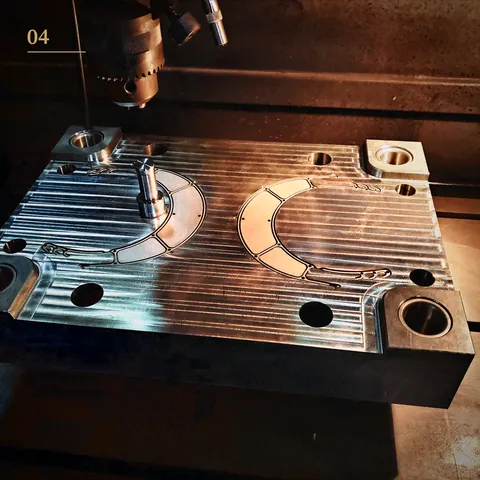
You cut a steel or aluminum mold once, then shoot molten plastic into it over and over. The tool is a real up-front cost, but once it exists each part takes seconds and very little material, so the cost per part is low and keeps falling as volume climbs. That is the whole case for molding: it trades a big fixed cost for a tiny variable one, so it wins decisively once you make enough parts to amortize the tool. It holds good tolerances and a repeatable finish across hundreds of thousands of identical parts. It is the default for consumer plastic at scale — housings, closures, containers, parts you will make in real quantity. It is the wrong first move for a handful of parts or a design that is still moving, because every change means cutting steel. If you want to see what drives that tool cost, the mold cost estimator walks through the levers, and how injection molding works covers the process end to end.
CNC machining — low-to-mid volume, tight tolerance, no tooling
A cutter removes material from a solid block of metal or plastic until the part is left. There is no part-specific tooling, so the first part and the hundredth cost about the same, and you can change the design between parts freely. That makes machining the natural choice for metal parts in low to moderate volume, for anything that needs tight tolerances or a precise functional surface, and for prototypes of parts that will eventually be cast or molded. Its limits are the mirror image of molding's: because you pay roughly the same for every part, the cost per part stays high and does not fall at volume, and deep or highly complex geometry can be slow and expensive to cut. Machining and molding are two ends of the same trade — no tooling and flat cost versus heavy tooling and falling cost — and volume decides which end you want.
Casting and die-casting — metal parts at volume
Casting pours or forces molten metal into a mold to make a near-net-shape part. Die-casting, which uses a reusable steel die under pressure, is the metal analogue of injection molding: a real tooling cost up front, then low cost per part at volume, with the ability to form complex shapes, thin webs and integrated features that would be slow to machine from solid. It shines for metal parts you will make in quantity — housings, brackets, heat sinks, hardware — especially in aluminum and zinc alloys. Cast parts often still need some machining on their critical surfaces and some finishing, so they are rarely a finished part straight from the die; budget those secondary steps. When you are weighing a metal part that could go either way, die casting versus injection molding walks through where each lands.
3D printing — prototypes, very low volume, complex geometry
Additive printing builds a part up layer by layer straight from CAD, with no tooling at all. That makes it unbeatable for the first stage of almost any product: prototypes you can hold, revise and reprint in days, and tiny production runs where no tool could ever pay for itself. It also makes geometry nearly free — internal channels, lattices and organic shapes that no other process can produce come out the same price as a simple block. Its weaknesses are volume and properties: the cost per part is flat and does not fall, so it loses badly once quantity climbs, and printed parts are usually anisotropic (weaker across the layer lines) with a narrower material range and a layer-line finish. Use it to learn and to bridge, not to mass-produce. The trade-off is laid out in injection molding vs 3D printing.
Sheet metal — flat and formed metal parts
Sheet metal fabrication cuts flat blanks (by laser, punch or shear) and bends or forms them into brackets, enclosures, panels and chassis. Tooling ranges from almost none for laser-cut-and-bend work to real stamping dies for high-volume pressed parts, so it spans a wide volume range depending on how it is done. It is the right call when a part is essentially flat stock that is cut and folded — strong, thin-walled, and cheap in metal — rather than a solid or deeply three-dimensional shape. For an electronics enclosure or a mounting bracket it is frequently cheaper and faster than machining from solid or casting, and it keeps the part light.
Cut-and-sew and soft goods — fabric, foam and flexible parts
When the product is a bag, a case, a cover, an apparel item or a padded insert, the process is cut-and-sew: fabric and foam are cut to a pattern and sewn or bonded. The drivers are different — pattern and material selection, stitching and construction, trims and hardware — but the same discipline applies: the design has to be made for how it is cut and sewn, and volume still sets the economics of patterns, cutting dies and labor. Many finished products pair a hard molded or machined core with a cut-and-sew carry case or a foam insert, so soft goods are often one process among several in a single product.
A decision framework: volume × material × tolerance → shortlist
You can shortlist in under a minute by crossing three axes. Fix the material first (it rules whole families in or out), then read volume against tolerance:
| If your part is… | …at low volume | …at high volume |
|---|---|---|
| Plastic, moderate tolerance | 3D printing, or CNC for a few functional parts | Injection molding |
| Metal, tight tolerance | CNC machining | CNC, or casting/die-cast + finish machining on critical faces |
| Metal, flat or formed | Laser-cut & bend sheet metal | Sheet metal / progressive stamping |
| Complex metal shape | CNC or metal 3D printing | Die-casting or investment casting |
| Fabric / foam / flexible | Cut-and-sew sampling | Cut-and-sew production |
Then apply the tie-breakers: does the shortlisted process hold your tolerance and finish, does the tooling cost make sense for your lifetime volume, and does its timeline fit your launch? Anything that fails one of those drops off, and you are usually left with one clear answer and one fallback. These placements are representative starting points for the common cases, not firm rules — an unusual size, an extreme tolerance or a regulatory demand can move a part from one cell to another.
The crossover idea: prototype one way, produce another
The single most useful concept in process selection is that you rarely use one process for the whole life of a product. The economics change as volume grows, so the right process changes with it. The common and sensible arc is to 3D print or CNC machine while the design is still moving and volume is tiny, because neither needs tooling and both let you iterate freely, and then switch to injection molding or casting once the design is frozen and the volume justifies the tool. Somewhere between those two there is a crossover quantity where the process with expensive tooling and a low cost per part overtakes the one with no tooling and a high cost per part — for a given part that crossover might be a few hundred or a few thousand units, depending on part size, tooling class and material, so treat any specific number as illustrative rather than a quote. The planning lesson is to decide the production process while you are still prototyping, because a part designed only for the printer may need draft, uniform walls, a parting line and gate access before it can be molded. Design for where you are going, not only for where you are. See low-volume and short-run production for how to serve a first market before you commit to a production tool.
The mistakes that cost the most
Three errors account for most of the money wasted on process selection:
- Tooling up too early. Committing to an expensive mold or die for a volume that never arrives. If the quantity is uncertain or the design is still changing, a no-tooling process buys you time and cheap iteration until the volume is real. A tool is a bet on volume; make the bet only when the volume is a known number.
- Choosing a process that cannot hold the tolerance or finish. Every process has a precision and cosmetic ceiling. Picking one because it is cheap and then discovering it cannot hit the fit, the sealing surface or the cosmetic grade the part needs means re-doing the whole decision — after you have paid for it. Confirm the process can hold your critical dimensions before you choose it.
- Ignoring secondary operations. The headline process is often only half the part. Machining on a casting, finishing and painting, printing and labeling, inserts, assembly and packaging can quietly dominate the real cost and the real timeline. Cost the whole route from raw material to finished, packed part, not just the primary forming step.
All three are catchable on the CAD screen, before any steel is cut, which is exactly what a design-for-manufacturability review is for. A move that is free in the model is expensive once the tool exists.
Most products use several processes at once
It is worth saying plainly that "choosing the manufacturing process" for a product usually means choosing the right process for each part. A finished product is commonly an assembly: a molded plastic housing, a machined or die-cast metal bracket, a sheet-metal chassis, a cut-and-sew case or foam insert, and printed or labeled graphics. Each part gets the process that fits its own volume, material and tolerance, and then the parts are designed to assemble cleanly together. Thinking part-by-part rather than product-by-product is what keeps you from forcing one process to do another's job — and from paying for a tool where a cut part would do, or hand-machining where a mold would have paid for itself.
How JCH helps pick the process
We run a design-for-manufacturability review across processes through a vetted manufacturing network, rather than steering you toward whatever one shop happens to own. We take your volume, material, geometry, tolerance, finish, cost target and timeline, and tell you which process — or which combination — fits, including the honest cases where the right move is to prototype one way now and tool another way later, or to add a little wall or a radius so the part suits the production process you are heading for. When the answer is "machine a few now, mold them once you hit volume," we will say so plainly rather than selling tooling you do not yet need. Start with our design-for-manufacturability overview, or see how we scope the whole path in cost and timeline estimation.
What to settle before you commit to a process
Before you lock a process and pay for anything, make sure you can answer these:
- What is the realistic lifetime quantity, and how fast does volume ramp? This decides whether tooling pays off.
- Is the design frozen, or will it still change? A moving design argues for a no-tooling process a while longer.
- What are the critical tolerances and surfaces, and can the chosen process actually hold them in your material?
- What secondary operations (machining, finishing, printing, assembly, packaging) does the part need, and are they in the cost and the schedule?
- Do any end-use or regulatory demands force a material or add qualification time?
A process that looks cheapest on the primary forming step can be the most expensive once tolerance, finish and secondary operations are counted. Choosing the process is really choosing the whole route from raw material to a finished, packed part — price that route, not just the headline step.
From the tooling floor
The most common process-selection mistake we see is committing to a mold or die on a hoped-for volume that never materializes, and the second is choosing a process on price alone and only later discovering it cannot hold a tolerance the part genuinely needs. Both are cheap to avoid and expensive to fix. A short design-for-manufacturability review across processes — done while the model is still soft — usually pays for itself the first time it keeps you from cutting steel for a part that was not ready, or from hand-machining a part that should have been molded.
Common questions
How do I choose a manufacturing process for my product? Start from volume, material and geometry, then layer in tolerance, surface finish, cost target and timeline. High-volume plastic points to injection molding; low-to-mid volume metal or plastic with tight tolerances to CNC machining; metal at volume to casting or die-casting; prototypes and tiny runs to 3D printing; flat or bent metal to sheet metal; soft goods to cut-and-sew. The process has to hold your tolerance and finish in your material, and the tooling cost has to make sense for your lifetime quantity. These are representative guides, not firm cutoffs.
What is the single biggest driver? Volume, because it decides whether a one-time tooling cost can be spread thin enough to be worth it. Heavy-tooling, low-cost-per-part processes only win once you make enough parts to amortize the tool; no-tooling, higher-cost-per-part processes win at low volume. Material and geometry then narrow the field.
Should I use the same process for prototypes and production? Often not. A sensible path is to 3D print or CNC machine for prototypes and first small runs, then switch to molding or casting once volume justifies the tool — but plan the production process while prototyping, because a part designed for one process may need changes before it suits another.
What are the most common mistakes? Tooling up too early for a volume that never arrives; choosing a process that cannot hold the tolerance or finish; and ignoring secondary operations like machining, finishing, printing and assembly that quietly dominate real cost.
Can one product use more than one process? Yes — most products are an assembly of parts made different ways. Choosing the process is really choosing the right one for each part, then designing the parts to assemble cleanly.
JCH Design & Manufacturing can review your part across processes — molding, machining, casting, printing, sheet metal or cut-and-sew — against your volume, material, tolerance, finish and timeline, and tell you honestly which one fits and when to switch as you scale. Send your part and target volume; NDA first. Engineering estimate, not a quote.
Book a 30-minute callAsk JCH which process fits your part
Not sure whether your part should be molded, machined, cast, printed, cut-and-sewn or made from sheet metal? Ask our AI assistant. It answers from this website, and our tooling team follows up if you want.
AI assistant. Answers can be wrong; nothing it says is a quote or a promise.