What size injection molding press do I need? Clamp tonnage, explained
The press is sized mainly by clamp tonnage: the force that holds the mold shut against the plastic being injected into it. The working rule is simple — estimate your part's projected area, multiply by a cavity-pressure factor (a representative range of about 2 to 5 tons per square inch), add a margin, and round up to the next standard machine. Then check two more limits: the shot size and whether the mold physically fits between the tie-bars. Every number here is a representative engineering range, not a quote.
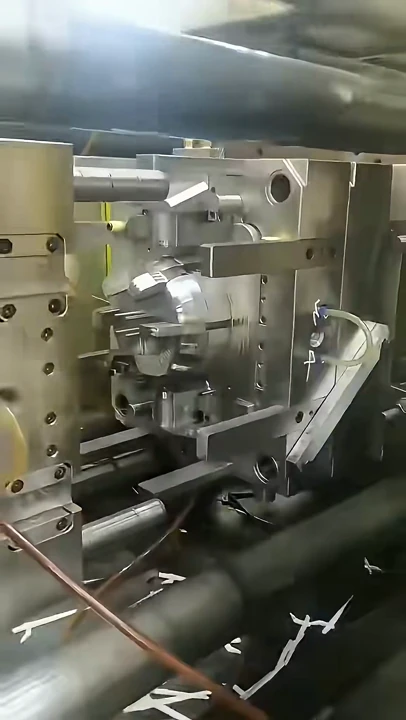
What clamp tonnage is — and why it decides the press
An injection molding machine does two jobs at once. The injection unit melts plastic and pushes it into the mold at very high pressure. The clamp unit holds the two mold halves pressed together while that happens. Those two forces fight each other: the molten plastic inside the cavity presses outward on both mold faces and tries to push the mold open along its parting line, while the clamp squeezes it shut. Presses are rated by the clamp force they can apply, measured in tons — a 150-ton press can hold its mold closed with 150 tons of force.
The reason this single number drives press selection is that the outward force is easy to picture: it is roughly the pressure inside the cavity multiplied by the area the cavity presents to the parting plane. If that outward force ever exceeds the clamp force, the mold breathes open a few thousandths of an inch and molten plastic squirts out into the gap, freezing as a thin fin called flash. Everything else about press sizing is about keeping clamp force comfortably on the winning side of that contest for your specific part and material.
The rule of thumb: projected area × cavity pressure
The working estimate used across the industry is:
Clamp tonnage ≈ projected area (in²) × cavity-pressure factor (tons/in²)
Projected area is the shadow the part casts on the mold's parting plane — the area you would see looking straight down the direction the press closes — and it must include the runner system that feeds the cavities, because that plastic is under pressure too. The cavity-pressure factor rolls up how hard the plastic is to fill and pack into one tons-per-square-inch number. As a representative range, easy-flowing resins in generous walls sit near the low end (about 2 to 3 tons/in²), while stiff or filled resins, thin walls and long flow paths climb toward 4 to 5 tons/in² or higher. These are general engineering figures, not promises; a mold-flow analysis gives the real peak cavity pressure for your part so the factor is not a guess.
A worked example (illustrative, not a quote)
Take a flat-ish ABS housing whose projected area on the parting plane is about 20 square inches. Using a mid-range factor of 3 tons/in², the clamp estimate is 20 × 3 = 60 tons. Add a sensible safety margin of 10–20% so the mold never flashes at the end of pack, and you land near 66–72 tons — so you would shop for a press in the 75-ton class.
Now swap the easy-flowing ABS for a stiff, glass-filled nylon in a thin wall with a long flow path and push the factor to 5 tons/in². The same 20 square inches now needs 20 × 5 = 100 tons, so you move up to a 120-ton press — same part footprint, very different machine, purely because the material and wall make the cavity harder to fill and pack. Finally, run four of those ABS cavities in one mold: the four parts alone total 80 square inches and the runner adds a few more, say about 88 square inches of projected area, so 88 × 3 = 264 tons; with the same 10–20% margin that is roughly 290–320 tons, a 300–350-ton machine. Engineering estimate, not a quote. To run your own part, use the clamp tonnage calculator.
What pushes the tonnage up
Four things move the cavity-pressure factor, and therefore the press size, in the same direction — up:
- Resin. Commodity resins like polyethylene and polypropylene flow easily and need less pressure to fill. Engineering resins such as polycarbonate, PC/ABS and especially glass-filled nylons are stiffer in the melt and need more.
- Wall thickness. Thin walls are harder to fill because the plastic freezes against the cold steel before it has travelled far, so the machine must push harder — higher pressure, higher tonnage. See wall thickness for molded parts for why uniform, sensible walls matter.
- Flow length. The farther the plastic has to travel from the gate to the last corner of the part, the more pressure it loses on the way, so a long, skinny part needs more pressure than a compact one of the same area. Engineers track this as the flow-length-to-wall-thickness (L/t) ratio.
- Number of cavities. Each cavity adds its own projected area and the runners add more, so a single- versus multi-cavity decision changes the tonnage directly. More cavities lower the per-part price but demand a bigger press.
The other press-fit limits: shot size and platen space
Clamp tonnage gets a part most of the way to the right press, but two more constraints decide whether a given machine can actually run the mold:
Shot size (barrel capacity). The injection unit can only melt and deliver so much plastic per cycle. The total shot — all cavities plus the runner — should generally use a comfortable middle band of the barrel's rated capacity, not the very top or the very bottom, so the melt is consistent and not degraded by sitting too long. A press with plenty of clamp force but too small a barrel still can't make the part.
Platen and tie-bar space. The mold is a steel block that has to physically fit between the four tie-bars and within the platen area, with enough open daylight for the mold to open and eject the part. A tall part needs enough stroke and ejector travel. A big multi-cavity tool can be limited by tie-bar spacing long before it runs out of tonnage. This is also tied to part size — see what size parts can be injection-molded.
Undersized vs oversized — what goes wrong at each end
| If the press is… | What happens |
|---|---|
| Undersized (not enough clamp) | The mold breathes open at peak pressure and the part flashes along the parting line; dimensions drift, parting-line seals wear, and the tool can be damaged over time. Chasing the flash by dropping injection pressure usually causes short shots instead. |
| Oversized (far more than needed) | You pay more per hour than the job needs, cycles can run longer than necessary, and a very large machine clamping and injecting into a small, delicate mold can over-pack or stress the tool if setup isn't careful. Bigger is not automatically safer. |
| Right-sized (comfortably above required) | Clamp force beats the opening force with a sensible margin, the shot sits in the barrel's good range, and the mold fits the platen with room to open and eject. This is the target. |
How JCH sizes the press when selecting a factory
When we place a tool, matching the mold to the right machine is part of the job, not an afterthought. We start from the part: projected area including runners, the resin and its melt behavior, the wall thickness and the longest flow path. From those we estimate the required clamp tonnage with the rule above, confirm it against a mold-flow analysis where the part warrants it, and add margin. We then check that the candidate machine's shot capacity suits the total shot and that the mold fits between the tie-bars with enough daylight and ejector stroke. Cavitation is decided in the same conversation, because the cavity count sets both the tonnage and the shot size — which is why press selection, tooling design and tooling cost are discussed together rather than in sequence. For a fuller picture of how a part becomes a tool and then production, see our overview of the injection molding process. We don't quote a press or a price sight unseen; the right machine comes from your actual part, resin and volume.
Common questions
How do I figure out what size injection molding press I need?
Start with clamp tonnage. Estimate the part's projected area (its shadow on the mold's parting plane, including the runner system), then multiply by a cavity-pressure factor, typically around 2 to 5 tons per square inch depending on the resin, wall thickness and flow length. Add a safety margin and round up to the next standard press size. Then confirm the press also fits the shot size and the mold's physical dimensions between the tie-bars. This is a representative engineering estimate, not a quote.
What is clamp tonnage and why does it matter?
Clamp tonnage is the force the press uses to hold the two mold halves shut while molten plastic is injected under high pressure. During injection the plastic pushes the mold open with a force equal to the cavity pressure times the projected area. If the clamp force is less than that, the mold cracks open slightly and plastic escapes at the parting line as flash. Sizing the press means making sure clamp force comfortably beats the opening force for your part and material.
How many tons per square inch do I need?
As a representative rule of thumb, easy-flowing resins in thick walls can be fine around 2 to 3 tons per square inch of projected area, while stiff engineering resins, glass-filled materials, thin walls and long flow paths push the figure toward 4 to 5 tons per square inch or more. These are general engineering ranges, not promises; the real number depends on your exact part, resin grade and mold layout, and a mold-flow analysis confirms it.
What happens if the press is too small or too big?
Too small and the clamp force loses to the injection force: the mold breathes open and you get flash, dimensional drift and short tool life. Too big wastes money, can run a longer cycle than needed, and a press whose clamp and injection forces dwarf a small mold can over-pack or even damage delicate tooling if it is not set up carefully. The goal is a press comfortably above the required tonnage, not many times above it.
Does the number of cavities change the press size?
Yes. Each extra cavity adds its own projected area, and the runner system adds more, so total projected area and therefore required clamp tonnage climb roughly with cavity count. A single-cavity tool may fit a small press while the same part in an eight-cavity mold can need several times the tonnage, plus more shot capacity. That is one reason cavitation is decided alongside press selection, not after.
JCH Design & Manufacturing can look at your part and resin and tell you the clamp tonnage class and press fit it points to — and whether a small design change would let it run on a smaller, cheaper machine. Send a sample, drawing or description with your target quantity; NDA first.
Book a 30-minute callAsk JCH about press size and clamp tonnage
Want a rough tonnage class for your part? Ask our AI assistant. It answers from this website; a real number comes only from Jack, against your drawing and resin.
AI assistant. Answers can be wrong; nothing it says is a quote or a promise.