Single-cavity vs multi-cavity (and family) molds
A single-cavity mold makes one part per cycle and is cheapest to build; a multi-cavity mold makes several per cycle for a lower per-part price at a higher tooling cost; a family mold makes different parts at once. More cavities spread one cycle's cooling time across more parts — so the per-part price usually falls at volume, though not automatically. Match cavity count to your real volume.
The three options
| Type | Per cycle | Tooling cost | Best for |
|---|---|---|---|
| Single-cavity | 1 part | Lowest | Low volume, large parts, prototypes/bridge runs |
| Multi-cavity | Several identical parts | Higher; per-part usually lowest at volume (confirm in quote) | Higher volume of one part |
| Family mold | One set of different parts | Higher (a more complex build; saves tool bases) | A kit of similar parts needed in similar ratios |
How to choose: the break-even
A higher-cavity tool costs more up front but each part is cheaper, so there's a break-even quantity where it pays back: roughly the tooling-cost difference ÷ the per-part savings. Below that volume the lower-cavity tool is cheaper overall; above it, the higher-cavity tool wins. What to weigh:
- Lifetime volume — the single biggest factor; more cavities only pay back above the break-even.
- Part size — large parts often stay single-cavity (a multi-cavity tool would need a huge press).
- How sure the volume is — uncertain demand favors starting lower and scaling (below).
- Cash now vs. per-part later — a lower tooling bill today vs. a lower unit cost at volume.
A worked example (illustrative, not a quote): if a 4-cavity tool costs 12,000 more to build than a 1-cavity tool but saves 1.50 per part, the break-even is 12,000 ÷ 1.50 = 8,000 parts. Under ~8,000 lifetime parts, the cheaper tool wins; well above it, the 4-cavity tool does. The rule: if your lifetime volume is under the break-even, stay low-cavity. And because forecasts are optimistic, check the break-even at half your forecast too — if the higher-cavity tool still pays back there, it's a safe call. (Numbers are round illustrations, not prices.)
What the simple break-even leaves out (so re-run it with the realistic saving, not the optimistic one): a multi-cavity tool needs more clamp force — roughly the total projected area of all cavities plus any cold runner × the average cavity pressure (a resin clamp factor in tons per square inch) sets the press tonnage, so more cavities push you to a larger, higher-hourly-rate press, which shrinks the per-part saving; it also carries more maintenance, more cavity-to-cavity variation and scrap, and a longer build. One money-saver worth asking about: a mold base built with space or blanks for extra cavities lets you add cavitation later without cutting a whole second tool, if the runner is designed to stay balanced with the blanks in place; agree it with the toolmaker before design freeze.
Run that math on your real lifetime volume rather than defaulting. (See what drives mold cost for the tooling side, and how to read a mold quote for comparing cavitation across quotes.)
Family molds: one caveat that matters
A family mold makes several different parts in one cycle — handy for a kit, like the two halves of an enclosure plus a clip. The catch: a family tool makes one set of its parts per cycle, so if you need them in different ratios you either over-produce some or add complexity. The cavities also have to fill evenly despite different sizes and wall thicknesses, which needs careful runner balancing (and sometimes a reduced or shut-off cavity when you don't need a part that run). So family tools work best when the parts are similar in size, wall, and material. If one part is much bigger or needed in a very different quantity, separate tools are often cleaner — and a family tool is a more complex build, so it saves tool bases but isn't automatically "cheapest." (A family mold has its own trade-offs.)
The staged path (start small, scale)
You don't have to commit to high cavitation on day one. A common path is to launch with a lower-cavity tool to prove demand, then move to higher cavitation once volume justifies it — keeping up-front tooling spend in line with real orders instead of a forecast. The trade-off is paying for a second tool later, so weigh it against how confident your volume is. A manufacturer can design with that growth in mind, or recommend the right cavity count from the start if your numbers are already clear.
Before adding cavities: three checks beyond the break-even
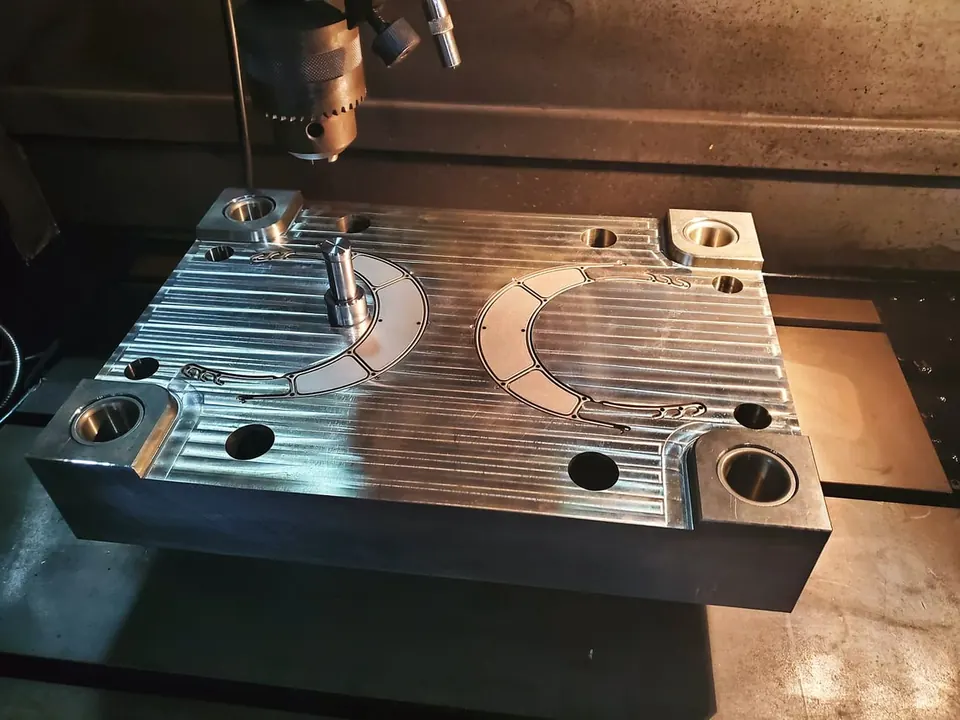
The break-even above assumes the larger tool runs well. Three physical checks decide whether it can; ask the toolmaker to confirm each before the cavity count is fixed.
| Check | What to compare | If it fails |
|---|---|---|
| Shot size | Total shot weight (all cavities plus runner) against the barrel capacity of the intended press; the shot size calculator does the arithmetic. | Too little of a large barrel leaves melt sitting hot for several cycles; too much leaves no margin. Either can force a different press and hourly rate. |
| Mold size | The mold base footprint against the tie-bar spacing, and the stack height plus opening stroke against the press's daylight. | More cavities widen the base; a tool that only fits a bigger press gives back part of its per-part saving. |
| Fill balance | How the runner splits to each cavity, and whether the fill was simulated with the runner itself modeled. | Cavities that fill at different rates pack differently and come out at different sizes. |
On the last point, a symmetric layout is not proof of balance. Plastics Technology notes that even a geometrically balanced runner fills unevenly because branching upsets the flow symmetry, with inside cavities often filling before outside ones, and that fill time sets the shear rate, so moving the tool to another press can shift the pattern. Ask for a short-shot set at sampling with the parts kept in cavity order.
Reading quality cavity by cavity: a worked example
Capability is easy to misjudge when parts from all cavities are measured as one population. Take a 10.00 ± 0.10 mm dimension on a four-cavity tool where every cavity shows the same shot-to-shot spread (σ = 0.010 mm) but a slightly different center. The NIST engineering statistics handbook gives Cpk as the smaller of (upper limit − mean) and (mean − lower limit), divided by 3σ:
| Cavity | Mean (mm) | Cpk |
|---|---|---|
| 1 | 10.00 | 0.10 ÷ 0.030 = 3.33 |
| 2 | 10.01 | 0.09 ÷ 0.030 = 3.00 |
| 3 | 9.99 | 0.09 ÷ 0.030 = 3.00 |
| 4 | 10.06 | 0.04 ÷ 0.030 = 1.33 |
| All four pooled | 10.015 | 0.085 ÷ (3 × 0.0287) = 0.99 |
The pooled σ of about 0.0287 mm comes from adding the within-cavity variance (0.010² = 0.000100) to the variance of the four cavity means (0.000725), then the square root. Pooled, the tool looks incapable. Split by cavity, three cavities have wide margin and cavity 4 sits 0.06 mm high: one steel correction, not a process overhaul. Run each cavity separately in the Cpk calculator before accepting or rejecting a multi-cavity tool on a single number.
Sources for this section:
- Plastics Technology: Why multi-cavity molds fill unevenly
- NIST/SEMATECH e-Handbook of Statistical Methods: Process capability (Cpk)
Common questions
Single vs multi-cavity? Single makes one part/cycle (cheapest tool); multi makes several (lower per-part at volume, higher tooling) because one cycle's cooling spreads over more parts — confirm the per-part number, since a bigger press costs more per hour.
How many cavities? Match your lifetime volume — the break-even is roughly the tooling-cost difference ÷ the per-part savings.
What's a family mold? One tool making several different parts per cycle (one set each cycle); best when they're similar in size/wall/material and needed in similar ratios, since you get a full set whether you need it or not.
Start small and scale? Yes — launch low-cavity to prove demand, step up cavitation later; the cost is a second tool.
Does cavity count affect quality? It can — a multi-cavity tool must fill every cavity evenly (balanced/hot runner), which is part of why more cavities cost more.
JCH Design & Manufacturing can run the cavity-count trade-off with you — your volume over time, how the parts relate, and where the break-even sits — so the tooling decision is made on your real numbers. Send your part and target quantity; NDA first.
Book a 30-minute call