What is metal injection molding (MIM), and when does it make sense?
Metal injection molding mixes fine metal powder with a plastic binder, molds it like plastic, removes the binder, then sinters the part in a furnace, where it shrinks by about a fifth to near-full density. It makes sense for small, complex steel or stainless parts, typically under 100 grams, needed in thousands or millions.
How the process works
MIM borrows the forming step from plastic molding and the densifying step from powder metallurgy. The sequence, as the Metal Injection Molding Association describes it:
- Feedstock. Very fine metal powder, generally under 30 micrometres, is mixed hot with a binder of thermoplastics and waxes until every particle is coated, then pelletized. The binder is typically about 40% of the volume.
- Molding. The pellets run on a conventional injection molding machine. The part that comes out, called the green part, has its full shape but is still powder held together by binder, and it is roughly 22 to 28% larger in every dimension than the finished part (an 18 to 22% shrink measured from the molded size).
- Debinding. Most of the binder is removed by a catalytic, solvent, water or thermal step, depending on the feedstock. What's left, the brown part, keeps its shape but is porous and fragile.
- Sintering. In a controlled-atmosphere furnace the brown part is heated to just below the alloy's melting range (or slightly into it for liquid-phase sintering); MIMA gives 1,350 to 1,400 °C for a stainless part. The remaining binder burns off, the pores close, and the part shrinks, typically 18 to 22% depending on binder volume, to 96 to 99% of theoretical density.
- Optional finishing. Coining, machining, heat treatment or coating where tolerances or properties need it.
The result has properties close to the same alloy in annealed wrought form, in a shape that would take many machining setups to cut.
Where MIM fits, in numbers
| Factor | Typical sweet spot | Stretch cases |
|---|---|---|
| Part weight | A few grams up to about 100 g | Some parts above 100 g |
| Wall | Uniform walls; debinding time grows with the thickest section | EPMA puts the practical limit at about 30 mm |
| As-sintered tolerance | About ±0.3 to ±0.5% of the dimension | About ±0.1% on a selected small dimension once the mold is fine-tuned; tighter with coining or machining |
| Volume | Thousands to millions of parts a year | One supplier puts the economic floor above about 10,000 a year |
Size and volume ranges come from MIM producers' design guidance and vary by supplier and alloy. Almost any metal that can be made as a fine powder can be molded; the EPMA, the powder metallurgy industry association, notes aluminum as the main exception, because its oxide film gets in the way of sintering. Stainless steels, low-alloy steels, tool steels, superalloys and magnetic alloys are all on the list.
Worked example: sizing the cavity for a small stainless latch
Take a hypothetical stainless latch with a 20.00 mm critical length and a drawing tolerance of ±0.3%, which is ±0.06 mm.
- Cut the cavity to the feedstock's factor. Suppose the feedstock supplier quotes 20.0% linear shrink, measured from the molded size. The cavity is 20.00 / (1 − 0.200) = 25.00 mm. Note that the cavity is 25% bigger than the part, not 20%. Shrink figures are quoted both ways, so ask which convention the molder's number uses.
- See what a small shift does. If a feedstock lot shrinks 19.5% instead, the part comes out at 25.00 × 0.805 = 20.13 mm, about 0.13 mm over nominal and roughly twice the allowed tolerance.
- Work out the real window. To stay within ±0.06 mm on a 25 mm green dimension, the shrink must repeat within about ±0.24 percentage points (0.06 / 25.00). That is why MIM tooling is cut for one specific feedstock, and why switching feedstock suppliers usually means recutting or at least re-qualifying the tool.
If the latch had a feature that needed ±0.02 mm, the honest plan is to mold it close and machine or coin that one feature, not to demand it as-sintered. Stack the remaining tolerances with the tolerance stack-up calculator before signing off the drawing.
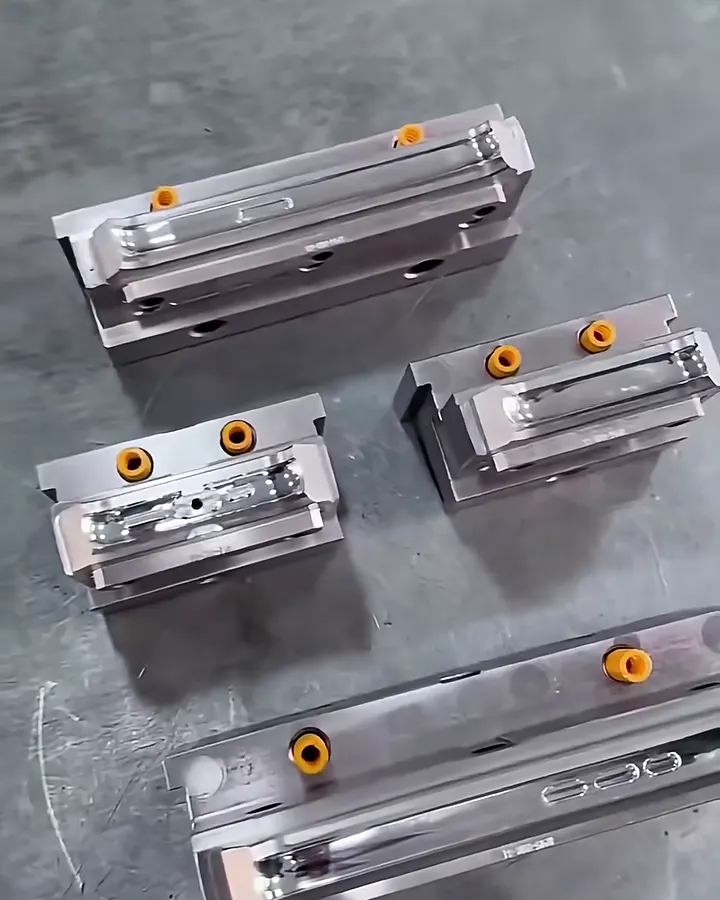
MIM against the alternatives
| Process | Where it beats MIM | Where MIM beats it |
|---|---|---|
| CNC machining from bar | Low volumes, large parts, the very tightest tolerances, no tooling | Complex small parts at volume, hard-to-machine alloys, less material wasted; runners and sprues can be reground into feedstock |
| Die casting | Larger and lighter parts in aluminum, magnesium or zinc | Steels, stainless steels and superalloys; die casting alloys are mainly aluminum, magnesium, zinc and copper. Finer detail on small parts |
| Investment casting | Larger parts and lower volumes | Thinner walls, sharper detail, small holes, better as-made surface |
| Press-and-sinter powder metallurgy | Simple prismatic shapes at the lowest part cost | Undercuts, cross holes and 3D shapes a rigid die can't eject; higher density (MIMA lists about 98% vs 88%) |
For the plastic-versus-metal question one level up, see die casting vs injection molding.
Design rules that keep MIM parts straight
- Keep walls uniform. Thick and thin sections debind and shrink at different rates, which shows up as distortion or internal voids. Core out heavy sections.
- Plan how the part sits in the furnace. The brown part is weak and shrinking while hot, so long thin features sag. Producers use ceramic setters and support fixtures; a flat face to sit on helps.
- Draft where the part grips steel. Core pins and deep recesses are where draft matters most. EPMA's guidance is that where draft is needed, 0.5° to 2° is generally enough; ask the molder which faces need it.
- Use the complexity. MIM's case is strongest when one part replaces an assembly of several, or carries knurls, lettering or cross holes that would each be a separate machining step.
- Specify only the tolerances that matter. Overly tight callouts force secondary machining and erase the cost advantage, a point the general guidance on molded part tolerances makes for plastics too.
When MIM makes sense, and when it doesn't
It makes sense when the part is small, made of steel, stainless or another alloy that sinters well, complicated enough that machining would take several setups, and needed in thousands or more. It is a poor fit for parts that are large or heavy, simple enough to turn or stamp, needed in tiny numbers, or made of aluminum. For tiny numbers, the tooling is hard to justify; low-volume production covers the routes that avoid it. And for parts that combine a MIM component with plastic, such as a molded handle around a metal insert, plastic and metal together explains how the two are coordinated.
Common questions
How much does a MIM part shrink?
Typically 18 to 22% in each direction during sintering (MIMA; some producers quote 15 to 20%), depending on the feedstock's binder content. The shrink is close to uniform, so the mold cavity is cut oversize by a factor matched to that specific feedstock. Ask whether the factor is measured from the molded size or the finished size, because the two give different cavity dimensions.
Are MIM parts as strong as machined parts?
They come close. MIM parts typically reach 96 to 99% of theoretical density, with properties similar to the same alloy in annealed wrought form. The small remaining porosity can matter for fatigue-critical or pressure-tight parts, so test those applications, and consider heat treatment or other densifying steps where the supplier recommends them.
Can aluminum parts be made by MIM?
Generally not in normal practice. Aluminum's tough oxide film gets in the way of sintering, which is why MIM work centers on steels, stainless steels, tool steels, superalloys and magnetic alloys. Small aluminum parts are more often die cast or machined.
What tolerances can MIM hold?
As-sintered tolerances of roughly plus or minus 0.3 to 0.5% of the dimension are a common starting point, and suppliers can do better on some features with process control. Tighter features are usually coined or machined after sintering, so call out only the dimensions that truly need it.
What volume makes MIM worth the tooling?
MIM is built for medium to high volumes, from thousands to millions of parts a year, because the mold, feedstock development and furnace setup all need to be spread across many parts. At very low quantities, machining or another tool-free route is usually the better first step.
Sources
- Metal Injection Molding Association (MPIF) - Process Overview: MIM
- Metal Injection Molding Association (MPIF) - Designing with MIM
- European Powder Metallurgy Association - Metal Injection Moulding (MIM)
- Advanced Powder Products - Metal Injection Molding 101
Send the part file and the quantity you expect to run, and we'll review it before you commit to tooling. NDA first if you want one.
Send a part for reviewBook a 30-minute call