How do I protect and maintain my tooling over its life?
A mold is a capital asset — a well-maintained production steel mold can run hundreds of thousands to over a million cycles, while aluminum and prototype tools are built for far fewer. Protecting it comes down to four things: routine maintenance, proper storage between runs, scheduled refurbishment as it wears, and good records with clear ownership. Most of it is driven by shot count, so the tool is serviced on a schedule rather than when a defect finally appears.
JCH coordinates tooling maintenance, storage, and refurbishment through a manufacturing network; this page is general guidance, not a quote.
Routine maintenance
- Cleaning between runs — resin residue and buildup removed so it doesn't bake onto cavity surfaces.
- Lubrication of moving components — ejector pins, slides, and lifters, so they don't gall or seize.
- Inspection of wear points — gates, parting line, vents, and cavity surfaces, where steel takes the most stress.
- Corrosion prevention — rust preventive on steel surfaces; corrosion is the main thing that quietly ruins an idle mold.
- Spares for wear items — ejector pins, springs, and replaceable inserts kept on hand so a service doesn't stall a run.
How long a tool lasts
| Tool steel | Typical life / use |
|---|---|
| Aluminum | Limited shots — prototyping and low volume |
| P20 (pre-hardened) | Mid-volume production |
| H13 / S7 (hardened) | High-volume, long-life production |
| Abrasive resins (glass-filled) | Wear steel faster, especially at gates → hardened/coated steel + wear inserts |
The two variables are the steel and what you mold. Matching the steel to your real volume up front — and then keeping up the maintenance — is what lets a tool run for many years instead of degrading early. Over-building the steel for a tiny run wastes money; under-building it for a high-volume part fails early.
Storage between runs
Before a tool goes into storage it's cleaned and coated with a rust preventive on the steel, then kept in a controlled, dry environment with its location logged. A tool idle for a long time gets a periodic inspection and re-coat so rust can't take hold. If your tool lives at the molder between runs, that storage should be documented — it's your asset, and you should know its condition and where it physically is.
Refurbishment over the tool's life
As cycles accumulate, steel wears at the high-stress points — gates, parting line, vents, ejection — and parts drift toward the edge of spec or start to flash. Refurbishment stays ahead of that: re-polishing cavities, re-cutting vents, replacing worn ejector pins and springs, swapping replaceable inserts. It's scheduled against shot count and condition, not left until parts fail, and spare wear components on hand keep a planned refurb from stalling production. Signs it's time: flash creeping in at the parting line, dimensions drifting toward a tolerance limit, cosmetic drag or dulling on cavity surfaces, or vents that no longer clear gas (showing up as short shots or burn marks).
The tooling file (what makes continuity painless)
Good records are what let any qualified shop pick the tool up and run it. Keep a tooling file with:
- Tool ID and shot count — identity and how much life it's used.
- Maintenance and refurbishment log — what's been serviced and when.
- Process sheet — the molding parameters that make good parts.
- Approved sample, drawings, and material spec — the definition of "good."
- Ownership paperwork — a bill of sale or tooling agreement proving the tool is yours.
With that file, a reorder, a second source, or a tool transfer is straightforward. Without it, every one of those becomes a reconstruction project.
How molds get damaged in production, and what prevents it
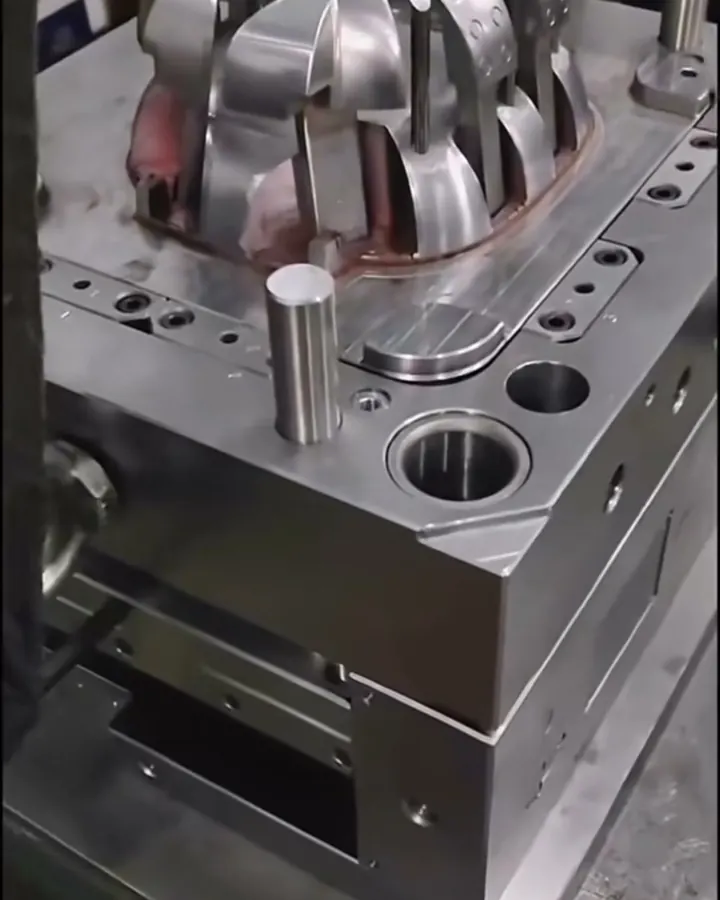
Most early tool damage is not age. It comes from a few preventable events:
| Damage | Usual cause | Prevention to ask for |
|---|---|---|
| Crushed parting line or cavity edge | The mold closing on a stuck part or a dropped runner | Mold protection (low-pressure close) set on the press, and part removal confirmed before every close |
| Rust in cavities after a run | Condensation on a chilled mold left idle or pulled cold | Bring the tool up to room temperature before shutdown, then dry and coat it |
| Cooling that slowly gets worse | Mineral scale building up on the cooling channel walls | Flow-test each circuit against its original baseline and descale when it drifts |
| Water inside the plates | Aging O-rings at the water connections | Check every fitting for leaks at each service; replace O-rings on a schedule |
| Dents and chipped edges | Lifting from the wrong points or setting the tool down unprotected | Lift by the designed lifting holes, halves strapped closed |
Two rows are quiet. Randy Kerkstra's tooling column in Plastics Technology warns that a mold run with a chiller is at risk of rust from condensation if it is not shut down properly. DME's medical molding white paper notes that scale acts as an insulator, so even a thin layer slows heat transfer before any loss of flow is noticeable. A tool can drift on cycle time and dimensions for that reason alone.
Verifying care on a tool you cannot see
When the tool sits in someone else's press, confirm maintenance with evidence. A short report after each run covers it:
- Cycle counter readings at the start and end of the run, from a counter mounted on the mold, so the count follows the tool if it moves.
- The service entry for that run: what was cleaned or replaced, and any damage found.
- Flow per cooling circuit against the baseline recorded when the tool was new. The DME paper recommends storing that baseline so channel cleaning can stop only once original flow is restored.
- Photos of the cavity and parting line after cleaning, taken from the same angles each time, so wear shows as change.
- Spares used, so a sudden run on ejector pins or springs flags a problem before parts do.
Agree this report before the first run and keep each one in the tooling file. The mold class selector matches the mold's build class to its expected cycle life, and the tooling custody note covers the ownership side.
Sources for this section:
- Plastics Technology: Designing molds for easy cleaning and maintenance in the press (Randy Kerkstra)
- DME: Medical molding white paper (cooling channel scale and flow baselines)
Common questions
How do I protect and maintain my tooling over its life?
Routine maintenance (cleaning, lubrication, wear-point inspection, corrosion prevention), proper storage, scheduled refurbishment, and good records with clear ownership. Most of it is driven by shot count — serviced on a schedule, not after a defect. The goal is predictable, in-spec parts for the tool's full life.
How long does a mold last?
Mostly the tool steel and the resin: aluminum = limited shots (prototyping), P20 = mid-volume, H13/S7 = high-volume long life. Glass-filled/abrasive resins wear steel faster (hardened/coated steel + wear inserts). Match the steel to real volume up front and maintain it, and a tool runs for years.
How should tooling be stored between runs?
Cleaned, coated with rust preventive, and kept in a controlled dry environment with its location logged. A long-idle tool gets a periodic inspection and re-coat. If it's stored at the molder, document it — it's your asset.
When does a tool need refurbishment?
As cycles accumulate, steel wears at gates, parting line, vents, and ejection, and parts drift or flash. Refurbishment (re-polish, re-cut vents, replace ejector pins/springs/inserts) is scheduled against shot count and condition, not left until parts fail.
What tooling records should I keep?
A tooling file: tool ID, shot count, maintenance/refurb log, process sheet, approved sample, drawings/material spec, and ownership paperwork (bill of sale or tooling agreement). With it, reorders/second-sourcing/transfers are painless; without it they're reconstruction projects.
JCH Design & Manufacturing can coordinate tooling maintenance, storage, and a tooling file for your molds through its partner network. Tell us the tool and part.
Book a 30-minute call