Flexible Pouch Size & Film Web Width Calculator
A pouch has to hold your fill volume divided by one minus the headspace share, and its size follows from that capacity once you pick a width: a flat pouch is solved with Anthony Robin's pillow approximation on its inside dimensions, and a stand-up pouch with its inside width × fillable height × bottom gusset times a shape factor. Worked through below, 250 g of a granular product at an assumed bulk density of 0.40 g/mL with 15 % headspace fits a stand-up pouch 150 mm wide and 183 mm tall with an 80 mm gusset and 8 mm seals, using our geometric reading of the shape factor (π/8), and one roll W-folded to make that pouch is 446 mm wide. Type your own fill, seals and gusset to size yours.
A sizing estimate to brief a converter and order sample pouches, not a quote. The fill test on real pouches with your real product decides the size.
How this works
The page answers the buyer's question in five steps: how much space the product needs, how much of the outside size is lost to seals, how much a pouch of a given inside size holds, which size meets the need, and how much film that size takes from the roll.
1. From the fill to the capacity. Weight does not size a pouch; volume does. A liquid's volume is on its spec. A powder, granule or snack has a bulk density that includes the air between pieces, so the tool divides the fill weight by the bulk density you enter. The pouch then has to hold more than the product, because the top needs room for the closing seal and for handling. The tool calls that allowance headspace and finds the required capacity as C = Vfill ÷ (1 − headspace). YLTPACK's volume guide puts it per product: "For powders or granular products, fill up to 80–85% of the theoretical capacity to ensure easy sealing and handling. For liquids, maintain a 10–15% headspace to accommodate expansion and prevent leakage." (YLTPACK, How To Calculate The Volume Of a Stand Up Pouch.) The default of 15 % sits inside both of those bands.
2. From the outside size to the inside size. Pouch sizes are quoted on the outside. Smartpouches' measuring brochure takes the width from the outside left edge to the outside right edge and the height from the outside bottom edge to the very top, and defines the bottom gusset as twice the distance from the outside bottom edge up to the deepest point of the fold inside (Smartpouches, How to measure a stand up pouch). ePac's guide asks for the opposite basis when estimating volume: "you must measure the internal, fillable area of the pouch, which means measuring up to the zipper or seal line" (ePac, How to Calculate the Volume of Your Stand Up Pouch). The calculator bridges the two by taking one seal width s off each sealed edge: inside width = W − 2s, and fillable height = H − s when the bottom is a fold or a gusset, or H − 2s when the bottom is a seal too. That deduction is our reading. If your design puts a zipper or tear notch below the top seal, enter a wider s or more headspace.
3. Flat pouches: the pillow. Two flat panels joined at their edges cannot become a box; they balloon into a cushion that is deep in the middle and pinched at every edge. ePac's guide says as much about lay-flat pouches, noting that W × H "provides the surface area, not the true 3D volume, which is difficult to calculate precisely for a pillow shape." Geometry has a name for the shape. The Wikipedia article on the paper bag problem gives Anthony C. Robin's approximation for "the capacity of a sealed expanded bag": V = w³·(h ÷ (π·w) − 0.142·(1 − 10−h/w)), where w is "the shorter dimension" and h "the longer dimension". For a unit square the article reports "roughly 0.19", and it warns that "The approximation ignores the crimping round the equator of the bag." The tool feeds Robin's formula the inside width and fillable height. Applying it to a pouch whose bottom is a fold rather than a seal is our reading: a fold and a seal both join the two panels along that edge.
4. Stand-up pouches: a box with a shape factor. ePac's method states that "The Stand-Up Pouch is treated as a rectangular prism" and gives a nominal volume of W × H × D, with its example of 15 cm × 20 cm × 6 cm = 1,800 cm³. YLTPACK starts from the same box and then shrinks it, "Because standing pouches are not perfect cuboids (due to sidewall angles and corner spaces)", by a correction factor of 0.60 to 0.65 for powders or granular products, 0.65 to 0.70 for viscous liquids, and 0.70 to 0.75 for thin liquids that pour easily; its worked case is 15 × 21.5 × 8 cm = 2,580 cm³, times 0.65, about 1.68 L. The selector offers the low end of each YLTPACK band; picking the low end is our choice, because a smaller factor asks for a taller pouch.
The default is lower still. It comes from our own geometry, not from a published figure. A filled stand-up pouch opens to a base whose depth is the full gusset at the center and zero at the side seals, which we draw as an ellipse Wi wide and BG deep, with area (π/4)·Wi·BG. At the top seal the two faces meet, so the depth falls to zero there. If the depth shrinks evenly from the base to the seal, the average cross-section is half the base, and the volume is (π/8)·Wi·hi·BG. Two published figures are worth setting beside it. YLTPACK's own size chart, on the same page, gives liquid capacities that by our arithmetic run from about 16 % to 54 % of each pouch's outside box across its 11 rows (its 6″ × 9.4″ × 3.25″ pouch at 24 oz of liquid is 709.8 mL against 3,003.7 mL, or 24 %), all under the 0.60 to 0.75 band. The chart calls its figures "general industry references", and its rows fall below even Robin's figure for the same faces, so we read them as nominal fills rather than measured capacities. And a stand-up pouch should hold at least as much as a flat pouch made from the same two faces, so the tool also reports Robin's figure for those faces; if k × box ever falls below it, the factor you chose is too low by our reading.
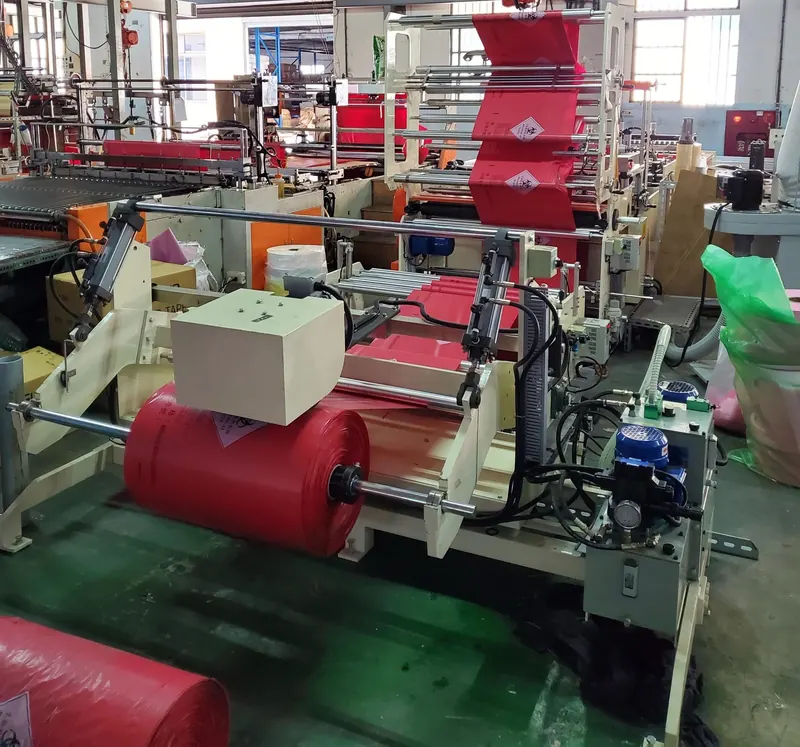
5. From the pouch to the roll. On the pouch machine of patent 5,699,653, which unwinds the web in a horizontal plane, the bottom of the pouch is a fold. The patent describes it: "the plow 20 folds the web up into a vertical plane about a longitudinal fold line which forms the bottom edge of a pouch", and later "the knife cuts the web through the side seals to sever the web into finished individual pouches" (patent 5,699,653, Google Patents). Each half of the web becomes one face, so our reading is that the web is twice the pouch height, and each pouch uses one pouch width of web length between side seals. For a stand-up pouch, patent 5,181,365 folds the web "into a generally W-shape comprising side walls 24 and 26 connected at bottom edges thereof by a bottom gusset 28" (patent 5,181,365, Google Patents). Unfolded, that W is one face of height H, the gusset going up BG ÷ 2 and back down BG ÷ 2, and the other face: 2H + BG across, again our reading. If the converter builds pouches from separate front, back and gusset webs instead, each web is H, H and BG wide. Any lanes, edge trim and register marks the line needs come on top; the trim box adds them evenly to both edges.
Worked example, three cases
Case A is the stand-up example button, case B the flat pouch button, and case C reruns the published cases the method rests on.
Case A shows the spread between the factors honestly: the same 625 mL fits a 183 mm pouch under our reading and a 114 mm pouch at YLTPACK's 0.65. A difference that size is why the next step after this page is a fill test, not a print order. ePac's tip for irregular or airy products is the procedure to follow: "Fill an empty sample pouch with your actual product to the desired level", then pour it into a measuring container. Divide the measured capacity by the box wi·hi·BG of that sample and you have your own k, which the "My own factor" option accepts. Case B shows what one extra seal takes from a small pouch: about a tenth of the capacity, or 6 mm more height to win it back.
Choosing the gusset
Capacity is one test of a stand-up pouch; standing up is the other. YLTPACK's gusset article gives what it calls "the most reliable starting rule": "Bottom gusset depth should be roughly 40% to 60% of the pouch width. It should also be at least one third of the total height." It lists "Using a gusset smaller than 40% of the pouch width, which almost always causes tipping" among the errors it sees repeated (YLTPACK, How to Measure and Select Gusset Size). The article presents the rule from its own production experience, and the tool applies it to BG as entered; treating YLTPACK's "gusset depth" as the full opened base BG is our reading. The result panel flags a gusset under 40 % or over 60 % of W, and one shorter than a third of H. Case A first used a 130 mm width with a 70 mm gusset; the solved height of 243 mm put the gusset under a third of H, so the example moved to 150 mm and 80 mm.
Mistakes that undersize a pouch
- Sizing by weight. 250 g of a dense powder and 250 g of puffed snacks take up very different volumes, so one pouch cannot suit both. Convert through bulk density first.
- Measuring the outside and filling the inside. Seals, a zipper track and the top of the gusset fold all sit within the printed outside size. Take them off before you judge whether a size holds the product.
- Treating a flat pouch as W × H × a thickness. A pillow's depth is set by its panel size, and the panels pull in at the edges as it fills. Use the pillow formula, then test.
- Borrowing a shape factor without checking it. One published chart implies 0.16 to 0.54 of the outside box from row to row, and one published band runs as high as 0.75 of it, for the same style of pouch. Measure k on one sample.
- Ordering film for the pouch count alone. The run length here is film inside finished pouches. Setup, splices and print registration take more, and only the line running the job can say how much.
- Forgetting the zipper. A reclosable track takes height under the top seal. Raise s or the headspace so the fill line stays below it.
This page against the other ways to size a pouch
| Approach | Good for | Limits |
|---|---|---|
| This calculator | A first size and web width to brief a converter; comparing flat against stand-up; seeing how much capacity seals and gusset take | Models, not measurements: Robin ignores the crimped edge, and k for stand-up pouches spans a wide range |
| Fill test on sample pouches (ePac's method) | The real capacity of a real pouch with the real product, and your own k | Needs blank pouches in roughly the right size first; this page tells you which size to ask for |
| Converter or machine maker | Lanes, edge trim, seal widths the sealing jaws actually make, zipper and notch positions, setup waste | Specific to one line and one film structure |
| Shipping Carton Size Calculator | Packing filled pouches into an inner or master carton | Treats each pouch as a block; measure a filled pouch for its size |
| Blister and clamshell gauge calculator | Rigid formed packs instead of film pouches | Thermoformed sheet, not flexible film |
Sources for the method. Pillow formula, unit-square value and its crimping caveat: Wikipedia, Paper bag problem. Stand-up pouch as a rectangular prism, inside-measurement basis, 1,800 cm³ example, flat-pouch area caveat and the fill test: ePac Flexible Packaging. Correction factors by product type, the 2,580 cm³ × 0.65 case, the size chart and the headspace guidance: YLTPACK volume guide. Gusset proportions: YLTPACK gusset guide. Outside dimensions and the gusset definition: Smartpouches brochure. Folded bottom, side-seal cutting and the W-folded gusset web: patent 5,699,653 and patent 5,181,365. Unit conversions: NIST SP 811, Appendix B.9. The seal deductions, the π/8 shape factor, the low-end factor choice, the web-width and pitch lines and the flat-floor check are our reading, labeled where they appear.
Reviewed by the JCH tooling team · updated November 2026.
Pouch sizing questions
How do I find the pouch size for a given amount of product?
Turn the amount into milliliters first. For anything that pours as pieces or powder, weigh a level cup of it and divide to get its bulk density, then divide your fill weight by that. Add room for closing, choose a width that suits the shelf, and solve for the height that holds the total. Confirm on a physical sample before printing.
Why can't I multiply width, height and thickness for a flat pouch?
Because an empty flat pouch has no thickness to multiply. Its depth appears only as product forces the faces apart, deepest at the center and zero along every edge, much like a cushion. Geometers call this the paper bag problem, and the approximation this page uses puts a filled square pouch at a little under a fifth of its side cubed.
What does the third number in a stand-up pouch size mean?
It is the bottom gusset: the depth of the base once it opens out under the product. Empty, the gusset is folded in half, so the fold rises only half that figure above the bottom edge. A 150 × 183 × 80 mm pouch therefore has a fold reaching 40 mm into it.
How much empty space should be left at the top?
One supplier's guide asks for a tenth to fifteen percent empty with liquids and puts powders at four-fifths full or a little more. Those are its general figures. A zipper, a spout or a fast filling line may need more, so set the value from a sample filled on the equipment that will run the job.
How wide is the film for a stand-up pouch made on one roll?
When a single roll is folded into a W to make the base, it must cover both faces plus the whole gusset: twice the outside height, plus the gusset. A 183 mm tall pouch with an 80 mm gusset comes off a 446 mm web, before whatever trim the machine running it adds at each edge.
How much film do I need for a pilot run of pouches?
Multiply the number of pouches by the width of one, since each pouch takes one width of the roll's length on the layouts shown here. Two thousand pouches 150 mm wide use 300 m. Threading, splices and registering the print use extra, an amount only the converter can give you.
Is a pouch sealed on four edges smaller inside than one folded at the bottom?
At the same printed size, yes. The bottom seal comes out of the panel. In the 75 × 89 mm example with 6 mm seals, the folded version holds about 71 mL while the four-seal version holds about 64 mL, so it needs a taller blank to carry the same fill.
Talk the pouch size through with Ask JCH
Have a fill weight, a product and a shelf in mind? Put them in the box. The assistant behind Ask JCH is an AI model that answers in a panel on this page. Once that first answer is in, a box for your email appears, and filling it is optional.
The assistant writes its own answers, and they can contain errors. Sizes stay in this tab unless you press Ask JCH, which sends your question with a short line about your last result.
Planning a pilot run in film pouches?
Bring the fill weight, the product's bulk density if you have measured it, and the shelf or carton the pouch has to fit. On the call we can walk the size through these models, list the questions the converter needs answered on seals, zipper and trim, and point out where a fill test has to settle the number.
Book a free 30-minute first consultation Describe the product in writing