ABS vs polycarbonate vs polypropylene: which should my part use?
Use ABS for opaque housings that need a good finish and easy painting. Use polycarbonate when the part must be clear, take hard impacts in the cold, or run hotter. Use polypropylene for living hinges, chemical contact and the lightest, lowest-cost part, accepting several times the shrinkage and much lower stiffness.
The short version
These three cover a huge share of everyday molded parts, and each wins in a different place. ABS is the default for opaque housings that need a good cosmetic surface, easy painting or plating, and decent toughness. Polycarbonate is the step up when the part must be clear, survive a hard hit, or run hotter. Polypropylene is the pick for living hinges, chemical contact, light weight, and the lowest material spend, as long as the part can tolerate a softer, higher-shrink plastic.
Side by side, from real datasheets
| Property | Polycarbonate (PC) | ABS | Polypropylene (PP) |
|---|---|---|---|
| Impact strength | Very high, tough even when cold | Good | Notch-sensitive; choose an impact-modified grade |
| Clarity | Transparent | Opaque | Translucent |
| Heat resistance (approx. continuous-use temp) | about ~120 °C | about ~85 °C | about ~100 °C |
| Relative cost per kg | Higher (engineering resin) | Low (commodity) | Lowest (commodity) |
| Typical uses | Lenses, machine guards, clear housings | Enclosures, trims, cosmetic housings | Caps, closures, containers, living hinges |
These are broad, well-known ballparks for general-purpose grades, not a spec; the continuous-use temperatures are a different measure from the load-bearing heat-deflection numbers in the datasheet table below, which is why PP can sit above ABS here yet below it there.
Generic comparison charts hide the fact that every number belongs to one grade, tested one way. The table below uses three named, general-purpose grades so you can see where each value comes from. Other grades of the same resin can be noticeably different, especially impact-modified PP and high-flow PC.
| Property (test) | ABS: Terluran GP-22 | PC: Makrolon 2407 | PP homopolymer: Moplen HP500N |
|---|---|---|---|
| Density | 1.04 g/cm³ | 1.20 g/cm³ | 0.90 g/cm³ |
| Tensile modulus (ISO 527) | 2,300 MPa | 2,400 MPa | 1,400 MPa |
| Yield stress (ISO 527) | 45 MPa | 66 MPa | 35 MPa |
| Notched impact, 23 °C | 22 kJ/m² (Charpy, ISO 179/1eA) | 65 kJ/m² (Izod, ISO 180/A; not directly comparable) | 4 kJ/m² (Charpy, ISO 179) |
| Notched Charpy, −30 °C | 8 kJ/m² | 14 kJ/m² | not listed |
| Heat deflection, 0.45 MPa | 99 °C (annealed 4 h/80 °C; the PP value is unannealed) | 136 °C | 95 °C |
| Molding shrinkage | usually no more than 0.7% (maker's guidance) | 0.5 to 0.7% | about 1 to 3% (typical for PP homopolymer) |
| Pre-drying | 80 °C, 2 to 4 h | 120 °C, 2 to 3 h, to 0.02% moisture max. | not hygroscopic; usually not needed |
| Clarity | opaque | 89% light transmission at 2 mm | translucent to opaque |
Two cautions on reading this. First, PP's room-temperature notched impact looks poor next to ABS, but that is a notched test on a homopolymer. Higher-impact PP grades exist (usually copolymers), and homopolymer in particular can be brittle in the cold, so pick the PP grade for the impact job rather than judging all PP by this one. Second, the shrinkage numbers depend on wall thickness, flow direction and processing; resin makers give them as ranges for a reason.
Why they behave so differently
ABS and polycarbonate are amorphous: their chains stay tangled at random when they cool, so they shrink a little and fairly evenly, hold dimensions well, and can be crystal clear (PC) or take a high-gloss finish. Polypropylene is semicrystalline: as it cools, part of it packs into ordered crystals, which pulls the material in much more. Crystals also form unevenly with flow direction and cooling rate, which is why PP parts are more prone to warp. Read why molded parts warp for the gating and cooling side of that.
The same crystal structure is what gives PP its useful habits. It shrugs off acids, bases and many cleaners, and a thin, correctly gated section of PP can flex over and over without cracking, which is why it is the standard living-hinge material; our page on living hinge design has the geometry. Polycarbonate goes the other way on chemicals: it is tough against impact but can craze or stress-crack when a solvent, some oils or certain cleaners meet a stressed area. ABS sits in between, and it is the easiest of the three to paint, bond, plate and pad-print.
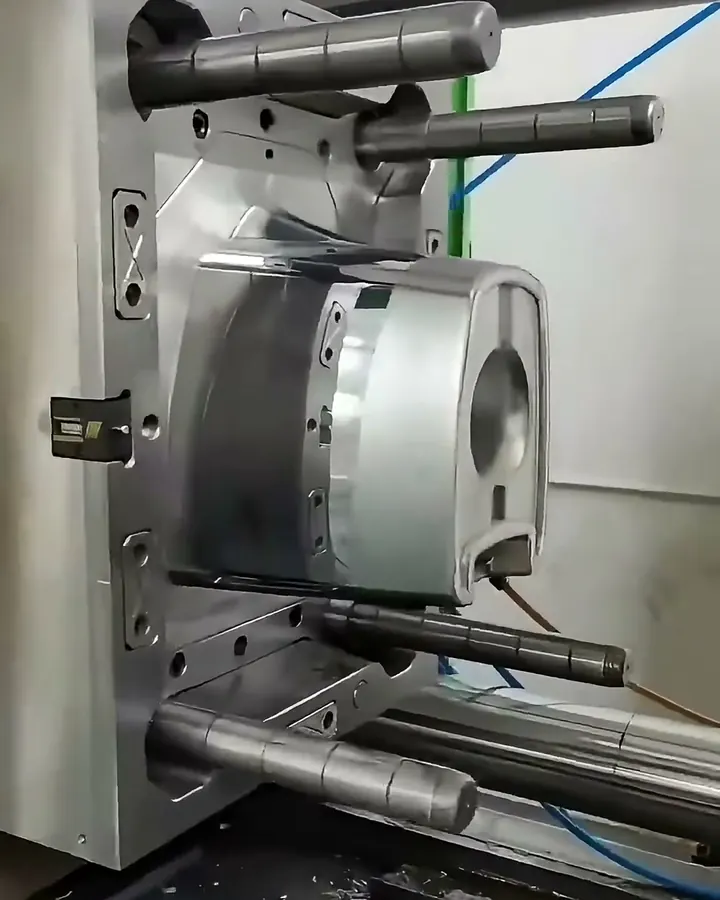
Worked example: one 100 mm housing, three resins
Take a hypothetical handheld housing half, 100 mm long, with a 2.0 mm main wall, two snap-fits, and a requirement to survive a drop in cold weather.
Dimensions. Say the cavity is cut for ABS at an assumed 0.6% shrink, inside the maker's usual 0.7% maximum: 100 × 1.006 = 100.6 mm long. Run polycarbonate in that same cavity at 0.5 to 0.7% and the part comes out about 99.9 to 100.1 mm (100.6 × 0.993 and × 0.995), close to nominal. Run PP homopolymer at 1 to 3% and it comes out about 97.6 to 99.6 mm: up to about 2.4 mm short and very likely warped. That's why a tool is cut for one resin, and why swapping resin after the steel is cut is rarely free. The plastic shrinkage calculator runs this for your own dimensions.
Stiffness. Plate bending stiffness scales with modulus times wall thickness cubed. To make a PP wall as stiff as the 2.0 mm ABS wall, you need 2.0 × (2,300 ÷ 1,400)1/3 = 2.0 × 1.18 = about 2.36 mm. Thicker walls cost cycle time and invite sink, so PP housings usually lean on ribs instead.
Cold drop. At −30 °C, the notched Charpy values above are 8 kJ/m² for the ABS grade and 14 kJ/m² for the PC grade. If the drop spec is in a cold environment, PC (or a PC/ABS blend) earns its place.
Material per part. The same volume of PC weighs 1.20 ÷ 0.90 = 1.33 times as much as PP, and about 15% more than ABS. Resin is bought by weight, so density quietly adds to the per-part material bill on top of any difference in resin grade.
Result for this housing: ABS if it's indoors and cosmetic, PC or PC/ABS if the cold-drop spec is real, and PP only if the design is rebuilt around PP's shrink and stiffness, typically with ribs and a flexible snap design. The snap-fit calculator lets you check whether a snap's strain stays inside each resin's limit.
Relative cost, without the price list
Among these three, general-purpose PP and ABS sit in the inexpensive commodity tier, and polycarbonate is an engineering resin that typically costs more per kilogram. PC/ABS blends sit between them and are often used to get most of PC's toughness at lower cost. Three things move the total more than the list price per kilogram: density (PC needs more kilograms for the same part), cycle time (thick PP walls cool slowly), and drying (PC must be dried; PP usually needn't be). Resin prices move with the market, so get a current quote for the actual grade before you decide on cost grounds.
Where each one goes wrong
- ABS outdoors. Its butadiene rubber degrades in sunlight; see UV-resistant plastics for outdoor parts.
- PC and chemicals. Cracks often start at a stressed boss or snap that met a cleaner, lubricant or adhesive. Ask the resin supplier for chemical-resistance data for your exact chemicals.
- PC molded wet. Undried PC can look fine and still be brittle; it must be dried to its datasheet moisture limit.
- PP and tolerances. High, direction-dependent shrink makes tight tolerances harder; check them against what molding can hold before committing.
- PP and decoration. PP is a low-surface-energy plastic, so paints, inks and adhesives struggle to wet it. Expect flame, corona or plasma treatment, an adhesion promoter, or an adhesive made for low-surface-energy plastics; plan for it early.
Pick-list by requirement
- Must be transparent: PC (of these three).
- Living hinge or repeated flexing: PP.
- Contact with acids, bases or many cleaning chemicals: PP first; test PC carefully.
- High-gloss cosmetic housing, painting or plating: ABS.
- Impact in the cold or a higher temperature rating: PC or PC/ABS.
- Lowest weight per part: PP.
- Tight tolerances with minimal warp: ABS or PC.
- Sun exposure: none of the three unprotected; use a UV-stabilized grade or a weatherable resin.
When the answer changes
If none of the three meets the load or heat target, the next step is usually an engineering resin or a glass-filled grade, which the resin selection guide walks through. If the part needs a flame rating, the comparison changes again, because flame-retardant versions of each resin have their own properties and their ratings depend on wall thickness.
Common questions
Is polycarbonate stronger than ABS?
In most ways that matter, yes. In the grades compared here, PC has a higher yield stress (66 versus 45 MPa), similar stiffness, much better heat resistance and better notched impact in the cold. ABS is easier to mold, paint and plate, and costs less. A PC/ABS blend splits the difference.
Why does polypropylene shrink so much more than ABS?
Polypropylene is semicrystalline. As it cools, part of the polymer packs into dense crystals, which pulls the material in much more than amorphous ABS or PC, which simply cool and contract. Crystallization also varies with flow direction and cooling rate, so PP shrinks unevenly and is more prone to warp.
Can a mold built for ABS run polycarbonate?
Sometimes, with care. Their shrinkage ranges overlap, so dimensions may land close. But PC needs higher melt and mold temperatures, needs drying, and can need different venting and gate sizes. The mold builder should confirm steel, cooling and gating suit PC before trying it. Running PP in an ABS mold rarely works.
Which is cheapest: ABS, polycarbonate or polypropylene?
Per kilogram, general-purpose PP and ABS are in the inexpensive commodity tier and PC costs more. Per part, also count density, since PC needs about a third more mass than PP for the same volume, plus cycle time and drying. Get current quotes on the actual grades, because resin prices move.
Which of the three is best for a living hinge?
Polypropylene. Its semicrystalline structure lets a thin, correctly designed hinge flex many times without cracking. ABS and PC hinges crack after limited flexing, so in those resins a hinge is usually a separate pin or a molded-in metal or PP part. Gate location and hinge thickness matter as much as the resin.
Sources
- INEOS Styrolution - Terluran GP-22 product page (properties, predrying, shrinkage)
- Covestro - Makrolon 2407 product data
- LyondellBasell Moplen HP500N technical data sheet (copy hosted by distributor Hongrun Plastics)
- SpecialChem - Shrinkage values of plastics
- Protolabs - Injection molding material selection guide
- 3M - Innovations in bonding to low surface energy surfaces
Send the part file and the quantity you expect to run, and we'll review it before you commit to tooling. NDA first if you want one.
Send a part for reviewBook a 30-minute call