Clamp Force Converter (US tons, metric tons, kN)
A press sold as “200 tons” clamps 1,779 kN if that rating is in short tons (US tons of 2,000 lbf) and 1,961 kN if it is in metric tons of 1,000 kgf, a gap of 182 kN or 10.2 percent, so the number by itself does not tell you which machine you are getting.
Enter a force in any of five units to see it in all of them, or choose “ton, unit not stated” to put both readings side by side. Add the clamp force your part needs and the converter reports whether the press clears it under each reading, with the margin in kN and percent.
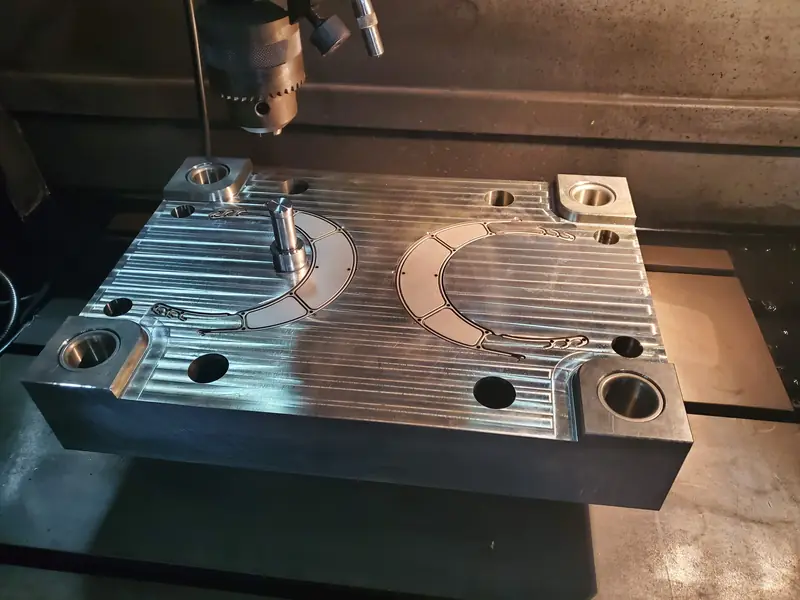
This is unit arithmetic, not a quote. The factors match NIST to the digits it prints; whether a given press suits your mold is still settled by the builder’s specification table and a trial on that machine.
How this works
Force has a single SI unit, the newton, yet the press pages cited below print clamp ratings in kN, short tons and metric tons. The converter turns whatever you type into newtons with factors from NIST Special Publication 811, Appendix B.9, then divides by the factor for each output unit. Every result passes through the same newton value, so the five outputs can never disagree with one another.
Two different tons. A ton-force is the weight of a ton under standard gravity, so it inherits whichever ton the writer had in mind. The short ton is 2,000 pounds, and NIST lists the matching force row, “ton-force (2000 lbf)”, at 8.896 443 kN. The metric ton is exactly 1,000 kilograms in the NIST mass table, and NIST gives the kilogram-force as exactly 9.806 65 N, so a metric ton-force comes to exactly 9.806 65 kN. The Wikipedia ton-force article tabulates both of these plus a third, the long ton-force of 2,240 lbf, roughly 9.964 kN, which none of the press pages cited below uses, though it travels under the same word.
The ratio behind every mix-up. Divide the two factors: 9.80665 ÷ 8.896443 = 1.102311. A metric ton-force is 10.23 percent bigger than a short ton-force, and the short one is 0.907185 of the metric one, 9.28 percent smaller. The difference per ton is 0.910 kN, so it scales with the rating: a 50-ton label hides a 45.5 kN question, and a 1,000-ton label hides one of 910 kN.
Keeping pounds exact. NIST prints the ton-force factor and the pound-force factor (4.448 222 N) to seven figures each, and multiplying the second by 2,000 lands one unit off in the last digit of the first. The converter takes the ton-force factor as printed and defines the pound-force as 1/2,000 of it, 4.4482215 N, so 200 short tons always returns exactly 400,000 lbf. Rounded to seven figures, that pound-force value is the one NIST prints.
Why builders publish different units
A clamp rating is written in the unit system of the builder’s own documentation, and the press pages we read on November 20, 2026 fall into three groups. Some give short-ton ratings only: Amada’s spec table for a press brake cell labels its row “Tonnage (US)” with a value of 146. Some give SI only: Engel’s injection molding machine page says “Our product portfolio ranges from 280 kN to 55,000 kN clamping force,” and Bühler’s Carat page lists “die locking forces of 10500 to 92000 kN.” Others print two columns: Milacron’s C-Series page shows its “Available Tonnage” as “1500-6750 US 1300-6100 METRIC,” and AIDA’s servo press tables give every model in kN and in U.S. tons. In our reading, a metric-ton rating with no kN figure next to it is the easiest to misread, because its unit name is the same word a short-ton reader already uses.
Model names are not ratings
AIDA’s DSF-M2 page heads one machine “DSF-M2-3150, 315 Ton Servo Press”, and its specification table lists that model at 3,150 kN and 347 U.S. ton. Neither 315 nor 347 is the exact conversion: by the NIST factors, 3,150 kN is 354.07 short tons-force and 321.21 metric tons-force. Our reading of the table is that the name is the kN figure divided by 10 and the U.S. ton column is the kN figure times 0.11. Every row of the DSF-M2 table fits that rule, as does every row of the DSF-C1-A table, where 2,000 kN is listed as 220 U.S. ton. Since the exact factor is 0.112404, that column sits 2.1 percent under the NIST conversion, which errs in the buyer’s favor. The Milacron range shows a related pattern. Its top end converts cleanly (6,750 short tons is 6,123 metric tons, printed as 6,100) while its bottom end does not (1,500 short tons is 1,361 metric tons, printed as 1,300), which, in our reading, points to model sizes named separately in each unit rather than one list converted.
The same arithmetic disposes of a common shortcut, “one ton is about 10 kN.” Applied to metric tons it understates the true count by 1.9 percent, close enough for conversation. Applied to short tons it understates the count by 11 percent.
Worked example: three cases by hand
Case 2 starts from the result of our injection molding tonnage calculator, whose worked example ends at 182.9 US tons of required clamp with a 10 percent margin already included. A molder then offers a press listed only as “180.” Press Run the 180-ton check to reproduce case 2 above.
Case 2 is the reason this converter exists. One printed “180” passes with 8.5 percent to spare or misses by 1.6 percent, and the deciding fact is a unit nobody wrote down. Case 3 shows the opposite risk: a careful table can still carry two different “ton” numbers for one machine, and only the kN line is unambiguous.
Common mistakes
- Comparing two quotes by model name. AIDA’s “315” is 3,150 kN, while a press rated 350 short tons is 3,113.76 kN, so here the smaller name is the stronger machine. Put both on kN from their spec tables first.
- Converting with the wrong ton. A requirement worked out in short tons and checked against a metric rating, or the reverse, carries a 10.2 percent error. That is roughly the 10 percent margin in our injection molding calculator’s example, so the mix-up can quietly spend all of it.
- Multiplying short tons by 10 to get kN. 200 short tons becomes 2,000 kN instead of 1,779.29 kN, overstating the press by 12.4 percent, which is the direction that hides a shortfall.
- Writing kg or lb where kgf or lbf is meant. A sheet quoting “50,000 kg” of clamp means 50,000 kgf, which is 490.33 kN. Keep the f so mass and force never end up in the same sum.
- Forgetting the long ton. A bare “ton” can also be the long ton-force of 2,240 lbf: 12 percent above the short ton and 1.6 percent above the metric one.
Converter, spec table or calculator: which to reach for
| Approach | Use it for | Limit |
|---|---|---|
| This converter | Press lists, quotes and spec sheets in mixed units; checking a rating against a calculated requirement | Converts what is printed; cannot tell which ton an unlabeled sheet meant |
| Builder’s specification table | The binding force figure for one specific model | Units vary by builder, and model names are rounded |
| Our tonnage calculators | Working out the force a part or process needs in the first place | Each reports in its own units; bring the result here to compare |
| Written confirmation from the builder or molder | Settling an unlabeled “ton” for good | Needs a reply before the press is booked |
Sources for the factors and press examples
The ton-force (2000 lbf), pound-force and kilogram-force factors, the metric ton of exactly 1,000 kg and standard gravity of 9.806 65 m/s² are from NIST SP 811 Appendix B.9. The metric ton-force of 1,000 kgf and the long ton-force of 2,240 lbf are from the Wikipedia ton-force article. Builder unit statements are quoted from Milacron C-Series, Engel injection molding machines, Bühler Carat, AIDA DSF-M2, AIDA DSF-C1-A and the Amada press brake cell spec table. All were read on November 20, 2026. The 0.11 pattern in the AIDA tables and the Milacron rounding are our own arithmetic on the printed figures.
Reviewed by the JCH tooling team · updated November 2026.
Ton-force questions we get
Is a 200-ton press US tons or metric?
The label alone cannot settle it. Taken as short tons, the machine delivers about 1,779 kilonewtons; taken as metric tons, about 1,961, roughly a tenth more. Look for a kN entry or an explicit unit word on the maker's data sheet, and if neither is printed, ask for written confirmation of the unit before a mold is sized against that press.
How many kN is one ton of clamp force?
It depends which ton. A short ton-force, the weight of 2,000 pounds, is 8.896443 kN by the NIST SP 811 factor. A metric ton-force, the weight of 1,000 kilograms, is exactly 9.80665 kN. Turned around, one kilonewton is about 0.1124 short ton or 0.1020 metric ton.
Why is a metric ton-force about 10 percent bigger than a short ton-force?
Because the underlying masses differ. A metric ton is 1,000 kilograms, close to 2,204.6 pounds, whereas a short ton is defined as 2,000 pounds. Both forces assume the same standard gravity, so their ratio simply equals the mass ratio, about 1.1023.
Which press builders rate clamp force in kN?
It varies by maker rather than by process. On the pages we checked, Engel injection machines and Bühler die casting machines appear only in kN, an Amada press brake table uses US tons, and Milacron and AIDA print two units. Take the figure for the exact model you are being quoted, straight from its data sheet.
What does a model name like 315 Ton tell me about the force?
Very little on its own. AIDA calls its DSF-M2-3150 a 315-ton press, yet the table beside it shows 3,150 kN, which works out to about 354 short tons or 321 metric tons. In both AIDA tables we read, the name tracks kN divided by 10 (our reading), so compare the kN entry instead.
Is a kilogram-force the same as a kilogram?
No. The kilogram measures mass, while a kilogram-force is the pull of standard gravity on one kilogram, exactly 9.80665 newtons. When a clamp spec quotes kg or lb, it means kgf or lbf, and this converter treats both of those inputs as forces.
Can press brake and stamping tonnage be converted the same way?
Yes. A ton-force is the same unit whether the machine holds a mold closed, bends sheet or punches out a blank; only the maker's choice of ton changes. Bring the required force over from the press brake or stamping calculator and test it here against each machine's printed figure.
Ask JCH about press ratings
Holding a press list in mixed units, or a spec sheet that only says “tons”? Type your question here and it goes to Ask JCH, the site’s AI assistant, together with your latest conversion. Replies are written by software, so check any figure that matters against the builder’s own table.
Machine-written replies; confirm before relying on one. None of them is a quote.
Comparing presses across quotes in different units?
Send us the press lists you have been given. Our tooling team can put every rating on one kN basis, check each against the clamp force your mold needs, and point out any line where the unit is missing, before a machine is picked for your tool.
Book a free 30-minute first consultation Send a drawing or press list