When do I need PEEK, PEI (Ultem), PPS or LCP instead of a common resin, and what does it change in tooling and molding?
Step up to PEEK, PEI, PPS or LCP only when you can name what PC, glass-filled PA66 and PPA fail: long-term heat beyond their RTI, V-0 at a thin wall, hot chemicals or steam, or walls too thin to fill. The mold changes too: 135 to 200 °C steel (except LCP), oil or electric heating, hardened steel and shallow vents.
Start from a requirement, not a resin name
PEEK, PEI, PPS and LCP get grouped as "high-temperature plastics", but they are four different materials that fail in four different ways. PEEK (Victrex 450G) is semicrystalline, melts at 343 °C and has a glass transition at about 143 to 150 °C. PEI (SABIC's Ultem 1000) is amorphous and transparent, with a glass transition of 217 °C. PPS is semicrystalline, melts at about 280 °C and is nearly always sold filled; Celanese's Fortron 1140L4 carries 40% glass and lists a glass transition of only 90 °C. LCP (liquid crystal polymer) has rod-like molecules that line up in the flow direction as the melt fills the cavity, which is why it flows so easily and shrinks so little along the flow; Celanese's Vectra E130i is a 30% glass grade that melts at about 335 °C.
Many parts that "need a high-temperature plastic" don't. A heat-stabilized glass-filled PA66 covers a lot of hot, loaded service in a 70 to 120 °C mold, and PPA reaches further. Protolabs' materials guide describes PEI as expensive and needing high processing temperatures, and says PPA itself is more expensive than ordinary nylons. The step up to one of the four is justified when you can name the requirement the common resin fails:
- Long-term heat above the common resin's long-term rating (its RTI, below), not just above its heat deflection temperature.
- A flame class at a thin wall without flame-retardant additives. Ultem 1000 is listed V-0 at 0.75 mm and thicker, Fortron 1140L4 V-0 at 0.38 mm, and Vectra E130i V-0 at 0.2 mm. The standard PC, PA66-GF30 and PPA grades compared here are HB. See UL 94 flame ratings for what those classes mean and how to read a yellow card.
- Hot chemicals, steam or hydrolysis that soften or crack nylon and polycarbonate.
- Very thin walls or very stable dimensions: connector walls under about 0.5 mm, near-zero water uptake, or tight tolerances that must hold when hot.
Three heat numbers, three different questions
Heat deflection temperature (HDT) is a short test: the temperature at which a loaded bar bends a set amount, here at 1.8 MPa. Glass fiber lifts the HDT of a semicrystalline resin almost to its melting point, so Zytel 70G30HSLR (PA66 with 30% glass) shows 253 °C even though its glass transition, dry, is 75 °C. Unfilled PEEK goes the other way: 152 °C HDT, because it is measured just above its glass transition, yet its long-term ratings (260 °C electrical, 240 °C mechanical) top this group, matched only by LCP's 240 °C. Victrex lists its flexural strength falling to 19 MPa at 175 °C, against 125 to 165 MPa at room temperature, so above about 150 °C unfilled PEEK is for light loads; glass- or carbon-filled PEEK grades are the usual answer for structure.
The relative temperature index (RTI) under UL 746B is the long-term aging rating, given separately for electrical properties, mechanical properties with impact, and mechanical properties without impact, and it often depends on thickness. For continuous service, compare RTI first, then use HDT to check short peaks under load. The HDT lookup tool covers the short-term side for common resins.
The chart makes the tooling point before any text does. Polycarbonate and glass-filled nylon run in molds around 70 to 120 °C. The PA66 band here is DuPont's general range for its reinforced PA66 grades, with 100 °C preferred. PPA, PEI and PPS want 135 to 165 °C at the steel, and PEEK 170 to 200 °C. LCP is the exception, at 80 to 120 °C for Vectra E130i.
Seven grades side by side
| Grade (maker datasheet) | HDT 1.8 MPa | RTI: electrical / mech. without impact / with impact | UL 94, as the maker lists it | Water uptake | Notched Charpy, 23 °C |
|---|---|---|---|---|---|
| PC, Lexan 141R | 125 °C | 130 / 125 / 125 °C | HB at 0.7 and 3 mm | 0.35% saturated | 73 kJ/m² |
| PA66-GF30, Zytel 70G30HSLR | 253 °C | not on the sheet cited | HB at 0.8 and 1.5 mm | 1.9% in humid air; 6% in water | not cited |
| PPA-GF35, Zytel HTN51G35HSL | 264 °C | 150 / 130 to 150 / 125 to 130 °C (0.85 to 3 mm) | HB at 0.85 to 3 mm | 4.5% saturated | not cited |
| PEI, Ultem 1000 | 201 °C | 170 / 170 / 170 °C | V-0 ≥0.75 mm; 5VA ≥3 mm | 1.25% at equilibrium | not cited (notched Izod 53 J/m) |
| PPS-GF40, Fortron 1140L4 | 270 °C | not on the sheet cited | V-0 at 0.38 and 1.5 mm; 5VA 3 mm | 0.02% saturated | 10 kJ/m² |
| LCP-GF30, Vectra E130i | 270 °C | electrical 240, mechanical 240 °C, at 0.75 mm | V-0 at 0.2 mm | 0.03% at 50% RH | not cited |
| PEEK unfilled, Victrex 450G | 152 °C | 260 / 240 / 180 °C | none listed (oxygen index 35% at 3.2 mm) | 0.45% saturated | 7.0 kJ/m² |
Two columns deserve a second look. The impact column shows the trade-off for heat resistance: the polycarbonate's notched Charpy is 73 kJ/m², the glass-filled PPS 10 and the unfilled PEEK 7.0. And PEEK's own ratings drop from 240 °C without impact to 180 °C with impact, so a part that gets knocked about at temperature is rated well below the headline number. Victrex's processing guide quotes continuous use temperatures of 260 °C, which matches the electrical RTI, not the mechanical ones.
What each family is good at, and where it fails
PEEK
Good at: the highest electrical RTI here (260 °C), a mechanical RTI matched only by LCP, wear, and chemistry. Victrex's chemical resistance chart rates water and steam A at 23, 100 and 200 °C, and 50% sodium hydroxide A at 23 and 100 °C, and its guide says PEEK does not hydrolyse in water, steam or sea water. Fails: the same chart marks sulfuric acid above 40%, nitric acid at 50% and stronger, 40% hydrofluoric acid and aqua regia with a C at every temperature listed. It is also notch-sensitive and loses stiffness above its glass transition, as shown above.
PEI (Ultem)
Good at: strength and stiffness that hold almost to its 217 °C glass transition (110 MPa tensile yield, 201 °C HDT unfilled), transparency, inherent flame resistance, and low, fairly predictable shrinkage of 0.5 to 0.7% in the flow direction. Fails: chemistry. SABIC's own comparison table scores Ultem 1 out of 10 for inorganic bases, 3 for chlorinated hydrocarbons and 3 for aromatic hydrocarbons, against 10 for alcohols and aliphatic hydrocarbons. Being amorphous, it has no crystalline structure to carry load above its glass transition.
PPS
Good at: hot chemical service, near-zero water uptake, and stiffness. Celanese lists pumps, valves, fuel rails, automotive heaters and lamp housings as uses for Fortron 1140L4. Fails: toughness. The 40% glass grade breaks at about 1.9% elongation, and Solvay's Ryton design guide warns PPS compounds are notch sensitive and calls for a fillet radius of 0.6 times the wall. Its weld lines are weak because glass fiber does not cross the weld, leaving a resin-rich seam.
LCP
Good at: thin walls and tiny features. Celanese describes Vectra E130i as having the "easiest flow", suitable where very thin walls are required, and used for surface-mount electronics. Its flow-direction shrinkage is 0.10% and its thermal expansion along the flow about 7 ppm/°C (3.9 × 10⁻⁶ per °F). An LCP maker's engineer, writing in Machine Design for Sumika, says LCP resists stress cracking in aromatic and halogenated hydrocarbons, strong acids, bases and ketones, and is stable in boiling water. Fails: high-temperature steam, concentrated sulfuric acid and boiling caustic, per the same article; weld lines, which are weaker than in most engineering plastics; and anisotropy. Across the flow, E130i shrinks 0.40% and expands about 20 ppm/°C, four and nearly three times the flow-direction values.
When a common resin is enough
| Requirement | Try first | Step up when |
|---|---|---|
| Warm housing, impact matters, no flame class | PC (RTI 125 to 130 °C) | Service runs past PC's RTI: PEI (RTI 170 °C) keeps clarity |
| Hot, loaded bracket in oil or air | Heat-stabilized PA66-GF30 (HDT 253 °C) | Moisture growth or stiffness loss above its 75 °C glass transition matters: PPA (glass transition 140 °C) or PPS |
| Hot water | Hydrolysis-resistant PA66-GF grade | Sustained high-temperature steam: PEEK, not LCP. Long hot-water service: PEEK or a PPS grade the maker rates for hot water |
| V-0 at walls under 0.75 mm | A flame-retardant nylon grade, if its yellow card covers your wall | If it doesn't: PPS (0.38 mm) or LCP (0.2 mm) |
| Fine-pitch connector, solder heat | PPS (V-0 at 0.38 mm) | Walls too thin to fill, or dimensions must not move: LCP |
| Chlorinated solvents or strong bases | Not PEI | PPS or PEEK, checked against the maker's chart for the actual chemical and temperature |
| Long service near 200 °C or above, with wear or sterilization | Nothing else in this set | PEEK, usually a filled grade for load |
Start the shortlist with the plastic material selector and the resin selection guide; both cover the common resins you should rule out before reaching for these four.
What changes in the mold
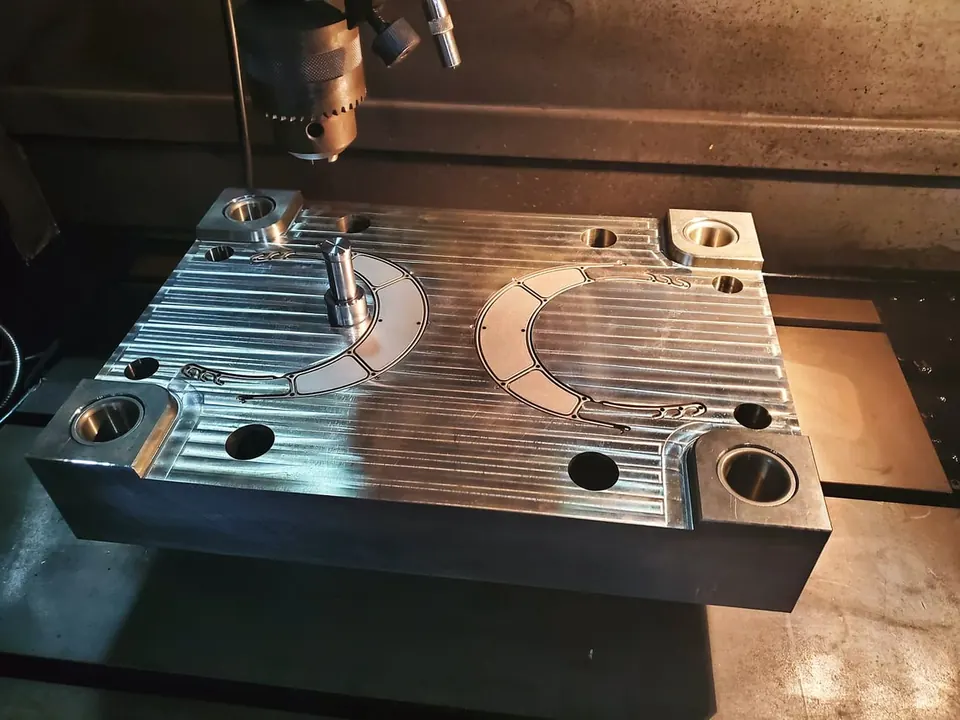
- The tool is heated, not cooled. Victrex says a tool surface of at least 170 °C is needed for PEEK to reach its normal crystallinity, and that molds may be heated electrically or with oil; pressurized water is uncommon at these temperatures because of the pressures involved and the safety concerns. Electric heaters are simple but prone to hot spots and suit small tools. Oil can also pull heat out of large shots and deep cores. Victrex strongly advises insulation boards between mold and platen, and warns that losses of as much as 40 °C in oil lines are common, so a heater set at 200 °C can leave the steel at about 160 °C, below the minimum. Measure the steel, not the controller. DuPont likewise recommends insulating plates between mold and press, and insulating the outside walls of large molds run above 100 °C. Mold cooling and conformal cooling covers channel layout, which matters just as much when the fluid is hot.
- Too cold a mold makes parts that pass inspection and fail later. Solvay says to run Ryton PPS either at or above 135 °C or below 82 °C, never between, because dimensions vary there, and that cold-molded PPS crystallizes and shrinks considerably if later held above 204 °C for extended periods. Parts for hot service must be molded hot.
- Hardened steel. Victrex recommends 52 to 56 HRC tooling, typically H13 hardened to 54 to 56 HRC, with D3 or D6 steels at 56 to 60 HRC for long runs of glass- or carbon-filled grades, and P20 for prototypes and short runs, or as the bolster around an H13 cavity and core. Solvay recommends A2, D2 or D7 hardened to HRC 60 or more for long-run PPS molds, with replaceable D2 gate blocks because wear concentrates at the gate. For glass-filled LCP, Sumika specifies HRC 55 to 62 and notes LCP gives off almost no corrosive gas, so no special corrosion-resistant steel is needed. Solvay also warns that aluminum tools are harder to heat evenly. See engineering-grade and glass-filled resins on abrasion, aluminum vs steel tooling, and the mold steel selector.
- Vents sized to the melt. Low-viscosity melts flash into gaps a stiffer melt would ignore. Solvay's PPS vents are 0.0076 to 0.0127 mm deep and 6.4 mm wide with a 0.8 to 1.6 mm land, plus vented runners and vacuum venting for blind pockets. Victrex gives 8 µm for its easy-flow PEEK 90G and 10 to 15 µm for standard grades. SABIC lists 0.025 to 0.076 mm for Ultem 1000. Poor venting burns parts and, Solvay adds, speeds up mold wear. More in venting injection molds and the vent depth guide.
- Gates and weld lines. Victrex wants PEEK gates of at least 1 mm unfilled and 2 mm for compounds, or two-thirds of the wall for thick parts, kept as large as possible to feed shrinkage. For LCP, Sumika limits gates to one or two locations because weld strength is low, and puts pin gates at 0.3 to 1.5 mm. Weld lines and knit lines explains placement.
- Drying and barrel. All four must be dried, even PPS and LCP, which take up almost no water: PEEK 450G at 150 °C for 3 h or 120 °C for 5 h, to under 0.02%; Ultem 1000 at 150 °C for 4 to 6 h, to 0.02%, with no more than 24 h total in the dryer; Fortron 1140L4 at 130 to 140 °C for 3 to 4 h, to 0.02%; Vectra E130i at 150 to 170 °C for 4 to 6 h, to 0.01%. PEEK needs a barrel that holds 400 °C and a clean purge, because contamination from other polymers shows up as black specks. See drying hygroscopic resins and the resin drying calculator.
Worked example: a 150 °C sensor bracket
Take a hypothetical bracket that sits at 150 °C continuously, carries a light screw clamp load, has 1.5 mm walls with a 0.8 mm stiffening rib, and must be V-0. The 40.00 mm hole spacing is critical.
Step 1, long-term heat. Compare mechanical RTI with 150 °C. PC: 125 − 150 = −25 °C, out. PPA at 1.5 mm: 140 − 150 = −10 °C, out (it reaches 150 °C only at 3 mm, with no margin). PA66-GF30: no RTI on the sheet cited, and it is HB anyway. PEI: 170 − 150 = +20 °C. LCP: 240 − 150 = +90 °C (rating listed at 0.75 mm). PEEK: 240 − 150 = +90 °C. PPS: read the RTI off the grade's yellow card before going further.
Step 2, flame at the thinnest wall. The 0.8 mm rib governs. PEI's V-0 starts at 0.75 mm, so 0.8 mm passes with only 0.05 mm to spare; thinning the rib later would break the rating. PPS passes at 0.38 mm and LCP at 0.2 mm. The 450G sheet lists no UL 94 class, so PEEK would need a grade whose listing covers 0.8 mm.
Step 3, short peaks. HDT minus service: PEI 201 − 150 = 51 °C, PPS and LCP 270 − 150 = 120 °C.
Step 4, cavity size. Cavity = part × (1 + shrinkage). PEI at 0.5 to 0.7%: 40 × 1.005 = 40.20 mm to 40 × 1.007 = 40.28 mm, a 0.08 mm spread from the datasheet range alone. PPS-GF40 along the flow at 0.20 to 0.60%: 40.08 to 40.24 mm. LCP along the flow at 0.10%: 40.04 mm, but across the flow at 0.40%: 40.16 mm, so the cavity depends on which way the hole spacing lies relative to the gate. Along the flow, the PEI and LCP cavities differ by 0.16 to 0.24 mm on the same dimension. A tool cut for one will not hold this tolerance with another, and Victrex's advice for PEEK, which applies equally here, is to cut the tool on the metal-safe side. The shrinkage calculator repeats this for your part.
Step 5, what the choice does to the tool. PEI: 135 to 165 °C oil or electric heating, insulated plates, a dryer run of 4 to 6 h at 150 °C. PPS: 140 to 160 °C, HRC 60 class steel if the 40% glass grade runs long, shallow vents, generous fillets. LCP: 80 to 120 °C, one or two gates placed so the weld lines that form behind the holes land away from the clamp load.
Result: PEI passes, but with a 20 °C RTI margin and a flame rating that leaves no room to thin the rib. LCP, and PPS once its RTI is confirmed, give far more margin; if the bracket also sees hot water or solvents, PPS has the stronger case. PEEK clears the heat test easily but would need a grade with a flame listing at 0.8 mm, and most of its extra capability would go unused.
Part design notes
- Keep walls uniform. Solvay's rules for PPS: wall changes no more than 40% of the thickest wall, inside corner radius 0.6 times the wall, ribs 0.6 times the wall and no taller than three times it, and most walls under 9.52 mm. See wall thickness for molded parts.
- Draft: Solvay asks for at least 1/4° per side on cavities 4.76 mm deep or less, rising to 2° as depth reaches 25 to 50 mm, and warns that undercuts wear fast in a stiff PPS part. Sumika suggests 0.5 to 1° for thin-walled LCP and 1 to 2° for thick.
- For LCP, Sumika advises designing small or thin parts with zero shrinkage along the flow, and keeping weld lines away from load.
- Preheat metal inserts to mold temperature for PEEK; Victrex says cold inserts leave low-crystallinity material around them and raise the risk of stress cracking.
- Tolerances: Victrex quotes about 0.05% as typical for PEEK. Solvay quotes 0.1% for small to medium PPS parts and 0.2% for larger ones. Compare with typical molding tolerances.
Checklist before you specify one of the four
- State the continuous service temperature and the peak, with how long the peak lasts.
- Find the RTI that matches your failure mode (electrical, mechanical with or without impact) at your wall thickness, on the yellow card for the exact grade and color.
- Find the flame class at your thinnest wall, not the nominal one.
- List chemicals by name, concentration and temperature, and check them on the maker's chart.
- Rule out PC, heat-stabilized PA66-GF and PPA in writing, with the line that fails.
- Agree the tool's heating method, steel hardness, vent depth and dryer capacity before steel is ordered.
Common questions
Is Ultem the same as PEI?
Ultem is SABIC's trade name for polyetherimide (PEI). Ultem 1000 is the unfilled, transparent general-purpose grade, with a 217 °C glass transition and V-0 listed at 0.75 mm and thicker. Other Ultem grades add glass or change the chemistry, so properties, shrinkage and flame listings differ. Put the full grade number on the drawing, not just the word Ultem.
Can a PEEK mold be heated with water like an ordinary tool?
Rarely. Victrex calls for at least 170 °C at the tool surface and says PEEK molds are usually heated with electric heaters or oil; pressurized water is uncommon at those temperatures because of the pressures and safety concerns involved. The mold also needs insulation boards against the platens, and the temperature should be checked at the steel.
Is PPS too brittle for snap-fits?
Usually, in the common glass-filled grades. Fortron 1140L4 breaks at about 1.9% elongation and has a notched Charpy value of 10 kJ/m², against 73 for a general-purpose polycarbonate. Solvay calls PPS compounds notch sensitive and asks for fillets of 0.6 times the wall. Use screws, heat staking or ultrasonic welding instead, or test a tougher grade.
Can one mold run both PPS and LCP?
Not to tight tolerances. Fortron 1140L4 shrinks 0.20 to 0.60% along the flow, while Vectra E130i shrinks 0.10% along and 0.40% across it. The mold temperatures differ too, 140 to 160 °C against 80 to 120 °C, and LCP's weak weld lines may need different gating. Changing resin after the steel is cut usually means rework.
Which of the four handles steam and hot water best?
PEEK, on the makers' own data. Victrex rates PEEK A for steam and water at 23, 100 and 200 °C and says it does not hydrolyse. Sumika notes LCP is stable in boiling water but deteriorates in high-temperature steam. For PPS, choose a grade the maker recommends for hot water; Solvay names hot-water resistance as a selection factor among its Ryton grades.
Sources
- Victrex - Injection Molding Processing Guide (PEEK)
- Victrex - VICTREX PEEK 450G datasheet (copy hosted by Protolabs)
- Victrex - VICTREX PEEK chemical resistance chart
- SABIC - ULTEM resin 1000 technical data sheet (copy hosted by Protolabs)
- SABIC - ULTEM resin vs. sulfone polymers, chemical resistance table (copy hosted by distributor Nagase)
- Celanese - Fortron 1140L4 PPS technical data (UL Prospector copy hosted by Protolabs)
- Solvay - Ryton PPS Design Guide (copy hosted by Drake Plastics)
- Celanese - Vectra E130i LCP technical data (UL Prospector copy hosted by Protolabs)
- Machine Design - Injection-Molding Liquid-Crystal Polymers (authored by Sumika Electronic Materials)
- SABIC - LEXAN resin 141R technical data sheet (copy hosted by Plasticker)
- DuPont - Zytel 70G30HSLR BK099 CAMPUS datasheet (copy hosted by Protolabs)
- DuPont - Zytel HTN51G35HSL NC010 PPA datasheet (IDES copy hosted by Protolabs)
- DuPont - Zytel and Minlon nylon molding guide
- Protolabs - Material alternatives for plastic injection molding
Send the part file and the quantity you expect to run, and we'll review it before you commit to tooling. NDA first if you want one.
Send a part for reviewBook a 30-minute call