How are molded plastic parts plated, painted or vacuum metallized?
Electroplated chrome needs plating-grade ABS or PC/ABS: the plater etches rubber particles out of its surface, leaving tiny pits the metal locks into. Paint needs a surface it can wet, so polypropylene gets flame, plasma or an adhesion promoter first. Vacuum metallizing puts a very thin metal film between lacquer coats. Each choice changes the resin grade, part geometry and mold polish.
Three finishes, three ways of holding on
Each finish grips the plastic differently, and that drives the resin, the geometry and the mold. Electroplate holds by mechanical interlock: the plater etches microscopic pits into the surface and the first metal layer grows into them. Paint has to wet the surface before it can bond, so surface energy matters more than strength. A vacuum-deposited film is far thinner than either and relies on a lacquer base coat for adhesion and smoothness. Settle the finish first, then the resin grade, the geometry and the steel polish; the other order is how tools get re-polished after first samples.
| Finish | What you see | How it holds up | Resins it suits | What the part needs |
|---|---|---|---|---|
| Electroplated copper, nickel, chrome | Real metal: bright, satin or black chrome, nickel, brass or gold | Thickest of the four, tens of micrometers of metal; a much harder surface than the bare plastic. Fails by blistering, poor adhesion or cracking in hot-cold cycles | ABS and PC/ABS plate easily. PP, PEI, PEEK and PPA need special etchants or compounded grades. PE, PVC and PBT generally won't plate | Rounded edges, shapes that drain, no small blind holes, rack tabs, gate and parting line off the show face |
| Spray paint, including soft-touch | Any color or gloss, metallic-flake paint, or a velvet soft feel | Set by the primer and topcoat. Soft-touch coatings can be softened by hand cream and sunscreen | ABS, PC and PC/ABS with a solvent system the resin tolerates. PP and PE only after flame, plasma or an adhesion promoter | Spray access to every visible face, defined mask lines, no silicone mold release |
| Vacuum metallizing (evaporated aluminum) | Mirror-bright metal under a clear top coat | Metal film about 0.2 to 0.5 µm. The top coat supplies the chemical, moisture and wear resistance | Wide range, because the base coat carries the adhesion and is matched to the plastic | Faces the source can see, fixture points, a show face smooth enough for a very thin film |
| Sputtered PVD | A thin metal film, used where better film adhesion is wanted | Still a thin film behind a top coat; sputtered films adhere to plastic better than evaporated ones | As for metallizing, with coats matched to the resin | Same line-of-sight and fixturing limits as metallizing |
Why chrome sticks only to certain resins
ABS is a terpolymer: rubbery polybutadiene particles spread through a stiffer styrene-acrylonitrile matrix. The conventional pre-plate etch is a hot chromic-sulfuric acid bath. One published make-up is 375 to 425 g/L chromium trioxide with 180 to 220 mL/L sulfuric acid, run at 50 to 65 °C. It attacks the butadiene at the surface much faster than the matrix and leaves a skin full of microscopic holes. The part is then neutralized, seeded with a palladium-tin catalyst and given an electroless strike of copper or nickel, typically 0.5 to 1 µm, which is the first conductive film the electroplating can build on. Because the bond is mechanical, anything that changes the surface skin, such as stress, moisture or contamination, changes adhesion.
That is why resin makers sell plating grades. INEOS Styrolution, for example, lists Novodur P2MC as an electroplating grade for parts like shower heads, and PC/ABS blends carry plating designations too. A Metal Finishing review of plateable resins puts ABS and PC/ABS at the easy end, with bond strength often above 5 lb per inch of width. More chemically resistant resins need harsher etching or specially compounded grades, PPS needs grit blasting, and polyethylene, PVC and PBT generally won't plate. Ask the plater which grades their etch line is set up to run.
After the strike, the decorative stack is built electrolytically. Acid copper goes on first, typically 12 to 25 µm. It is ductile, it levels the etched surface, and it buffers the stress between the plastic and the harder nickel above it. Nickel follows, then a chromium layer of about 0.3 µm. Providence Metallizing cites ISO 4525 grades running up to 15 µm copper plus 30 µm nickel plus 0.3 µm chromium for demanding decorative work. ASTM B604 is the matching ASTM specification for copper-nickel-chromium on plastics, with grades keyed to how severe the service is and with thermal cycling among the properties it tests.
Painting: the surface has to wet first
A liquid spreads on a surface whose energy is higher than its own surface tension and beads up on one that is lower. Peter Prentice of PolyTech Consultants gives the working rule: the plastic should sit 7 to 10 dynes/cm above the surface tension of the ink or coating. Untreated polypropylene and polyethylene usually measure 30 to 32 dynes/cm, which leaves most coatings nothing to hold on to.
There are three standard fixes. Flame treatment and atmospheric plasma both oxidize the outermost layer and add polar groups. In Enercon's tests, flame raised PP from 29.7 to 44.6 mJ/m² and blown-ion air plasma took it to 49.6. An SPE Plastics Engineering report on plasma-treated PP bumpers found that once surface energy passed 45 mN/m, the parts passed automotive durability tests without primer. The third fix is a chlorinated polyolefin (CPO) adhesion promoter sprayed under the paint; in one PCI study the dried promoter film was about 10 to 15 µm. Treatment does not keep: Prentice notes that the gain from corona treatment can disappear in storage, so the treatment is scheduled close to painting and checked with dyne pens on the day.
Dyne check, worked through. Say the coating's data sheet gives a surface tension of 30 dynes/cm, the same figure Prentice uses in his own example. The 7-to-10 rule then asks for 37 to 40 on the part. Untreated PP at 29.7 falls 7.3 to 10.3 short. Flame-treated PP at 44.6 clears the top of the band by 4.6, and air plasma at 49.6 clears it by 9.6. Because treatment fades, the dyne check belongs at the paint line, not only at first article.
ABS, PC and PC/ABS have different problems. Strong solvents in a paint can craze a PC part that carries molded-in stress, and silicone release agent on the surface spoils adhesion for paint and plating alike.
Soft-touch paint is its own case. It is usually a two-component polyurethane with a soft binder and matting particles in the micrometer range; the study below sprayed it over PC/ABS. Its weak point is what's on people's hands. In a Bayer MaterialScience study in PCI, hand creams and sun-tan lotions softened the coatings, and none of the formulations passed the sunscreen and insect-repellent test. Put those chemicals in the test plan.
Vacuum metallizing and PVD: thin metal, lacquer on both sides
Vacuum metallizing evaporates a low-melting metal, usually aluminum, inside a chamber pumped down to vacuum, with the parts rotating on fixtures in front of the source so the coat comes out even. The film is very thin. Providence Metallizing puts vacuum coatings at 0.2 to 0.5 µm against up to 60 µm for wet plating. A film that thin hides nothing, so the base coat does two jobs: it levels small surface imperfections into a mirror and it promotes adhesion to the plastic. The top coat over the metal supplies chemical, moisture and wear resistance. Sputtering, the other common PVD route, knocks metal off a target with a high-voltage discharge instead of boiling it off, and WayKen notes that sputtered films adhere to plastic better than evaporated ones.
Metallizing and PVD reach resins that won't take electroplate, add almost no thickness and skip the wet etch. They also leave durability to the top coat, so abrasion, chemical and humidity tests matter more than with heavy plate, and deep recesses facing away from the source get less metal.
Worked example: what plate thickness does to a fit
Take a hypothetical PC/ABS bezel with a 3.00 mm slot that a metal clip slides into, plated to the heavy grade above: 15 + 30 + 0.3 = 45.3 µm per face. Both slot walls get plated, so the slot closes by 2 × 45.3 = 90.6 µm, to 2.909 mm nominal. Electroplate builds heaviest on edges and outside faces, and Cybershield's Metal Finishing article notes its thickness can exceed 75 µm. At 75 µm per wall the slot ends up at 3.00 − 0.150 = 2.85 mm. So the steel is cut with a plate allowance, or the slot is masked, or the fit is redesigned to live with a 0.15 mm swing.
Worked example: why plated parts crack in hot-cold cycles
Thermal cycling is the classic failure test for plated plastic, and the arithmetic shows why. Novodur P2MC's datasheet lists a linear expansion coefficient of 100 × 10⁻⁶ per °C. The Engineering ToolBox gives nickel 13 × 10⁻⁶ and copper 16 to 16.7 × 10⁻⁶. Put the part through a hypothetical swing from −30 °C to +80 °C, a 110 °C range:
- ABS free strain: 100 × 10⁻⁶ × 110 = 0.0110, or 1.10%
- Nickel free strain: 13 × 10⁻⁶ × 110 = 0.00143, or 0.14%
- Copper free strain: 16.7 × 10⁻⁶ × 110 = 0.00184, or 0.18%
- Mismatch between ABS and nickel: 1.10 − 0.14 = 0.96%
On a 120 mm trim piece, the ABS wants to change length by 120 × 0.0110 = 1.32 mm while the bonded nickel wants 120 × 0.00143 = 0.17 mm. The 1.15 mm difference can't happen freely, so it turns into stress in the metal and shear at the etched interface on every cycle. MacDermid Enthone describes the ductile acid copper as buffering that stress between plastic and nickel, and reports OEMs asking for thicker copper and better thermocycling results. The thermal expansion calculator runs the same numbers for other lengths and temperature ranges.
Part design rules that change
- Edges and corners. Current crowds onto sharp edges, so plate builds up there and can burn. Spencer Electroplating's design guide for ABS and ABS/PC asks for edge radii of at least 0.3 mm, preferably 0.8 mm.
- Large flat faces. The same guide suggests a slight crown, about 0.06 mm per 100 mm, to hide minor waviness that a dead-flat mirror face would show.
- Grooves and slots. Spencer's guide: round the bottoms and keep depth to no more than half the width.
- Blind holes and cups. Trapped solution weeps out later and damages the plate. Cybershield flags small blind holes deeper than 5:1 and five-sided box shapes that trap air; use through-holes or add drain holes. Spencer suggests avoiding blind holes under 5.5 mm in diameter.
- Walls and ribs. Keep sections even. Sharretts Plating suggests walls no thicker than 3.8 mm and ribs rather than thicker walls, and Spencer keeps rib thickness to half the adjacent wall. Proportions like that also keep sink marks off the show face, where bright chrome or a mirror film makes them impossible to miss.
- Rack and fixture points. Sharretts recommends stiff tabs as rack points; they stay unplated. For metallizing and paint, decide where the fixture grips.
- Gate and parting line. Put both on hidden faces. Stress is highest near the gate, and plating exaggerates a parting-line step. Spencer's typical full-round edge gate in a 3.2 mm section is 2.4 to 3.2 mm across. See gate types for the options.
- Inserts. Cybershield's rule: if the plating is over 2.5 µm thick, install inserts before plating and mask the threads with a plug or screw.
What the mold has to deliver
Every finish here copies the molded surface, and the thinner the coating, the less it forgives. The cavity for a plated or metallized show face is normally polished to an SPI A grade. Hubs lists A-1 as a #3 diamond buff, roughly 0.012–0.025 µm Ra, and A-2 a #6 diamond buff at 0.025 to 0.05 µm. Hubs rates ABS only average at A-1 and A-2 and good at A-3, so a mirror cavity alone does not make a mirror part. Call-outs are covered under mold surface finish.
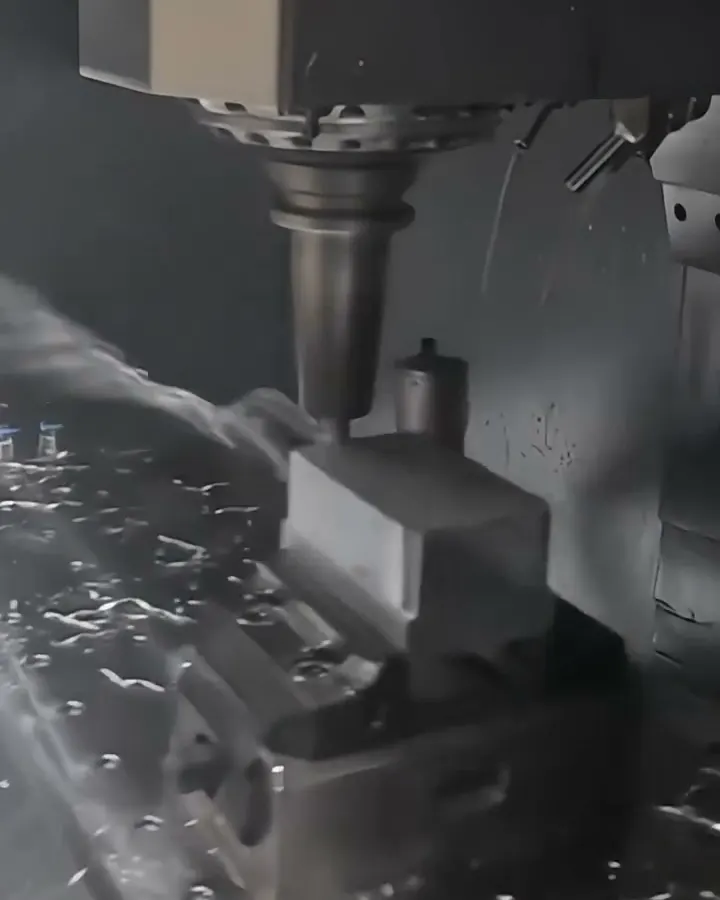
Molding conditions matter as much as the steel. Platers advise higher melt and mold temperatures, longer fill and lower injection pressure to cut surface stress, short barrel residence, dry resin and no silicone release. Spencer gives 60 to 100 °C as the mold temperature range for plating ABS and ABS/PC and asks for a slow fill. The P2MC datasheet calls for drying at 80 °C for 2 to 4 h. Sharretts adds that splay from damp resin may only become visible after the part is plated.
Surface marks from the fill get the same treatment. Flow lines and jetting that pass on a bare textured part will read through bright chrome and a mirror film, and gas trapped at the end of fill leaves dull spots the coating will show, so the last-to-fill areas need vents (the vent depth guide covers sizing). Check weld and knit lines against the show face before freezing the gate.
Tests that tell you something
- Adhesion. A tape test to ASTM D3359. Method B, the cross-cut lattice, is meant for coatings under 125 µm; Method A, the X-cut, for thicker ones. It was developed on metal, so name the method for plastic parts. Ratings run 0 to 5 with no in-between values.
- Molded-in stress, before plating. Dip sample parts in room-temperature glacial acetic acid for a few minutes. Sharretts notes that white spots mark stressed areas that later fail thermal cycle tests.
- Thermal cycling. ASTM B604 tests resistance to thermal cycling for copper-nickel-chromium on plastics, but the cycle itself comes from the buyer's specification. Agree on it before parts are plated.
- Humidity. The PCI adhesion-promoter study held painted samples at 50 °C and 98% relative humidity for 120 h, then repeated the cross-hatch test. That is a reasonable model for painted PP or TPO.
- Thickness. X-ray fluorescence measures plated layers without cutting the part.
- Chemicals. For soft-touch and painted housings, the creams, sunscreens and cleaners the product will meet.
Hexavalent chromium: the fact, not a compliance claim
The traditional ABS etch uses chromic acid, and chromium trioxide is a hexavalent chromium compound. The RoHS Directive lists hexavalent chromium in its Annex II, with a maximum of 0.1% by weight in homogeneous materials. Chromium-free etchants for ABS exist; a paper in Products Finishing describes one that runs at room temperature with the same process sequence as the chromic-sulfuric line. Whether a plated part meets a substance limit depends on the plater's chemistry and on testing the finished part; ask for documentation and test reports. This page makes no compliance claim.
When another decoration is the better answer
- A film molded into the part. In-mold labeling and decorating molds a printed film, protected by a hardcoat, into the part, with no spray or plating line afterwards.
- Metallic color in the resin. Aluminum-flake color gives a metallic look with no coating at all, but conventional flake pigments create visible flow lines. Fraunhofer IAP has developed tetrahedral, non-flake particles specifically to avoid that.
- A metallic logo or trim line. Hot-stamp foil does it without coating the whole part; see pad printing, silk-screen and hot stamping.
- Clear parts. Decoration behind a clear wall is protected by it; clear molded parts covers the resin and tooling side.
Checklist before you ask for quotes
- Name the finish and mark the show faces, with a boundary sample.
- Specify the resin by grade. For electroplate, a plating grade the plater has confirmed.
- For plate, give the layer stack and minimum thickness (ASTM B604, ISO 4525 or your own spec), plus the adhesion and thermal cycle tests.
- For paint on PP or PE, give the pretreatment and the minimum dyne level at the time of painting.
- Check every fit against plate thickness, including build-up on edges.
- Mark rack or fixture points, and keep the gate and parting line off the show face.
- Call out the cavity polish grade for the show face and state no silicone release.
- List the chemicals the finish must survive.
Common questions
Can polypropylene be chrome plated?
It can, but not the way ABS is. The Metal Finishing review of plateable resins lists polypropylene among the difficult resins that need alternative etchants or a grade compounded for plating. For most PP parts that need a metal look, vacuum metallizing over a base coat is the more practical route; for true electroplate, design in plating-grade ABS or PC/ABS.
Is vacuum metallizing as durable as chrome plating?
Usually not, because the metal film is far thinner: about 0.2 to 0.5 µm against up to 60 µm for wet plating, per Providence Metallizing. Its protection comes from the lacquer top coat, so abrasion, chemical and humidity tests decide whether it is good enough. For parts that are gripped or rubbed every day, test metallized samples side by side with plated ones before deciding.
Why did plating blister on some parts and not others?
Blisters often trace back to molding rather than the plating line. Sharretts Plating lists moisture left in the resin, stressed areas near the gate, degraded material from long barrel residence and contamination on the surface. Cutting and peeling a blister shows which layer let go, and an acetic acid dip on unplated parts from the same run shows whether molded-in stress is the cause.
Can a plated part also be painted or labeled?
Yes. Paint, labels and gaskets can all be added after plating, and Cybershield notes that the paint, ink or gasket material is chosen to suit the final metal layer, not the plastic underneath. If only part of the surface should be plated, plan masking, a peelable resist or a two-shot design with a non-plating resin before the tool is built.
Does a plated part need a different mold?
Usually the same type of mold, built with the finish in mind: a polished show face, gates on hidden surfaces and often larger than normal, vents at the end of fill, rack tabs, generous edge radii and plate allowance on tight fits. Gate location and edge radii are hard to change once steel is cut.
Sources
- Products Finishing (Ijeri, Shah, Bane) - Chromium-free etching and palladium-free plating of plastics
- Products Finishing (MacDermid Enthone, Pullara) - Acid copper technologies for plating on plastics
- Providence Metallizing - Plastic electroplating: definition, process and classification
- Metal Finishing (Skelly, Cybershield) - Decorative plating processes for common plastic resins, June 2008
- Cybershield - Plating plastic design guidelines
- Sharretts Plating - Guide to troubleshooting plating onto plastics
- Spencer Electroplating Service - Design, converting and handling techniques for electroplating ABS and ABS/PC alloys (SlideShare)
- INEOS Styrolution - Novodur P2MC electroplating-grade ABS technical datasheet (copy hosted by Plasticker)
- The Engineering ToolBox - Coefficients of linear thermal expansion
- Enercon Industries (Plantier et al.) - Implementing plasma and flame surface treating technologies to improve adhesion
- PolyTech Consultants (Prentice) - Corona discharge and surface energy
- SPE Plastics Engineering - Plasma treatments revolutionize polypropylene bumper paintability (2025)
- PCI Magazine - Waterborne, chlorine-free adhesion promoter for TPO (2005)
- PCI Magazine (Bayer MaterialScience) - The new age of waterborne soft-touch coatings (2008)
- Midwest Tungsten Service - Basecoats for vacuum metallizing
- WayKen - Understanding the vacuum metalizing process and applications
- Hubs - Injection molding SPI surface finishes
- ASTM D3359 - Standard test methods for rating adhesion by tape test
- ASTM B604 - Decorative electroplated coatings of copper plus nickel plus chromium on plastics
- RoHS Directive 2011/65, Annex II restricted substances (legislation.gov.uk copy)
- All-About-Industries (Fraunhofer IAP) - Metallic effect pigments provide flawlessly shiny plastic surfaces
Send the part file and the quantity you expect to run, and we'll review it before you commit to tooling. NDA first if you want one.
Send a part for reviewBook a 30-minute call