Rotational molding vs injection molding: which fits my part?
Pick rotational molding for large, hollow, one-piece parts such as tanks, kayaks and coolers made in thousands a year, where low-pressure molds keep tooling cost down and a wall that varies about 20% is acceptable. Pick injection molding for parts with an open side, thin walls, tight tolerances and high volume. Blow molding covers thin-walled hollow containers in large runs.
Start with the shape, then the numbers
Most parts sort themselves before anyone compares tooling quotes. Ask these in order:
- Is it hollow and closed, or nearly so? A tank, float, kayak hull or cooler body is one continuous skin wrapped around empty space. Injection molding can't make that in one piece, because a steel core has to fill the inside and then pull out through an open side. Rotomolding and blow molding both make closed shapes directly.
- How big is it? An injection press has to hold the mold shut against melt pressure acting over the part's projected area, so the press sets a ceiling. A rotational mold runs at close to atmospheric pressure and has no such limit; the Association of Rotational Molders (ARM) cites one-piece tanks as large as 30,000 gallons.
- How many a year? Rotomolding cycles are long. ARM's rule of thumb is that a typical medium-sized mold makes roughly 5,000 to 10,000 parts a year running around the clock, so a higher rate means more molds, not a faster machine.
- How tight are the dimensions, and on which face? Injection molding defines both faces of every wall in steel. Rotomolding defines the outside face only; the inside forms freely.
Open-sided, small to mid-size, high volume and tight: that's an injection part. Closed, big, a few thousand a year and forgiving: that's a rotomold. The useful thinking happens on parts that sit between those two descriptions.
What sets the wall in each process
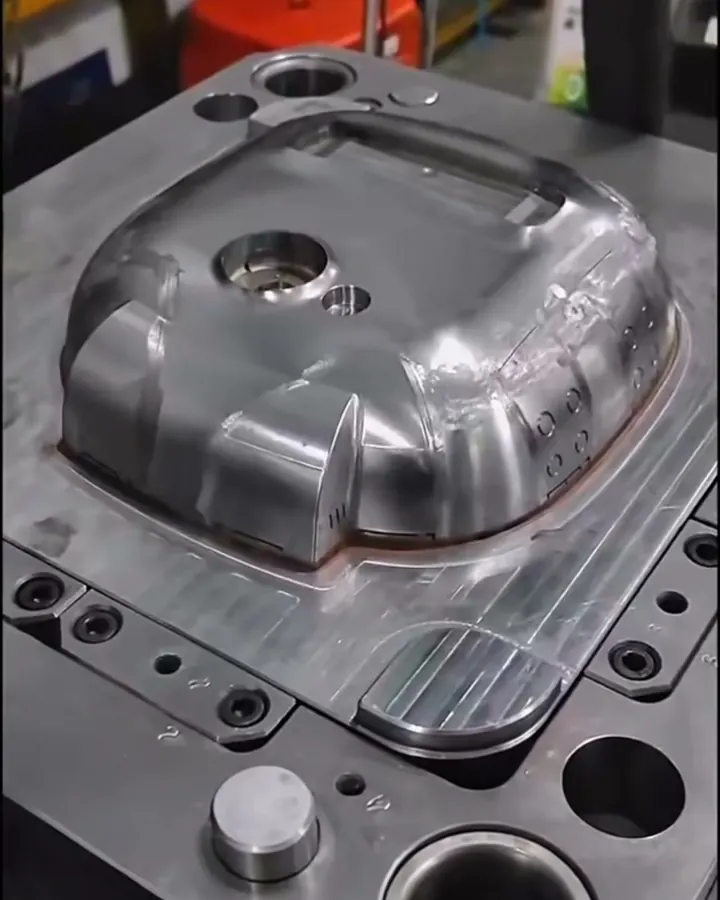
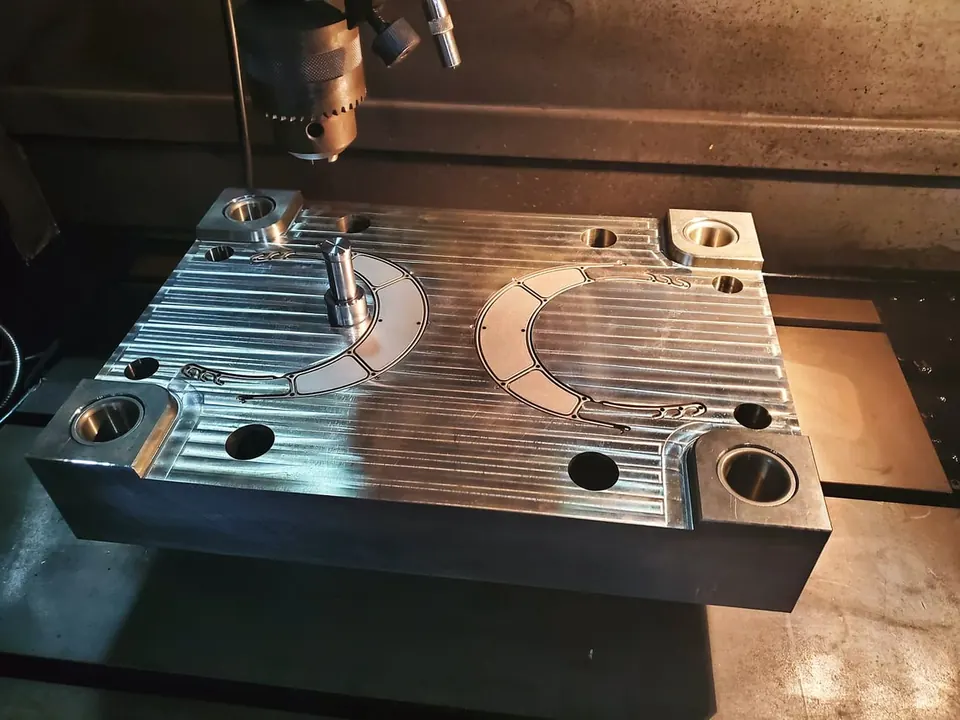
In an injection mold the wall is a gap. A cavity forms the outside, a core forms the inside, and molten plastic is forced into the space between them under high pressure. Wall thickness is cut into the steel, so it repeats shot after shot but costs machining to change, and the tool has to be heavy enough to resist that pressure, with cooling channels, ejectors and a core that can be withdrawn. Thick sections are expensive here. BASF's cooling-time method shows the time to cool rising with the square of wall thickness, so doubling a wall roughly quadruples the time the part sits in the closed mold.
A rotational mold is only an outer shell. A weighed charge of powder, usually ground to about 35 mesh, goes into the cavity, the mold is closed and moved into an oven, and it turns slowly about two axes, normally under 10 rpm according to ARM. As the metal heats, powder tacks onto whichever patch of mold is hot enough as it passes through the powder pool, building up layer by layer until the pool is used up; further heating melts the layer into a solid wall and lets trapped air dissolve out. Then the mold is cooled, still turning, and opened. There's no core and no injection pressure. The wall comes from the shot weight, and ARM notes that more powder gives a proportionally thicker nominal wall, so wall thickness can be changed after the mold exists. An injection mold can't do that without cutting steel.
Heat drives everything in rotomolding, and that explains its quirks. Outside corners heat first and collect extra material, so they come out thicker; sharp inside corners heat last and come out thinner. Areas shielded from the oven, including faces that sit close to a neighboring mold on the same arm, run thin. Molders use this on purpose, adding heat fins or air amplifiers to thicken an area and insulation to stop buildup where a hole will be cut. ARM puts normal commercial wall variation at about ±20%, reducible to about ±10% with tighter process development and more scrap risk; LyondellBasell's rotomolding guide also quotes ±10% as achievable. A wall that floats by a fifth against a wall fixed in steel: that is the central trade.
Side by side
| Rotational molding | Injection molding | |
|---|---|---|
| How the wall forms | Powder melts onto a heated, rotating shell; thickness set by shot weight | Melt forced into a steel gap between cavity and core |
| Mold | Cast aluminum, CNC-machined aluminum (typical overall tolerance about ±0.010 in), or fabricated steel or aluminum sheet for very large simple parts (ARM) | Steel or aluminum plates built to resist injection pressure, with cooling and ejection; see aluminum vs steel tooling |
| Shapes | Closed hollow bodies, double walls, very large parts | At least one open side; ribs, bosses, snaps and fine detail |
| Typical PE wall | Often 0.125 to 0.250 in (3.2 to 6.4 mm) on small and medium parts, much thicker on big tanks; under about 0.075 in risks thin or bare spots (ARM) | 0.030 to 0.200 in (0.76 to 5.08 mm) for polyethylene (Protolabs) |
| Wall variation | About ±20% commercial, about ±10% with tight control (ARM) | Fixed by the steel |
| Draft on PE | Outside faces 0 to 1°, inside faces 2 to 4°, plus 1° per side for each 0.001 in of texture depth (ARM) | 0.5° minimum on vertical faces, 2° for most cases (Protolabs) |
| Tolerance | From about ±0.020 in/in on free-formed outside dimensions down to about ±0.005 in/in at precision level (±0.004 in/in on inside sections that shrink onto the mold) (ARM) | Resin tolerance no tighter than ±0.002 in/in, plus ±0.003 in machining tolerance (Protolabs) |
| Materials | Mostly PE, about 84% of rotomolding resin (LyondellBasell); also crosslinked PE, nylon, PP, PVC plastisol, polycarbonate | Nearly any thermoplastic, filled or unfilled |
| Cycle | Long; a 2026 simulation of an LLDPE part in the journal Materials put full cycles at about 2,900 to 4,900 s depending on mold metal, mold wall and oven setting | Short by comparison; cooling dominates and scales with wall squared (BASF) |
| Output per mold | About 5,000 to 10,000 a year for a medium mold run around the clock (ARM) | Much higher, and extra cavities multiply it |
Surface finish follows the same split. A rotational mold can carry high gloss, sandblast, shot-peen or wood-grain texture, and the texture can change from one area to another, but only on the outside face; the inside is whatever the melt left behind. An injection mold finishes both faces and reproduces much finer detail, which is why snap fits, small text and close-fitting mating edges belong there. For texture choices on the injection side, see mold surface texture and finish.
Materials: mostly polyethylene, by design
Rotomolding puts no shear on the melt and holds it hot for a long cook, so the resin has to flow without pressure, sinter from powder and survive the heat. Polyethylene does all three, which is why it dominates. ARM describes general-purpose rotomolding PE grades at a melt index of about 4 to 7 g/10 min and tank grades lower, about 1.5 to 4. Density sets stiffness: linear low density grades sit below about 0.940 g/cm³ and high density above it. Crosslinked PE trades recyclability for toughness and stress-crack resistance and is used for gas and oil storage tanks and refuse containers. Foamed layers between solid skins add stiffness, flotation and insulation, a build ARM says is often used for large canoes and boat hulls; marine and boat parts covers that end use. Nylon, polypropylene, PVC plastisol and polycarbonate are rotomolded too, but ARM notes their processing windows are narrower. Injection molding, by contrast, takes almost any thermoplastic, including glass-filled engineering grades, so a part that needs high stiffness at temperature or a specific engineering resin is usually an injection part regardless of shape; choosing the right resin walks through that side.
Design rules that change when you switch
An injection-molded design doesn't transfer directly. The features that make injection parts efficient, such as thin solid ribs, sharp detail and cored bosses, are hard or impossible in a free-formed wall. ARM's design guide gives these starting points for polyethylene:
- Keep parallel walls at least 5× the nominal wall apart, outside to outside. Powder bridges narrower gaps and leaves a thin or missing wall; 3× has been molded, with occasional bridging.
- Keep corner angles at 45° or more. 90° and up mold easily; 30° is the floor with standard PE powder.
- Radius every corner. ARM's ideal is 0.250 in inside and outside; the minimum is 0.060 in inside and 0.125 in outside. Inside radii under 25% of the wall concentrate stress.
- Make ribs hollow and broad: at least 5× the wall wide and 4× the wall tall, wider than tall where possible. Solid injection-style ribs aren't recommended.
- Use kiss-offs for stiffness. Two walls are pushed toward each other in the mold and fuse, tying a large panel together. A gap of 175% of the nominal wall between the mold protrusions is ARM's starting point.
- Allow 1 to 4% shrink on PE, moving with grade, density, pigment and cooling rate. Blue organic pigments tend to shrink more; whites and pastels slightly less.
- Avoid big flat panels. ARM's commercial flatness on PE is ±0.020 to 0.030 in per inch; a crown of about 0.015 in/in, ribs or texture helps.
- Plan the vent. Almost every rotational mold needs a vent tube, which leaves an opening you either use or plug.
Going the other direction, a thick plain rotomolded wall usually has to become a thinner ribbed one before it can be injection molded. Wall thickness for molded parts covers the injection rules, and the wall thickness checker flags walls outside a resin's usual range.
Worked example: a 600 mm vertical water tank
Take a hypothetical closed cylindrical tank, 600 mm outside diameter and 900 mm tall, in a PE rotograde at about 0.94 g/cm³, with a 6 mm nominal wall. Six millimeters is 0.236 in, inside ARM's usual range for small and medium parts.
Shot weight
The outside surface is the side, π × 0.6 × 0.9 = 1.696 m², plus two ends, 2 × π × 0.3² = 0.565 m², for 2.262 m² in total. Multiply by the 6 mm wall and you get about 13,570 cm³ of plastic, which at 0.94 g/cm³ is a shot of roughly 12.8 kg of powder. That ignores corner buildup, but it's how a first shot weight gets set.
Wall specification
At ARM's commercial ±20%, a 6 mm nominal wall can land anywhere from 4.8 to 7.2 mm. If the stress check says no section may fall below 5.0 mm, the nominal has to rise to 5.0 ÷ 0.8 = 6.25 mm, and since wall scales with shot weight, the shot grows to 12.8 × 6.25 ÷ 6 = 13.3 kg. If you pay for tighter control instead, ±10% would let the nominal drop to 5.0 ÷ 0.9 = 5.56 mm and the shot to about 11.8 kg. Either way, put the minimum wall on the drawing, not only the nominal; ARM recommends it because it gives the molder a number to inspect against. Capacity hardly moves: about 241 liters inside at 6 mm, about half a liter less at 6.25 mm.
Dimensions and flatness
With 1 to 4% shrink, the mold for a 600 mm diameter is cut roughly 6 to 24 mm larger than the part, and where your grade and color fall in that band is learned from first samples. For tolerance, ARM's table gives ±0.020 in/in on free-formed outside dimensions at its loosest level, about ±12 mm on 600 mm, and ±0.005 in/in at precision level, about ±3 mm. A flat 600 mm base at commercial flatness could be out by up to about 12 to 18 mm, so the base is better crowned or ribbed; at a 6 mm wall, ARM's proportions call for ribs at least 30 mm wide and 24 mm tall. Fitting bosses that project outward should be at least six times the wall in outside diameter, 36 mm here, then drilled or cut open.
Molds for the rate
Suppose the plan is 15,000 tanks a year, and treat this tank as a medium-sized mold; a bigger, thicker part cycles slower and makes fewer. At ARM's 5,000 to 10,000 parts per medium mold per year, 15,000 ÷ 10,000 = 1.5, so two molds at best, and 15,000 ÷ 5,000 = 3 molds at worst. Rotomolding scales by adding molds, and ARM notes cast aluminum molds repeat well when several are poured from one pattern.
Could it be injection molded instead?
Not in one piece: a closed cylinder has no side for a core to leave through. It would be molded as a body and a lid, then welded or threaded together, which puts a seam into a part that holds water. The 6 mm wall is above the 5.08 mm top of Protolabs' polyethylene range, so the design would be redrawn around a thinner ribbed wall; keeping 6 mm would mean about four times the cooling time of a 3 mm wall by BASF's square rule. The press would also have to clamp a projected area of about 0.28 m² (π × 0.3², roughly 438 in²). Run that through the tonnage calculator and read what size parts can be injection molded before going further. For this tank, rotomolding is the natural fit.
Volume and the break-even
Prices vary too much by part and shop to put figures on this page, but the structure of the comparison doesn't. Total cost in each process is tooling plus quantity times per-part cost, so the crossover is:
Break-even quantity = (injection tooling − every rotomold the rate requires) ÷ (rotomolded per-part cost − injection per-part cost)
Two things get missed. The rotomold side means the number of molds the annual rate demands, from the capacity math above, not one mold. And per-part cost has to include what happens after the part leaves the tool: trimming vent and fill openings, drilling, spin-welded fittings and, on the injection side, joining the halves. Put both sets of quotes through the cost-per-part calculator at a low, expected and high volume and see where the lines cross. ARM notes that some products begin rotomolded and later move to blow molding as volume grows, though it calls that uncommon, because a design that uses rotomolding's freedoms is hard to fit into a more restrictive process. If a big jump in volume is likely, keep the geometry compatible with the higher-volume process from the start. For small runs of parts that really are injection-style, the options are in low-volume production.
What goes wrong
Rotomolding failures mostly trace back to heat and powder flow. LyondellBasell's troubleshooting table covers the usual ones:
- Underfused parts: many small bubbles in the wall or a rough, powdery inside surface, from too little oven temperature or heating time.
- Over-cured parts: resin degraded by excess heat or time, which costs physical properties.
- Warped panels: uneven cooling, resin pulling away from the mold wall, or poor venting; the fixes include rotating during cooling and avoiding large flat panels.
- Thin or missing wall at narrow gaps and tight corners, from powder bridging.
- Blow holes traced to porosity in a cast aluminum mold.
- Weak colored parts: high pigment loadings can reduce tensile and impact strength, so keep pigment low or use a precolored compound.
When a large part is forced into injection molding, the failures change: sink and voids in thick sections, warp on broad panels (see why molded parts warp) and long cycles wherever the wall is heavy. For big, stiff parts that still need to be injection molded, structural foam and gas assist are the usual workarounds.
When blow molding or another process wins
Blow molding also makes closed hollow parts and is the process ARM names as the place rotomolded products move to when quantities outgrow rotomolding. The price of entry is higher: ARM calls blow molding significantly more capital-intensive. Wall control differs too. ARM points out that blow-molded and thermoformed parts tend to thin at outside corners where rotomolded parts thicken, and LyondellBasell rates rotomolded wall uniformity better than what blow molding normally reaches. Blow molding fits containers with a neck, relatively thin walls and volumes large enough to pay for the tooling; extrusion, injection and stretch blow molding compared goes into the variants.
Two more options deserve a look. Shallow hollow panels can sometimes be thermoformed or made as two thermoformed sheets joined together, with cheaper tooling; see injection molding vs thermoforming. And for a handful of prototypes, ARM mentions non-metallic molds that yield up to about 100 parts, while smaller injection-style parts can be printed first, as covered in injection molding vs 3D printing.
Checklist before you ask for quotes
- Sketch the part as one closed skin or as open pieces. Closed points to rotomolding or blow molding.
- Write down annual volume and peak rate, and convert it to rotomolds needed at 5,000 to 10,000 parts per mold per year.
- State a minimum wall as well as a nominal one, and mark the few dimensions that really matter. Rotomolding holds some dimensions closely, not many at once.
- Name the resin grade and color early; PE density and pigment both move shrink.
- Check every gap, corner angle and rib against the ARM numbers above before the mold is designed.
- Ask each shop which secondary work its quote includes: trimming, drilling, fittings, inserts, assembly.
- For outdoor parts, confirm UV stabilization on the datasheet. ARM says most PE rotograde powders already include it, but check; UV-resistant plastics for outdoor parts explains what to ask.
Common questions
Is rotational molding cheaper than injection molding?
For tooling, usually yes. Rotational molds are thin shells that don't have to resist injection pressure, and ARM describes their cost as generally lower than injection or blow molds. Per part, usually not, because cycles are long and each mold makes far fewer parts a year. Which is cheaper overall depends on volume, part size and secondary work, so compare total cost at your expected quantities.
Can rotomolding hold tight tolerances?
It can hold a few critical dimensions closely, not many at once. ARM's table for polyethylene runs from about plus or minus 0.020 in/in on free-formed outside dimensions down to about plus or minus 0.005 in/in on outside dimensions and plus or minus 0.004 in/in on inside sections that shrink onto the mold, at ARM's precision level. Machined molds, consistent resin and color, and cooling fixtures all help. If many features need injection-level precision, it's the wrong process.
What materials can be rotomolded?
Polyethylene dominates, about 84% of rotomolding resin by LyondellBasell's figure, in linear low, medium and high density grades plus crosslinked PE. Nylon, polypropylene, PVC plastisol and polycarbonate are molded too, with narrower processing windows. Rotomolding grades are formulated for flow, sintering and heat stability, so a powder ground from an injection grade isn't a safe substitute.
Why are rotomolded outside corners thicker than the walls?
Outside corners heat up first, so they reach the temperature where powder starts to stick earlier and collect material for longer. Sharp inside corners heat last and come out thinner. Generous radii even this out; ARM's ideal is 0.250 in on both inside and outside corners for polyethylene parts.
How many parts a year can one rotational mold make?
ARM's design guide puts a typical medium-sized mold at about 5,000 to 10,000 parts a year when run around the clock. The real figure depends on part size, wall thickness and cycle length. Higher volumes are met with duplicate molds, which is why mold count belongs in any cost comparison.
Sources
- Association of Rotational Molders - Design Guide Pt 1 Overview
- Association of Rotational Molders - Design Guide Pt 2 Ch 12: Tolerances
- LyondellBasell - A Guide to Rotational Molding (PDF)
- Protolabs - Design Guidelines: Plastic Injection Molding
- BASF - Estimating Cooling Times in Injection Molding (PDF)
- Materials (MDPI) - Effect of Mould Material and Design on LLDPE Rotational Moulding Efficiency (2026)
Send the part file and the quantity you expect to run, and we'll review it before you commit to tooling. NDA first if you want one.
Send a part for reviewBook a 30-minute call