Why does the surface of a molded part peel or flake (delamination), and how is it fixed?
A skin that peels or flakes never bonded to the plastic beneath it. The usual causes are foreign or incompatible material in the melt, release agent on the steel, too much shear through a small gate, or melt meeting a cold mold. BASF's troubleshooting table ranks contamination first: clear the material before touching the tool, then work on heat and speed.
A peeling part usually announces itself late. It looks fine at the press, then a thin outer layer lifts at an edge during trimming, assembly or a drop test, and once a fingernail gets under it the skin comes away in flakes or a whole sheet. BASF's troubleshooting brochure defines delamination as the peeling of surface layers; Mold-Masters describes the same thing from the other side, a part separating into layers that can be peeled off, with surface layers flaking away. Fictiv's defect guide adds the point buyers tend to miss: the effect is more than cosmetic, because the layers that failed to bond also reduce part strength.
Why a skin stops sticking to the wall under it
A molded wall is not the same all the way through. Melt that touches the steel freezes into a skin almost at once, and the melt still moving behind it is sheared hardest in the band just under that skin, while the center of the wall flows fastest. BASF puts the cause in that band: excessive shear in a melt that is already relatively cold, combined with intense cooling from a cold mold. In a semi-crystalline resin, such as nylon or acetal, that can leave layers with different crystal structures. In an amorphous resin, such as ABS or polycarbonate, it can pull apart the mix of polymer, additives and pigment.
The second route is anything in the melt that was never going to blend. A bit of another polymer, a color concentrate whose carrier does not suit the base resin, or a film of release agent on the steel does not fuse with the plastic around it. Fictiv describes these contaminants as creating local areas that stop the plastic from bonding. Under high shear such a spot gets smeared into a thin layer near the surface, and that layer becomes the plane the skin parts along. Mold-Masters sums up both routes in one line: poor bonding between layers because of high shear stress, or a melt that is not homogeneous.
The usual causes and what each leaves behind
| Cause | What the guides list | Clue on the part or in the records | Quickest check |
|---|---|---|---|
| Contamination or an incompatible blend | BASF ranks contaminated granules first. Mold-Masters lists physical and chemical contamination, an incompatible color dye and a high share of recycled material | Starts with a new lot, a color change, a different regrind bin or the first job after a resin change. Patches can turn up anywhere on the part | Purge, then run sealed virgin resin with no colorant and no regrind |
| Moisture | Mold-Masters puts resin moisture in its fix sequence; Fictiv says to pre-dry the material | Usually arrives with silver splay streaks and follows dryer performance | Check dryer temperature, time and the resin's moisture against the datasheet |
| Too much shear | BASF: fast injection, pin gates, narrow sprues and runners, thin walls. Mold-Masters: sharp corners at the gate | Worst near the gate or where flow squeezes through a thin section; gets worse when fill speed goes up | Work out the gate shear rate; slow the fill as a test |
| Mold release on the steel | Fictiv names release agents as a usual contaminant | Appears after the tool was sprayed for sticking parts, often in the sprayed area, and fades over the next shots | Stop spraying, clean the cavity, watch the next shots |
| Cold mold or cold melt | BASF: intense cooling of the mold. Mold-Masters: cold mold | Worst at start-up and eases as the tool warms; worse far from the gate | Measure the steel surface and the melt, not the setpoints |
BASF adds a sixth case that looks different: air pulled into the melt while the screw meters. It leaves thin skins that can be pulled off the surface, and BASF says it is seen mainly in unreinforced semi-crystalline grades. Its remedies are on the machine side: more back pressure during screw recovery, a check that the metering stroke has not run past what the screw is meant to deliver, a press with a bigger screw if it has, or a shallow-flighted three-zone screw.
Telling them apart before changing anything
Start with what changed. A tool that ran clean for a long time and then began to peel rarely grew a gate problem overnight; something arrived in the material, the release can came out, or the mold or melt ran colder. A part that peeled from the first trial shots points the other way, toward gate size, corners and wall thickness. Bozzelli's warning in Plastics Technology is useful here: however hard you purge after a resin change, small amounts of the previous material stay on the screw flights. A job that follows an incompatible resin on the same barrel is a prime suspect.
Then read where the peel sits. Peeling clustered at the gate, or just past a thin section, a sharp corner or a tight runner bend, is shear. Patches scattered across the part with no pattern are material. A peel that matches where the setter sprayed is release. A peel that is worst on the first shots of the morning and fades as the tool reaches temperature is cold steel.
Check that it is really delamination. Splay leaves silver streaks that sit flat in the surface and do not lift. A coating that comes off a clean substrate is an adhesion problem with the paint or plating, covered in plating, painting and metallizing molded plastic; look at the underside of the flake to see which material it is. A second material peeling off the first on an overmolded part is a bond and pairing question, which two-shot and multi-material molding covers.
One conflict between the guides is worth knowing. BASF and Mold-Masters both say to slow injection. Fictiv's table suggests raising fill speed in small steps until the peel disappears, and making the gate larger so the plastic does not harden before the cavity is full. Both can be right. Too fast shears the melt under the skin; too slow lets the front cool and freeze early, which is the cold-melt case. Which one you have shows up in the location clues above, so change speed in one direction, a small step at a time, and keep the parts from each step.
Fixes in the material
- Clean, then prove it. BASF's fix for contamination is a thorough clean of the machine and the hot runner before processing. After an incompatible resin, that can mean pulling the screw, not just purging it.
- Check the color carrier. BASF asks whether the masterbatch suits the plastic being molded, and says to change to one with a suitable carrier if not. Masterbatch versus precolored resin explains what the carrier is and why it matters.
- Control regrind and recycled content. Mold-Masters lists a high share of recycled material as a cause and adjusting the regrind ratio as a fix. A regrind bin that picked up another resin carries it into every shot; regrind in injection molding covers how the ratio and the grinding are controlled, and recycled PCR resin explains why mixed post-consumer streams need tighter checks.
- Dry to the datasheet. For a general-purpose ABS such as SABIC's Cycolac MG47, the datasheet gives 80 to 95 °C for 2 to 4 h and a maximum moisture of 0.10%. Moisture and hygroscopic resins explains which resins pick up water and how to confirm the dryer is working.
Fixes at the press
Mold-Masters gives a solution order: raise melt temperature, raise mold temperature, lower injection speed, then eliminate contamination, adjust the regrind ratio, adjust resin moisture, purge, and remove sharp corners at the gate. BASF's troubleshooting table ranks contaminated granules first, injection speed second and melt temperature third. Read together, the press changes are heat and speed, and the order to try them depends on what the clues pointed to. Mold-Masters also lists a melt that is too hot or poorly mixed as a cause, so raise melt temperature only within the datasheet window.
Keep every change inside the resin maker's window. MG47's datasheet gives a melt temperature of 220 to 260 °C, a mold temperature of 50 to 70 °C and back pressure of 0.3 to 0.7 MPa. It also suggests a shot size of 50 to 70% of barrel capacity, which points the same way as BASF's metering-stroke check: a shot that asks too much of the screw invites trouble. A mold whose surface measures below the bottom of the window is a cold mold whatever the controller says, and a melt run at the bottom of its range has less heat to keep the skin and core fused.
Fixes in the tool
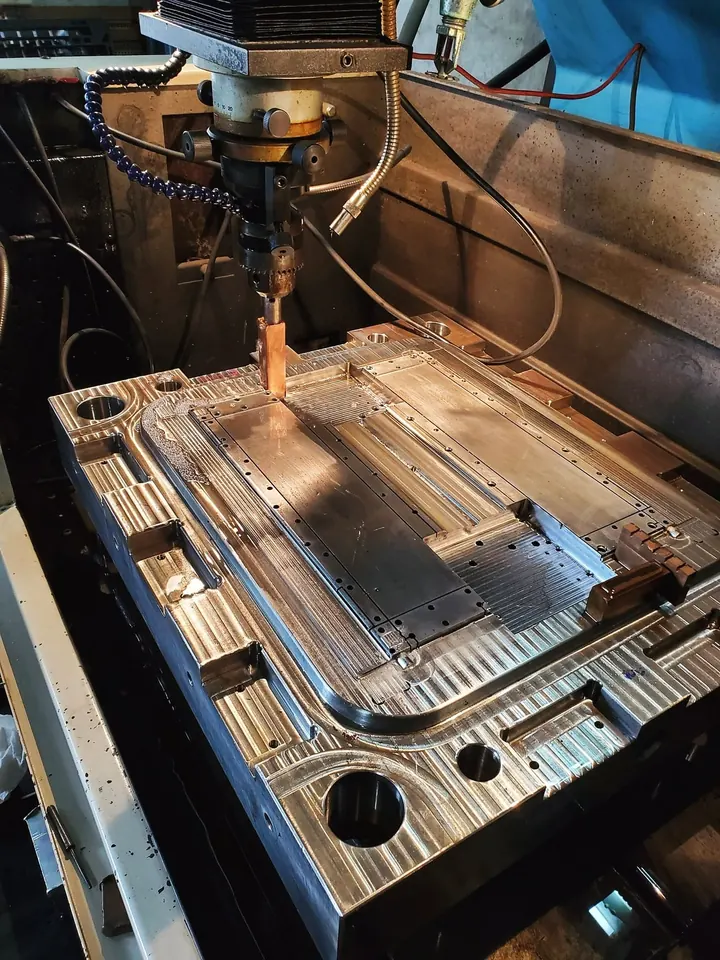
- Give the melt a bigger door. BASF suggests enlarging the sprue and runners, swapping a pin gate for a film gate, or thickening the wall. Fictiv lists a larger runner diameter and a larger gate. The gate size calculator checks a gate against the resin's shear limit, and gate types covers the options when a pin gate has to change.
- Break sharp edges. Mold-Masters names a gate with sharp corners, and sharp corners that create shear heat. Fictiv asks part designers for smooth corners for the same reason.
- Hold the steel at temperature. A tool that cannot reach the mold temperature window during production needs cooling work rather than a setpoint change; mold cooling covers the circuit layout.
- Remove the reason for release spray. Fictiv's fix for release-agent contamination is less reliance on the spray, usually by improving part ejection. With adequate draft and enough ejector area, the setter has no reason to reach for the can.
Worked example: a peeling ABS cover
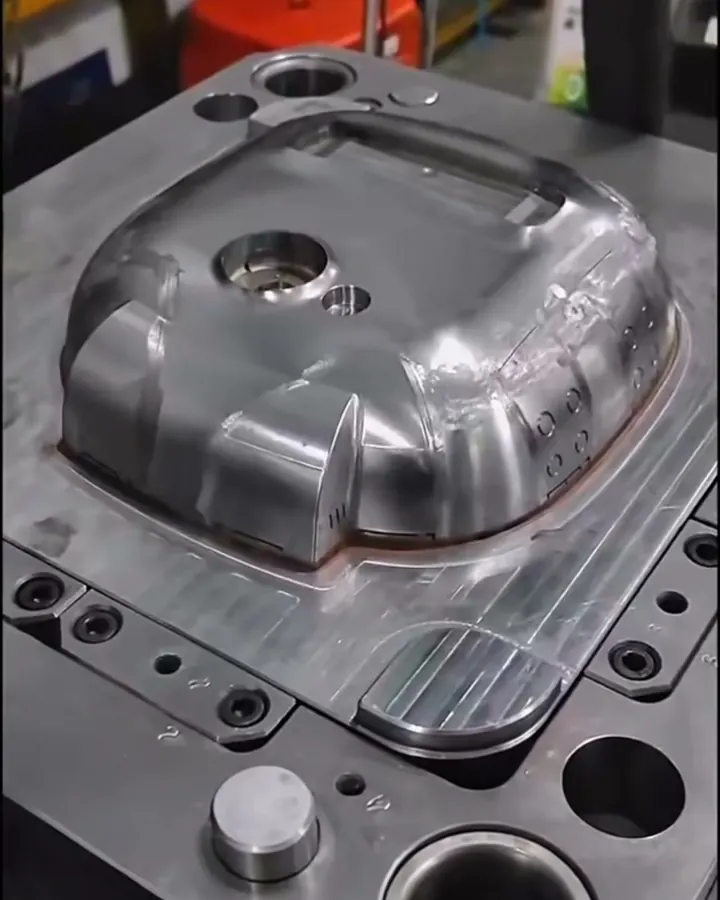
A hypothetical cover in a general-purpose ABS like MG47 has a 2.0 mm wall and a cavity volume of 18 cm³. It is filled through one round pin gate 1.2 mm across, in 0.6 s. Parts peel in a band about the size of a thumbnail just past the gate, worst on the morning start-up. The mold surface measures 40 °C on the cavity side. Regrind is not used, and a purge followed by sealed virgin resin with no colorant still peels, so the material is cleared and the problem is heat and shear.
Mold temperature. 40 °C sits 10 °C below the 50 to 70 °C on the datasheet. That is the first fix, and it costs nothing in steel.
Gate shear. J. Barry Smith's screening method takes the flow rate through a gate as cavity volume divided by fill time, here 18 / 0.6 = 30 cm³/s. For a round gate the apparent shear rate is 32 x Q / (π x D³), with D in cm. At D = 0.12 cm, D³ = 0.001728, so the rate is 960 / 0.00543 = about 177,000 per second. Smith's table, a consultant's screening guide rather than a resin maker's figure, puts the limit for ABS at 50,000 per second (use the supplier's own limit where one is published), so this gate runs at about 3.5 times the limit, and he warns that above the critical rate the melt fractures and its molecular weight drops.
Slowing down alone. At a 1.0 s fill, Q = 18 cm³/s and the rate falls to 576 / 0.00543 = about 106,000 per second. That is still about 2.1 times the limit, and the slower fill gives the front more time to cool. Speed alone will not fix this gate.
Opening the gate. Solving the same formula for 50,000 per second at the original 0.6 s gives D = (960 / (π x 50,000))^(1/3) = 0.183 cm, so 1.83 mm. A 1.8 mm gate gives 960 / 0.0183 = about 52,400 at 0.6 s, about 5% over, and 576 / 0.0183 = about 31,400 at 1.0 s, comfortably under. The BASF route of a film or edge gate does better: 6 x Q / (W x H²) for a gate 0.6 cm wide and 0.12 cm deep is 180 / 0.00864 = about 20,800 per second at the full 0.6 s fill.
The order. Raise the mold into its window first and run a set of parts. If the peel at the gate persists, slow the fill as a test and keep those parts. Then open the gate, which is a small change to the steel, and recheck at the faster fill. If the cover were a plating grade, Smith's table drops the ABS limit to 30,000, and the 1.8 mm gate at 1.0 s would sit just over it; a plated cover needs the edge gate or a bigger round one, about 2.2 mm at 0.6 s. For glass- or mineral-filled grades he says to at least halve the limit.
Checklist for a peeling part
- Peel a flake and look at both sides. Confirm it is the molded resin, not paint, plating or an overmolded layer.
- Write down what changed: resin lot, colorant, regrind source, previous job on the press, release spray, dryer, mold temperature.
- Purge, then run sealed virgin resin, dried, with no colorant and no regrind. If the peel stops, the cause is in the material.
- Stop any release spray and clean the cavity before judging the next shots.
- Measure actual mold surface and melt temperatures and compare them with the datasheet window.
- Calculate the gate shear rate at the real fill time and compare it with the supplier's limit for the grade, or a screening table such as Smith's if none is published.
- Change one thing at a time and keep labeled parts from each step.
- Only then change steel: gate size or type, runner size, corner radii, cooling, draft or ejection.
When the answer changes
Plated and painted parts expose peeling that would pass on a bare part, so tighter shear limits and a clean material record matter more there. Filled grades have less shear headroom, by Smith's rule of half. Parts with a high share of recycled content inherit whatever else was in the stream, so the material checks come first. Write peeling into the first-sample defect list with a simple test, such as a tape or fingernail pull at the gate area, and settle the pass limit during first-article review. For context, the tool-or-process defects note sets delamination beside the other common defects, and the defect troubleshooter helps when the symptom is harder to name.
Common questions
Is delamination only a cosmetic defect?
No. Fictiv points out that the layers that failed to bond also reduce part strength, and a skin that lifts at the press can keep flaking during assembly or use. Treat peeling on a snap, boss, sealing face or plated surface as a functional reject, and agree the test and the limit on sample parts before production.
Why did parts start peeling after a color change?
Two likely reasons. BASF lists an incompatible masterbatch as a cause and says to switch to one with a carrier that suits the base resin. And Bozzelli notes in Plastics Technology that small amounts of the previous resin stay on the screw flights however hard you purge. Run sealed virgin resin with no colorant to tell the two apart.
Should injection speed go up or down to stop peeling?
It depends on the cause. BASF and Mold-Masters say to slow down, because fast fill shears the melt under the skin. Fictiv's table suggests raising fill speed in small steps, because a fill that is too slow lets the front cool and harden early. Peeling at the gate points to shear; peeling far from it on a cold tool points to cooling.
Can mold release spray cause peeling?
Yes. Fictiv says delamination is usually caused by contaminants such as mold-release agents, which stop the plastic bonding in local spots. If peeling started after a setter sprayed the tool, stop the spray, clean the cavity and watch the next shots. The lasting fix is better ejection and draft, so the tool releases parts without help.
Does regrind make delamination more likely?
It can. Mold-Masters lists a high percentage of recycled material among the causes and adjusting the regrind ratio among the fixes. Regrind can also carry another resin if the grinder or bin was shared, which turns it into a contamination problem. Run virgin only as a test; if the peeling stops, the regrind source and ratio need tighter control.
Sources
- BASF - Injection Molding Problems in Engineering Thermoplastics: Causes and Solutions (delamination, troubleshooting table)
- Mold-Masters - Hot Runner Troubleshooting Guide (1.6.5 Delaminating parts)
- Fictiv - The 10 Most Common Injection Molding Defects and How to Fix Them (surface delamination)
- Plastics Technology - Safety First: Know the Compatibility of Different Resins (John Bozzelli)
- J. Barry Smith (Plastics Consultancy Network) - Injection Moulding: Gates and Runners (gate shear rate, limits by resin)
- SABIC - Cycolac MG47 ABS technical datasheet (drying, melt and mold temperature), hosted by Protolabs
Send the part file and the quantity you expect to run, and we'll review it before you commit to tooling. NDA first if you want one.
Send a part for reviewBook a 30-minute call