

From drawing to dock · step 7 of 10
Step 7: Cut & sew. Fabric in, finished goods out.
For bags, cases, pouches and soft goods, fabric panels are cut to a pattern, sewn, finished and packed to a written spec. Sewn programs are made in Taiwan, Vietnam or China depending on the program, and each product is marked with the country where it is actually made.
What happens in this step
Materials approved, pattern proved, lots checked.
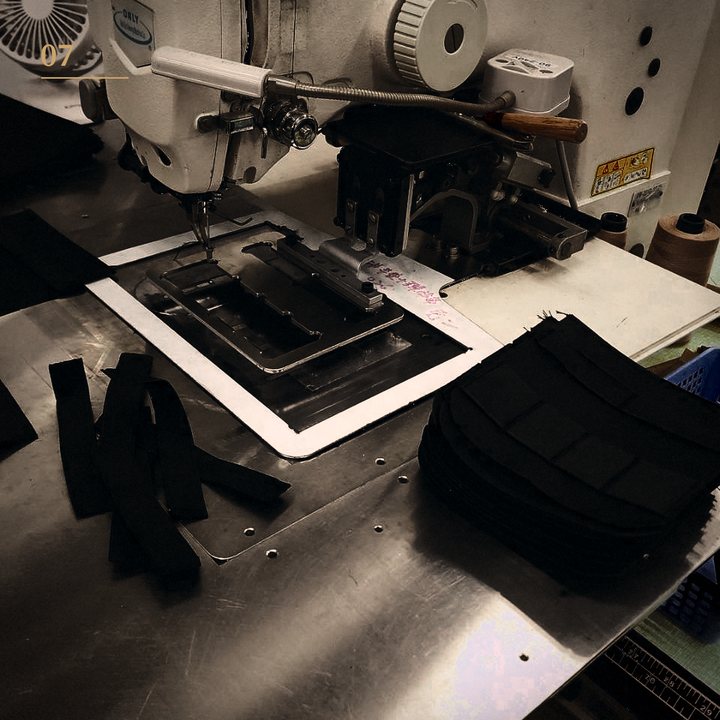
The fabric, webbing, thread and hardware are approved against the sample before the cutting table sees them. The pattern is proved on a sample, and the stitch, seam and hardware spec is written down before the line starts. Repeat seams run on programmable pattern sewers with a template holding each part. Every lot is checked against the spec before it is packed.
This page is the short version for your program's timeline. The full picture, with the line, the materials and the photographs, is on cut-and-sew manufacturing.
What you send us
The product and the spec behind it.
- A sample, a sketch or a tech pack.
- Materials: fabric, webbing, thread, hardware and any trim.
- Stitch and seam requirements, and where the load goes.
- Labels, packaging and the count per master carton.
- Your quantity, and any buyer specification or textile standard.
What you get back
Goods made to the spec you approved.
- A sample to approve before production.
- A written spec: stitches per inch, bar-tack placement, seam allowance, hardware and color.
- Lots inspected against that spec, with hardware pull-tested.
- Finished goods counted into marked master cartons, ready for freight.
Quantities and timing
The material decides the minimum.
The first-order quantity depends on the material. Stock fabrics and trims allow smaller runs; special materials have to be ordered, and the minimum is quoted from that material. The schedule follows the same logic: stock materials start sooner, special orders wait for the mill.
Common mistakes at this stage
Where sewn goods go wrong.
- Approving the look of a sample without writing down the spec behind it.
- Choosing a special fabric without checking its minimum order.
- Leaving stitches per inch and bar-tack placement to the line.
- Skipping the hardware pull test.
- Assuming a sewn product's origin without checking where it is actually made.
Before you approve the sample
What the sewn sample has to settle.
A sewn product is approved as a sample, but it is made from a specification. The sample is your chance to check the spec before hundreds of pieces are cut.
- The fabric, lining, webbing and thread are the ones that will be ordered for production.
- Seams, bar-tacks and stitch density hold under the load the product will carry.
- Zippers, buckles, snaps and other hardware work smoothly and pass the pull test.
- Color matches the approved standard under normal light.
- Labels, care marks and the country-of-origin mark are correct.
- The fold, the bag or box it ships in, and the carton count are agreed.
Special materials add a second clock to the schedule. A fabric that has to be ordered from a mill sets the start date and often the minimum, so it is worth choosing materials early, and knowing which stock alternatives would work if timing matters more than the exact fabric.
Inventor or business?
The same step, from where you stand.
Starting out. If this is your first sewn product, a sketch and a product you like the feel of are enough to start. The tech pack can be built with you, and stock materials keep the first order small.
Already selling. If you already sell the product, send the current sample, the spec you hold your supplier to, and a recent lot. The new line is set up to match what your customers already buy.
Questions
What people ask about this step.
Where are sewn goods made?
In Taiwan, Vietnam and China, depending on the program. Each product is marked with the country where it is actually made.
Is there a minimum order?
It depends on the material. Stock fabrics and trims allow smaller runs; special materials have to be ordered, and the minimum is quoted from that material.
What do you check on sewn goods?
Stitches per inch, bar-tacks and stress points, thread and seam allowance, hardware, edges and finish, and color against the approved sample.
Can the bag and its retail box come from one program?
Yes. The retail box, the insert and the master carton can run in the same program.
Related
Have something to make?
Send what you have. Jack reads it himself, and we’ll sign your NDA — or use ours — before you share details.