

From drawing to dock · step 10 of 10
Step 10: Freight to your dock.
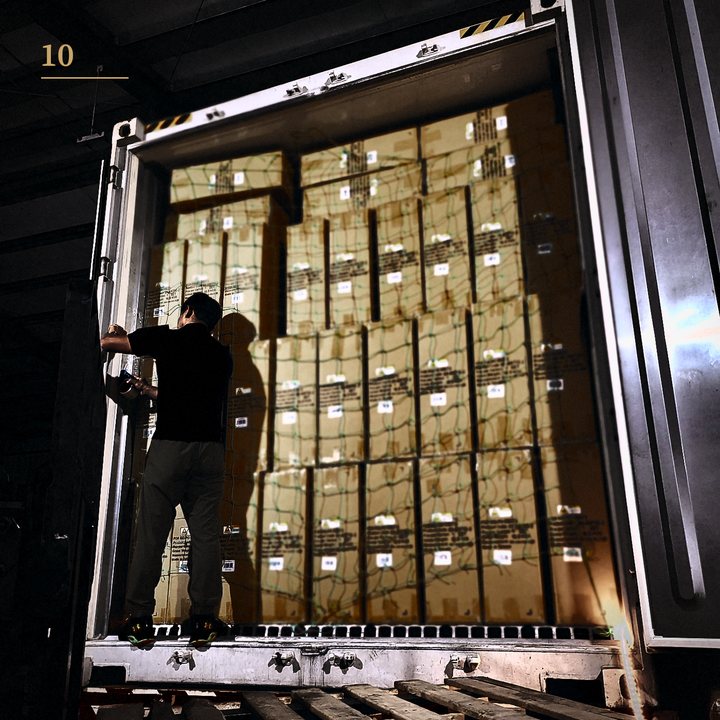
The finished order is booked, cleared through a licensed customs broker, and delivered to your US dock. The origin and the duty are worked out before the goods ship, not after they land.
What happens in this step
From the factory door to yours.
- Booking. The shipment is booked by sea or air, depending on the order and the date.
- Documents. Commercial invoice, packing list and origin paperwork prepared to match what is actually in the cartons.
- Customs. Entry cleared through a licensed customs broker.
- Delivery. Delivered to your dock, your warehouse or your fulfillment center.
If you need it, the US side can also cover break-bulk and re-palletizing, holding inventory on your schedule in commercially leased warehousing, and shipping into fulfillment.
What you send us
Where it goes and how it lands.
- The delivery address and dock hours.
- Your required delivery date, which sets sea or air.
- Any retailer routing guide or labeling rule.
- Your customs broker, if you have one.
Duty and origin
Worked out before the goods ship.
A US import duty is built in layers: the base rate from the product's HTS line, the China Section 301 lists for China-origin goods, the July 2026 Section 301 action, and Section 232 for covered metals. China-origin goods carry a 12.5% duty on top of the 2018 lists; Taiwan-origin goods are generally topped up to 10% combined. The arithmetic is in Taiwan vs. China tariffs for US importers.
Two rules keep this honest. Origin is where the article last became a new article, not the port it sailed from. And if you supplied the mold to the factory, its value counts toward the customs value of the parts. Rates change often; confirm your HTS line with a licensed customs broker.
What you get back
Goods at your dock, with the paperwork right.
- The shipment delivered to your US dock.
- Customs entry cleared through a licensed customs broker.
- Origin and duty worked out before shipping.
- Master cartons counted and marked the way your receiving team expects.
Common mistakes at this stage
Where the last step goes wrong.
- Leaving the HTS classification until the goods are on the water.
- Assuming goods shipped through Taiwan are Taiwan-origin. Origin follows the manufacturing, not the port.
- Forgetting the mold's value when working out customs value.
- Missing a retailer's routing guide, then paying chargebacks.
- Booking sea freight for a date only air can meet.
Before the goods ship
A short checklist for the last step.
Most freight problems are paperwork problems that started earlier. The goods are ready, but the documents do not match the cartons, the classification is not settled, or the delivery appointment is not booked.
- The HTS classification is agreed with your customs broker.
- The origin is known, and the country marking on the product and carton matches it.
- The commercial invoice and packing list match what is actually in the cartons.
- The value includes anything that counts toward customs value, such as a mold you supplied.
- Carton marks, labels and any retailer routing rules are met.
- The delivery appointment, dock hours and receiving contact are confirmed.
Sea freight is the usual choice for volume; air is there when the date matters more than the cost. The choice is made with the order, so the production schedule, the packing and the booking line up. When the goods land, the program is not over: the next order runs on the same approved sample, the same tool and the same checks.
Inventor or business?
The same step, from where you stand.
Starting out. If this is your first import, you will need a customs broker and an HTS classification before the goods ship. Jack's side works with a licensed customs broker, and the classification is settled with you before the booking, not after the goods land.
Already selling. If you already import, send your broker's details, your routing guide and your receiving rules. The freight is booked to fit the way your dock already works.
Questions
What people ask about this step.
Do you handle customs clearance?
Yes. Entry is cleared through a licensed customs broker, and origin and duty are worked out before the goods ship.
Sea or air?
Either, depending on the order and the delivery date.
What duty will my product pay?
It depends on the HTS line and the origin. Taiwan-origin goods are generally topped up to 10% combined; China-origin goods carry the Section 301 lists and a 12.5% duty on top. Confirm your line with a licensed customs broker.
Can you hold inventory in the US?
Yes. Break-bulk, re-palletizing and holding inventory in commercially leased warehousing are available, as well as shipping into fulfillment.
Related
Have something to make?
Send what you have. Jack reads it himself, and we’ll sign your NDA — or use ours — before you share details.