

From drawing to dock · step 6 of 10
Step 6: Electronics & PCBA. Boards built and tested.
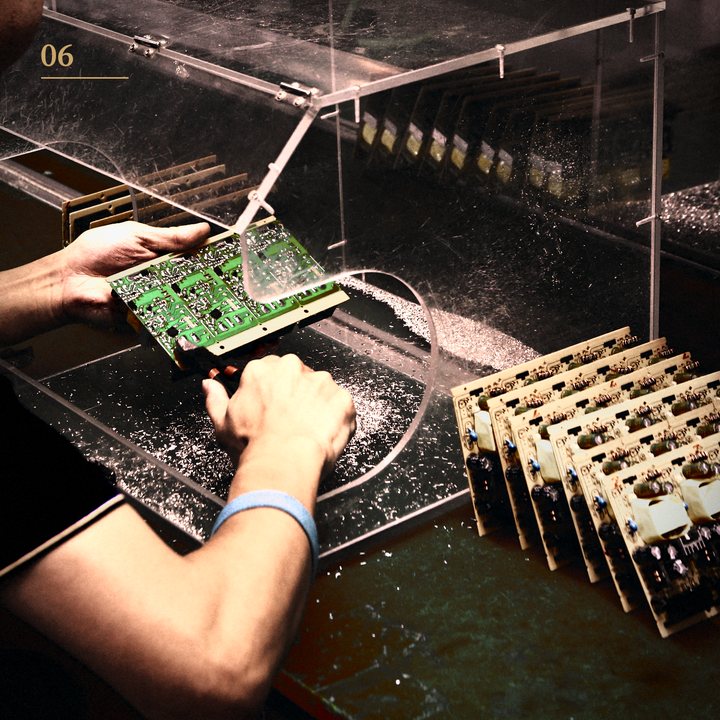
If your product has a circuit board, the board is assembled, inspected and tested before it goes into the housing. Jack treats the board and the enclosure as one design, and asks the questions that decide whether a board works before anything runs at volume.
What happens in this step
Parts bought, boards assembled, every board tested.
Components are sourced, the bare boards are fabricated, parts are placed and soldered, and the assembled boards are inspected and tested. Taiwan's printed-circuit industry is large and deep, which puts fabrication, assembly, test and component distribution close together and shortens the loop when a first article needs a change.
The board rarely lives alone. Bosses, standoffs, snap fits, connector openings and light pipes all move when the board moves, so the tool behind the housing and the board are designed together, or one of them gets cut twice.
What you send us
A package, not just Gerbers.
- The bill of materials with manufacturer part numbers, and approved alternates or a no-substitute flag.
- Gerber and drill files, and the pick-and-place (centroid) file.
- The assembly and fabrication drawings.
- A test specification: how each board is programmed, powered and checked.
- The workmanship class you need under IPC-A-610.
- Every file at the same revision.
Gerbers get you a price. The BOM, the class, the test plan and the first article get you a board that works.
What you get back
Boards that are proven, not just populated.
- Assembled boards inspected by camera (AOI), with X-ray where hidden joints such as BGAs need it.
- Boards tested the way you specify: flying probe, in-circuit or functional test.
- A first article built, inspected and tested before the run starts.
- Written approval required for any part substitution.
- Certification support: Jack has taken products through UL and CE, and FCC certification support is available.
How long it takes
Set by the parts list.
Timing depends mostly on component availability and on the test plan. Jack gives you the schedule with the quote, and flags any part on allocation early, before it can hold up the run.
Common mistakes at this stage
What sinks a first article.
- A BOM that says "10k resistor" instead of a manufacturer part number.
- A centroid file whose origin does not match the board outline.
- Not naming the IPC class, so nobody knows what an acceptable joint is.
- Relying on optical inspection for joints hidden under a BGA or QFN.
- Paying for the cheapest test instead of the test that proves the board works.
- Letting the assembler substitute parts without written approval.
Before volume
What the first article has to prove on a board.
On a board, the first article is where the whole data package gets tested at once: the BOM, the files, the assembly process and the test. It is the cheapest place to find a problem, because only a few boards exist.
- Every placed part matches the BOM, including the manufacturer part number and orientation.
- Solder joints meet the IPC class you named, including the hidden ones.
- The board programs, powers up and passes your functional test.
- The board fits the enclosure, with connectors, buttons and lights where the housing expects them.
- Any substitution has written approval, recorded against the build.
After sign-off, the same program, the same parts and the same test run in volume. Parts on long lead times are ordered early, and anything at risk of shortage is raised before it can hold up the run. If a listing such as UL or CE applies, the board that was tested for the listing is the board that goes into production.
Inventor or business?
The same step, from where you stand.
Starting out. If this is your first electronic product, you may not have every file on the list yet. That is normal. Jack can tell you which files the assembler needs, what a test plan should cover, and whether a listing such as UL or CE applies before you spend on a run.
Already selling. If you already build the board elsewhere, send the current data package and a production board. The first article at the new line is built to your existing revision and tested the way you test today, so the move does not change the product.
Questions
What people ask about this step.
What files does a PCB assembler need?
The BOM with manufacturer part numbers, Gerbers, drill files, the pick-and-place file, assembly and fabrication drawings, and a test specification, all at the same revision.
Is optical inspection enough?
Not for joints hidden under BGA or QFN packages. Those need X-ray inspection.
What is the difference between flying-probe and functional test?
Flying probe checks the board without a fixture and suits small runs. Functional test powers the board and exercises it the way the product will, which proves it works.
Can you help with safety listings?
Yes. Jack has taken products through UL and CE, and FCC certification support is available. Raise it early, because the design and test plan should allow for it.
Can the enclosure and the board come from one program?
Yes. Jack designs the housing tool and the board together, so they fit the first time.
Related
Have something to make?
Send what you have. Jack reads it himself, and we’ll sign your NDA — or use ours — before you share details.