

From drawing to dock · step 1 of 10
Step 1: Idea. Bring what you have.
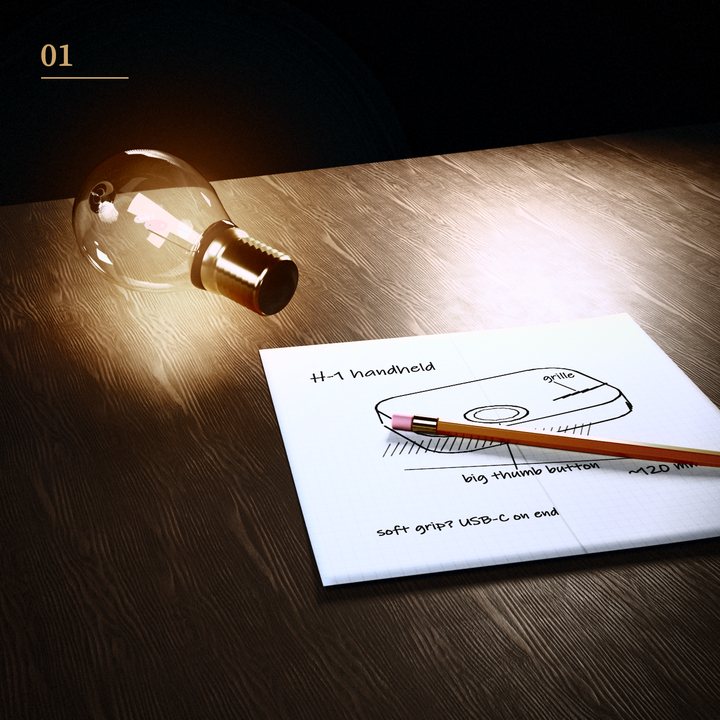
You can start with a sketch, a photo, a product you can hold or just a clear description. You do not need a finished drawing. Jack Cheng reads it himself, asks the questions that decide the product, and tells you plainly what the next step is, including when a cheaper first step makes more sense than a tool.
What happens in this step
The idea becomes a short, honest brief.
Most products that reach a factory started as something much rougher than a drawing: a napkin sketch, a photo of a competitor's product with notes on it, a part that broke, or a paragraph describing what it has to do. That is enough to start.
In this first step Jack turns what you have into a working brief. He wants to know what the product does, who uses it, what it is made of (or could be made of), roughly how many you expect to sell in the first year, and where it will be sold. Those answers decide almost everything that follows: whether it is molded, machined, sewn or assembled, what the tool has to survive, and whether it makes sense to build a tool at all yet.
No job is too small, and none is too big: the same conversation works for one part or for a program that runs into the millions. If the honest answer is that a tool will not pay for itself at your volume yet, Jack says so and suggests the cheaper first step, such as samples or a short run.
Before you share anything
Your idea stays yours.
We’ll sign your NDA — or use ours — before you share details. If you are not sure what to send yet, a general description is enough for a first call, and the details can follow once the NDA is signed.
It also helps to know who you are talking to. You deal with Jack Cheng, the principal, not an agent or a queue. He answers the phone and the texts himself on a US number, (321) 323-4474, and he is the same person who later specifies the tool and watches the line.
What you send us
Whatever you have. More is better, none of it is required.
- A sketch, a photo, or a product you already sell or want to improve.
- A sample, if you have one. A physical part answers many questions a description cannot.
- What it has to do, and anything it must fit, carry, survive or pass.
- A rough first-year quantity, even if it is a guess.
- A target price or budget, if you have one.
- Where it will be sold, and any standard or certification a buyer has mentioned.
You can attach files to the contact form. The privacy page explains how attachments are stored and when they are deleted.
What you get back
A straight answer and a plan.
- Whether the product can be made the way you imagine, and what would make it easier or cheaper to make.
- The likely manufacturing route: molding, machining, cut and sew, electronics assembly, or a mix.
- The next step and what it involves, usually a drawing and CAD, sometimes a sample first.
- Where it could be made. Taiwan first where it fits; China or Vietnam when that is the better factory, said out loud.
- An honest no, if that is the answer, and where possible the name of someone better placed.
A first conversation costs nothing.
How long it takes
Days, not weeks.
This step is a conversation, so it usually moves as fast as you do. The first call is short; most of the time goes into answering the questions it raises. When there is a sample or a competitor product to look at, Jack may ask you to send it before he gives a firm view.
Common mistakes at this stage
Where ideas lose time and money.
- Waiting for a perfect drawing before talking to anyone. The drawing is easier to get right once the manufacturing route is known.
- Guessing the volume too high to get a lower unit price. The volume sets the tool; a tool built for a volume you never reach is money you do not get back.
- Designing around a feature that is expensive to make, such as an undercut, when a small change would remove it.
- Sending confidential details before an NDA is signed.
- Choosing a country before choosing a factory. The right factory for the part matters more than the flag.
- Asking five suppliers for a price on an idea. Without a brief, the quotes cannot be compared.
Questions
What people ask about this step.
Do I need a drawing to start?
No. A sketch, a photo, a sample or a clear description is enough to start. Drawings and CAD are the next step, and Jack's team can make them.
Will you sign an NDA before I share my idea?
Yes. We'll sign your NDA, or use ours, before you share details.
Is my project too small?
No job is too small, and none is too big: any volume, from one part to millions. If a tool will not pay for itself at your volume yet, Jack will say so and suggest a cheaper first step, such as samples or a short run.
Does the first conversation cost anything?
No. A first conversation costs nothing.
Who will I be talking to?
Jack Cheng, the principal. He answers the phone and the texts himself on a US number, (321) 323-4474.
Related
Have something to make?
Send what you have. Jack reads it himself, and we’ll sign your NDA — or use ours — before you share details.