

From drawing to dock · step 2 of 10
Step 2: Drawing & CAD. The file a factory can quote.
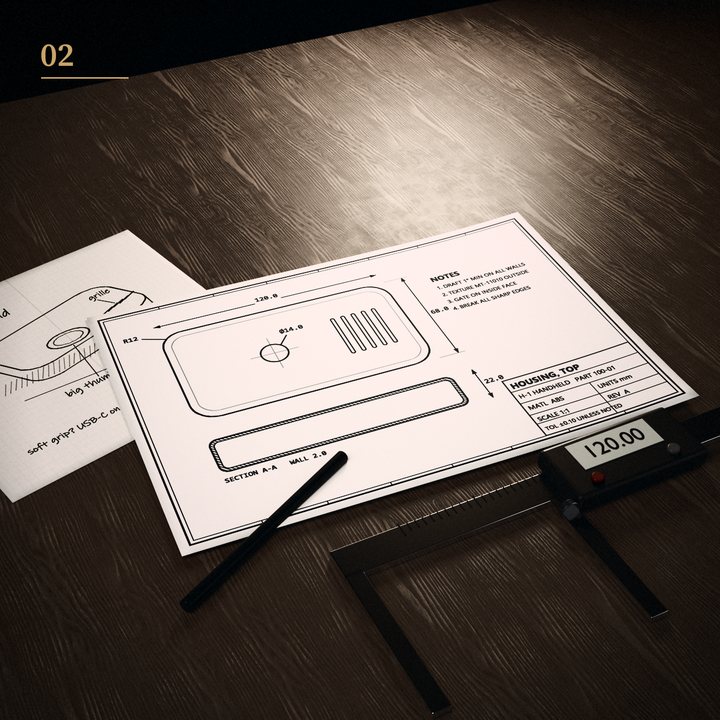
Your sketch, sample or description becomes a dimensioned drawing and a CAD model that a factory can quote and build to. The important part is not the lines; it is deciding which dimensions matter, how tightly, which surfaces are seen, and which material the part is made of.
What happens in this step
Design for manufacture, before anyone cuts steel.
Jack's engineers in Taiwan, a flexible team scaled to each project, turn what you sent into CAD and a 2D drawing. Along the way they design the part for the process that will make it: draft angles so a molded part releases from the tool, even wall thickness so it does not sink or warp, and features placed so the tool stays simple.
If you sent a sample instead of a sketch, this step is reverse engineering. A 3D scan records the geometry of one physical part, including its wear and its own manufacturing variation. It does not say which dimensions are critical. The real work is assigning tolerances, and that is done by an engineer, not by the scanner. More on that in reverse engineering from a sample.
What you send us
The more the drawing knows, the fewer surprises later.
- Whatever you have: a sketch, a photo, a sample, an old drawing, or a STEP or IGES file.
- What the part must fit or mate with, and anything that must not change.
- The material you want, including additives such as glass fill, flame retardant or UV stabilizer.
- Which surfaces customers see (the A-surface) and the finish they need.
- The annual volume, which decides the tool behind the drawing.
- Any standard, safety listing or buyer specification that applies.
What you get back
A drawing you can hold a supplier to.
- A 3D CAD model and a dimensioned 2D drawing with tolerance zones, only as tight as the part needs.
- Notes on material and finish, and on the cosmetic surfaces.
- Suggestions that make the part cheaper to tool or easier to mold, such as removing an undercut.
- A package ready for a quote that states cavity count, steel, tool life and sample rounds.
A complete package is also what makes competing quotes comparable. See how to compare injection mold quotes.
How long it takes
Set by the part, quoted with the project.
A simple part can be drawn quickly; an assembly with several mating parts takes longer, because every interface has to be worked out. Reverse engineering adds time for each interface that must be preserved. Jack gives you the timing for your part when he quotes the work, rather than a generic number.
Common mistakes at this stage
Cheap to fix on screen, expensive in steel.
- Putting tight tolerances on every dimension. Tight tolerances cost machining and inspection time; use them only where the part needs them.
- Leaving the material vague. Glass-filled resin, for example, wears soft steel and changes the tool.
- Forgetting draft, which makes parts stick in the tool.
- Treating a 3D scan as a specification.
- Sending different revisions of the same file. Every file in the package should carry the same revision.
- Changing the design after steel is cut. A change on screen costs minutes; a change in steel costs weeks.
Before you move on
Sign off the drawing, not just the picture.
The drawing is the document every later step is judged against. The sample is checked against it, the tool is built to it, the first article is measured against it, and inspectors hold lots to it. If a dimension is missing from the drawing, nobody can hold a supplier to it later.
- Every critical dimension is marked, with a tolerance you can live with.
- The material grade and any additives are named, not described.
- Cosmetic surfaces and finishes are marked on the drawing, not only in an email.
- Mating parts have been checked together in CAD.
- The revision letter is the same on every file you send.
- You know which changes would be cheap now and expensive after the tool is cut.
A good drawing also makes the next conversation shorter. When a factory quotes from a complete package, the quote can state exactly what it includes. When it quotes from a picture, it has to guess, and guesses show up later as change orders.
Questions
What people ask about this step.
Can you make a drawing from a sample?
Yes. The sample is measured and scanned, and an engineer rebuilds it in CAD and assigns the tolerances. A scan alone records one part's geometry, including its wear, and does not say which dimensions are critical.
What file formats do you need?
STEP or IGES for 3D, and a 2D drawing with the critical dimensions. If you have neither, a sketch, a photo or a sample is enough to start.
Why does the material matter at the drawing stage?
The material decides wall thickness, draft, shrink and the steel the tool needs. Additives such as glass fill or flame retardant change all of these.
Who owns the CAD files?
Keep your drawings and CAD on your side. Ownership of the design and the tool belongs in the written agreement.
Will you sign an NDA before seeing my design?
Yes. We'll sign your NDA, or use ours, before you share details.
Related
Have something to make?
Send what you have. Jack reads it himself, and we’ll sign your NDA — or use ours — before you share details.