

From drawing to dock · step 5 of 10
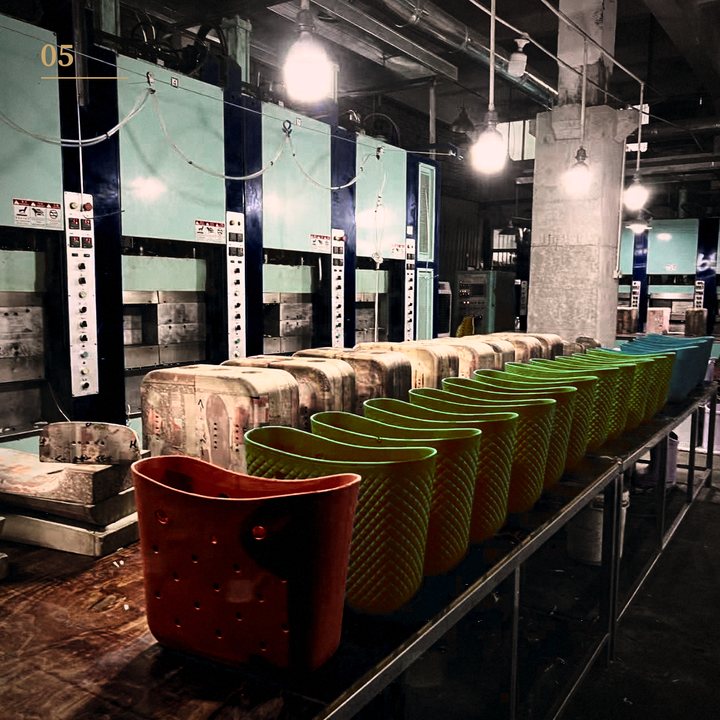
Step 5: Molding. Resin in, finished parts out.
Once the first article is approved, the tool goes into production and makes your parts at the volume you need, from one part to millions. Every lot is checked against the approved sample, so the thousandth part matches the first.
What happens in this step
The approved process, run the same way every time.
Molding runs at qualified partner factories in Taiwan, and in China or Vietnam when that is the better factory for the part. The process that produced the approved first article, the resin, the temperatures and the cycle, is the process that runs production.
Parts come off the press, are trimmed and checked, and move on to assembly, packing or the next step. The risk in this step is drift: why an approved sample drifts by lot three explains how a cheaper resin, a different line or a quiet subcontract can creep in, and why someone who answers to you should be on the floor.
What you send us
The order, and what the parts are for.
- The purchase order: quantities, delivery dates and destinations.
- The approved sample and drawing, which become the reference for every lot.
- Colors, finishes and any marking or labeling.
- How the parts should be packed, or whether they go straight into assembly and packaging.
What you get back
Parts that match the approved sample.
- Production parts at the volume you ordered, from a short run to millions.
- Lots checked against the approved sample while the line runs, not only at the end.
- Parts packed to your spec, ready for assembly, packaging or freight.
- The tool kept in custody between runs, ready for the next order.
How long it takes
Set by the order.
Production time depends on the quantity, the cavity count, the cycle time and whether the parts go on to assembly and packaging. Jack gives you the schedule with the order.
Origin
Where the part is molded is where it comes from.
A part molded in Taiwan from resin is generally a Taiwan product at the US border, outside the China Section 301 lists, even if the tool was built elsewhere. Check your own HTS line with a licensed customs broker. The rates are in Taiwan vs. China tariffs for US importers.
Common mistakes at this stage
How good tools make bad lots.
- Assuming the second lot will match the first without checking it.
- Letting the factory substitute a resin grade to save cost.
- Paying the balance before the pre-shipment check.
- Ordering the tool for one volume and the production for another.
- Forgetting that color and texture are part of the approved sample.
Running production well
What keeps lot twenty matching lot one.
Molding is a repeatable process when the inputs stay the same. Most quality problems in production are not new; they are a change somebody did not mention.
- Material control. The resin grade on the approved record is the resin that runs. Any change needs your written approval.
- Process record. The settings that made the approved first article are written down and reused, run after run.
- The same tool, the same press class. Moving a tool to a different machine is a change, and should be re-checked.
- Checks while it runs. Parts are pulled and compared to the approved sample during the run, not only at the end.
- Tool care. The tool is cleaned and maintained between runs, and its shot count recorded.
Nothing on this list is exotic. It is the discipline of doing the same thing every time, with someone who answers to you on the floor to make sure it happens. That is why every order also goes through the four checks in step 9.
Inventor or business?
The same step, from where you stand.
Starting out. If this is your first product, the first production run is usually the smallest one you will ever order. Order what you can sell and store, not what gives the lowest unit price on paper; the tool stays ready for the next run.
Already selling. If you already sell the product, the question is usually continuity: the same part, the same color and the same packing as the lots your customers already know. Send the current approved sample and a recent lot, and production is held to them.
Questions
What people ask about this step.
What volumes can you mold?
Any volume, from one part to millions. No job is too small, and none is too big.
Where is production molding done?
At qualified partner factories in Taiwan, and in China or Vietnam when that is the better factory for the part.
How do you keep later lots matching the sample?
Every lot is checked against the approved sample while the line runs, and Jack's own people are on the floor.
Is a part molded in Taiwan Taiwan-origin?
Generally yes, even if the tool was built elsewhere. Confirm your HTS line with a licensed customs broker.
What happens to my tool between orders?
It stays in custody, maintained and ready for the next run, or ready to move if you want it moved.
Related
Have something to make?
Send what you have. Jack reads it himself, and we’ll sign your NDA — or use ours — before you share details.