

From drawing to dock · step 4 of 10
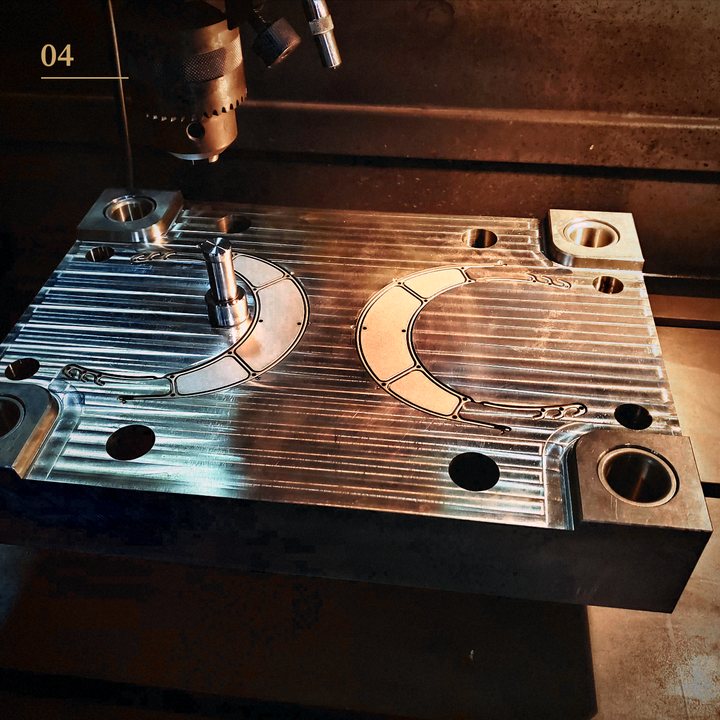
Step 4: Mold. Steel built for your part.
The mold is the tool that makes your part, and it is priced by the life you ask of it. Jack specifies the steel, the cavity count and the runner from your volume and material, a new mold usually takes about four weeks depending on its complexity, and it is proved with a measured first article before production starts.
What happens in this step
Specify, build, trial, measure.
Jack starts with your volume and your material, because those two answers decide the tool before anyone draws a runner. He specifies the tool with the toolmaker in Mandarin, so the drawing is not translated twice. The tool is built, run at a first trial (T1), corrected in writing where needed, and approved only when the parts measure right against your drawing.
- Steel follows the shot count. Aluminum for prototypes and bridge runs, pre-hardened P20 for low and mid volumes, hardened H13 or S136 for high volumes and abrasive glass-filled resins.
- Cavities follow the annual volume. More cavities cost more to build and less per part.
- The runner is chosen by volume: a hot runner costs more to build and less to run.
- Mechanisms such as slides and lifters are priced one by one, so undercuts are worth designing out in step 2.
What you send us
The approved design and the numbers behind it.
- The drawing and CAD, approved after the sample in step 3.
- The material, including any additives.
- Your annual volume and expected product life.
- Cosmetic requirements and any texture.
What you get back
A quote you can compare, and a tool you own on paper and in fact.
- A quote that states cavity count, steel, expected tool life, sample rounds included and who owns the tool.
- The tool, built and trialed, with a measured first article against your drawing.
- Written ownership, a nameplate on the tool, and your drawings kept on your side.
- A custody record: where the tool is, how many shots it has run and when it was last maintained.
Every mold is quoted per project; there is no standard price. Published ranges for different tool classes are in what an injection mold really costs, and how to line up quotes that disagree is in how to compare injection mold quotes.
How long it takes
About four weeks for a new mold.
A new mold usually takes about four weeks, depending on its complexity, then trial shots and the measured first article. Plan your launch backward from the approved first article, not from the day steel is cut.
Already have a tool at another factory? A mold can be moved. On Jack's programs the physical move from China to Taiwan takes about 7 days, about 3 of them in transit; the tool is then checked against the new press and re-sampled before production.
Common mistakes at this stage
The expensive ones.
- Buying the hardest steel instead of the steel your lifetime volume needs.
- Comparing quotes that assume different steel, cavities or sample rounds.
- Leaving tool ownership out of the written agreement.
- Approving the tool on a good-looking first shot instead of a measured first article.
- Designing an undercut you do not need, then paying for a slide.
- Paying the final tooling balance before the samples are approved.
Before you approve the tool
What the first article has to show.
The first article is the proof that the tool makes the part on your drawing. Approve it on measurements, not on appearance: a part can look perfect and still be out of tolerance where it matters.
- Critical dimensions measured and recorded against the drawing, on parts from every cavity.
- Cosmetic surfaces checked against the approved sample: no sink, flash, flow lines or gate marks where they should not be.
- The part assembles with its mating parts.
- The resin on the approved record is the resin that ran.
- Any correction after T1 is written down, with the new result measured.
Once the first article is approved, it becomes the reference for every production lot. Keep a signed set on your side and one at the factory. The payment milestone that follows it should follow the approval, not the shipment of samples.
Questions
What people ask about this step.
How long does it take to build an injection mold?
A new mold usually takes about four weeks, depending on its complexity, followed by trial shots and a measured first article.
How much does a mold cost?
Every mold is quoted per project. Price is set mostly by shot life, cavity count, the runner, mechanisms and finish.
Which steel does my mold need?
The one your lifetime volume and material need: aluminum for prototypes, P20 for low and mid volumes, hardened H13 or S136 for high volumes and glass-filled resins.
Who owns the mold?
You should, in writing, with the tool labeled and the drawings kept on your side.
Can you move my existing mold?
Yes. On Jack's programs the physical move from China to Taiwan takes about 7 days, about 3 of them in transit, before the tool is checked and re-sampled at the new factory.
Related
Have something to make?
Send what you have. Jack reads it himself, and we’ll sign your NDA — or use ours — before you share details.